

No. For the same vehicle in 2026, you generally choose either the standard mileage method or the actual expense method; you cannot deduct mileage and then add fuel, insurance, repairs, or depreciation already covered by that mileage allowance. Business parking and tolls are separate, and different vehicles can use different eligible methods in the same year.
TL;DR
- For mileage and actual vehicle expenses same year, choose one method per vehicle; do not double-count operating costs.
- Standard mileage includes fuel, maintenance, insurance, and depreciation; business parking and tolls remain separate.
- Actual vehicle expenses require receipts, mileage records, and a defensible business-use allocation.
- CEOHAVEN tax planning serves entrepreneurs who need vehicle deductions coordinated with bookkeeping and tax preparation.
Can you deduct mileage and actual vehicle expenses the same year?
Not for the same vehicle’s covered operating costs. IRS Publication 463, which addresses travel, gift, and car expenses, explains the federal distinction: standard mileage substitutes for specified actual vehicle expenses. It does not sit on top of them.
Your mileage records support either method. A log proves business use; it does not automatically mean you elected standard mileage. Choose a recording system you will maintain consistently, whether that means a manual log or one of the mileage tracking apps for business owners.
| Question | Standard mileage method | Actual expense method |
|---|---|---|
| What creates the deduction? | Eligible business miles multiplied by the applicable IRS rate | Deductible vehicle costs allocated to business use |
| Are fuel and repairs separate deductions? | No; the allowance covers them | Yes, to the extent attributable to business use |
| Is depreciation separate? | No; the allowance includes a depreciation component | Depreciation follows applicable tax rules and limits |
| Are business parking and tolls separate? | Generally yes | Generally yes |
| Best for | Eligible owners seeking a simpler operating-cost calculation | Owners whose substantiated business costs produce a larger allowable deduction |
| Main limitation | Eligibility rules and restrictions on switching | More records, allocation work, and depreciation complexity |
Neither method turns personal driving into a business deduction. Classification comes before calculation.
Why this matters
A vehicle deduction fails when the books and the return tell different stories. You record fuel throughout the year, your preparer claims standard mileage, and nobody removes the overlapping expense deduction.
The opposite mistake also happens: you choose actual expenses but keep only receipts. Receipts establish spending, not business purpose or the share attributable to personal driving.
For 2026, settle the method vehicle by vehicle before finalizing the return. Your accounting file can retain every transaction without treating every transaction as a separate tax deduction.
Standard mileage: simpler calculation, specific exclusions
Standard mileage covers the ordinary costs of operating your vehicle, including fuel, oil, repairs, maintenance, insurance, registration fees, and depreciation. For a leased vehicle, you cannot add lease payments to the mileage allowance.
The advantage is a simpler calculation. You still need evidence of business mileage, total mileage, and the purpose of business trips; an app’s automatic classification is not a tax conclusion.
The limitation is eligibility. Under IRS Publication 463, standard mileage is unavailable in situations including:
- Operating 5 or more cars simultaneously, as in a fleet operation.
- Claiming Section 179 expensing on that vehicle.
- Claiming a special depreciation allowance on that vehicle.
- Using depreciation other than straight-line depreciation on that vehicle.
- Claiming actual expenses for a leased vehicle after the relevant mileage-method restriction applies.
Using different vehicles at different times is not the same as operating 5 vehicles simultaneously. Review the actual use pattern rather than assuming every multi-vehicle business is excluded.
Best for: eligible owners who want a simpler calculation without abandoning detailed mileage records. The easier formula does not remove the substantiation requirement.
Actual expenses: more detail, not automatic full deductibility
The actual expense method uses eligible vehicle costs, including fuel, repairs, insurance, lease payments, and allowable depreciation. Mixed personal and business use requires an allocation rather than a deduction for the entire bill.
A vehicle with less than 100% business use generally does not support deducting all of its operating expenses. Paying from a business account does not change the character of a personal trip.
The benefit is that the deduction reflects substantiated costs rather than a mileage allowance. The drawback is the recordkeeping: expense documentation, business mileage, total mileage, ownership or lease records, and any depreciation history must agree.
Depreciation adds another layer. Certain accelerated deductions require more than 50% qualified business use, and a later decline to 50% or less can trigger recapture under the listed-property rules. IRS Publication 946 addresses depreciation requirements and limitations; a vehicle purchase is not automatically an immediate full deduction.
Best for: owners whose documented actual costs produce the stronger allowable result after allocation and depreciation limits. A larger purchase alone does not establish which method wins.
Why the right vehicle deduction varies
The right method depends on facts you can document, not a blanket rule that mileage always wins or an expensive vehicle always belongs on actual expenses.
- Prior elections: The vehicle’s first business-use year and depreciation history determine which methods remain available.
- Ownership or leasing: Owned and leased vehicles follow different switching restrictions.
- Business-use share: Personal driving reduces the deductible portion under actual expenses and never becomes deductible business mileage.
- Operating costs: Actual fuel, insurance, maintenance, and repair records determine the actual-expense calculation.
- Fleet activity: Simultaneous use of multiple vehicles affects standard-mileage eligibility.
- Who owns and uses it: A sole proprietor’s deduction and a corporation’s reimbursement of an owner-employee require different reporting treatment.
For 2026 planning, compare eligible methods before filing, but preserve the records needed for both calculations. You cannot reconstruct a missing business purpose from a bank statement.
Can you use mileage for one car and actual expenses for another?
Yes, different vehicles can use different eligible methods in the same tax year. Apply the rules separately to each vehicle and maintain records that identify which vehicle made each business trip.
That distinction matters when you replace a vehicle or use multiple cars. Separate vehicles do not create permission to combine both methods for one car, and transferring the same trip between logs does not create another deduction.
For a replacement, retain the outgoing vehicle’s mileage, disposition records, and depreciation history. Start a separate file for the incoming vehicle so its first business-use election is clear.
Can you switch from mileage to actual expenses during the year?
You generally choose one method for the vehicle for the tax year, rather than switching between mileage and actual expenses by month or trip. Comparing both calculations is permitted; claiming overlapping deductions is not.
For an owned vehicle, you must choose standard mileage in the first year it is available for business use if you want that option. After using standard mileage initially, you can generally choose actual expenses in a later year, subject to the applicable depreciation rules.
Starting with actual expenses for an owned vehicle generally closes off standard mileage in later years. A leased vehicle carries a different restriction: if you choose standard mileage, you must continue that method for the entire lease period, including renewals.
Compare annually where permitted; do not assume you can reset the vehicle’s history.
Build a vehicle file that supports the deduction
A defensible 2026 vehicle file connects the trip, the expense, and the reporting treatment. Keep these tasks separate so a complete receipt folder does not hide an incomplete mileage log.
- Identify the vehicle. Record ownership or lease details, the date business use began, and prior deduction methods.
- Classify each trip. Record its date, destination, business purpose, and mileage. Separate personal travel and ordinary commuting.
- Reconcile total mileage. Retain beginning and ending odometer information and reconcile business miles with total use.
- Retain expense records. Keep receipts and supporting documents for actual costs and separately deductible items.
- Reconcile the deduction. Confirm that the return, reimbursements, and bookkeeping do not claim the same cost twice.
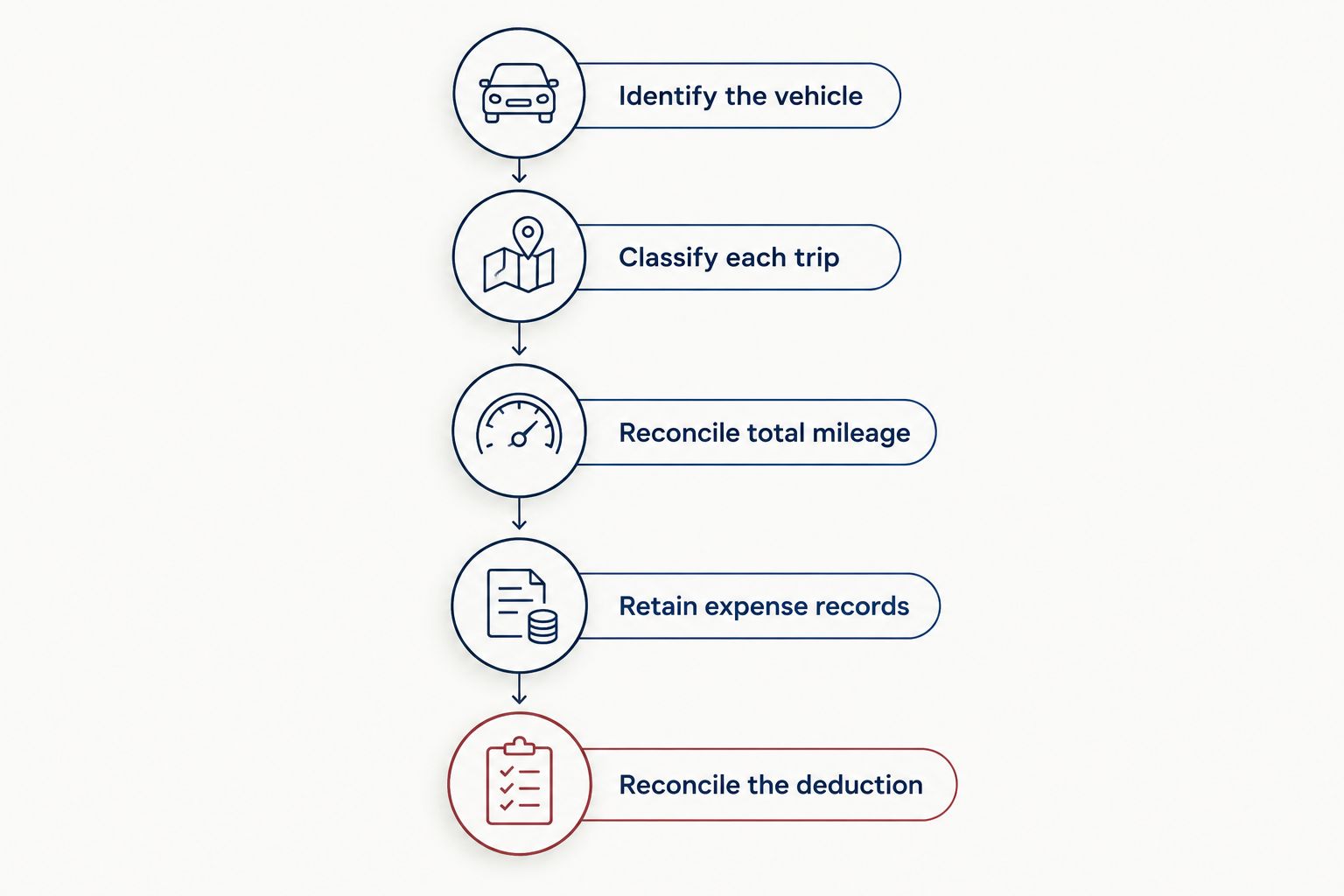
The final deduction must agree with the trip records and the books.
Tracking technology supplies evidence, not tax authority. The same distinction applies when discussing fleet tracking for mileage audits: location records help substantiate travel, but the linked discussion concerns UK HMRC rules, not US deductibility. For a US return, apply IRS requirements and document the business purpose separately.
Review the log while the reason for the trip is still clear. A map shows where you drove; it does not explain why that drive belonged to the business.
Handle S corporation reimbursements without a second deduction
If you personally own a vehicle and drive for your S corporation, distinguish the corporation’s reimbursement from your personal vehicle spending. An accountable plan requires a business connection, adequate substantiation, and the return of excess reimbursements.
A properly substantiated mileage reimbursement does not give the corporation a second deduction for fuel already covered by that reimbursement. Corporate payment of personal vehicle costs also needs correct classification rather than automatic posting to deductible auto expense.
Company-owned vehicles require separate attention to personal use and fringe-benefit reporting. Do not copy a sole proprietor’s Schedule C treatment into corporate books without reviewing ownership and use.
CEOHAVEN tax planning is best for entrepreneurs who need vehicle deductions coordinated with tax preparation and bookkeeping. The firm’s stated services address those areas; the vehicle’s eligibility and supporting records still determine the deduction.
For 2026, bring the mileage log, reimbursement records, expense detail, and prior vehicle depreciation schedule into the same review. You can discuss that coordination with CEOHAVEN.
Separate parking, tolls, interest, and commuting
Business parking and tolls generally remain deductible in addition to standard mileage. Parking at your regular workplace is a commuting expense, not a separate business deduction simply because the charge appears on a receipt.
Self-employed taxpayers can generally deduct the business share of vehicle loan interest separately even when using standard mileage. Certain vehicle personal property taxes also receive separate treatment, subject to the applicable rules; do not assume every registration charge qualifies.
Ordinary travel between home and a regular workplace is personal commuting. A qualifying principal-place-of-business home office can change the treatment of travel to other work locations in the same business, but merely answering email at home does not establish that qualification.
The controlling question is the trip’s purpose and applicable rule—not whether you drove a vehicle with a business name on it.
FAQ
Can I deduct gas if I claim standard mileage?
No. Standard mileage already covers fuel, so you cannot add a separate deduction for gas for the same vehicle and covered business use.
Do I still need a mileage log if I deduct actual expenses?
Yes. Actual expenses still require support for business use, and mileage records establish the business share of a mixed-use vehicle. Receipts alone do not establish that share.
Can I deduct car insurance and mileage together?
No, not for the same vehicle’s covered operating costs. Standard mileage includes insurance; under actual expenses, the deductible business share of insurance enters that calculation instead.
Can I deduct business parking on top of mileage?
Yes. Business parking and tolls are generally deductible in addition to standard mileage. Parking associated with ordinary commuting remains personal.
Can I claim mileage after taking Section 179 on my vehicle?
No. Claiming Section 179 on the vehicle prevents use of standard mileage for that vehicle under the IRS eligibility rules.
Can I use mileage for a leased business vehicle?
Yes, if the vehicle qualifies. Once you choose standard mileage for a leased vehicle, you must continue it throughout the lease period, including renewals.
Does paying for a vehicle from my business account make every mile deductible?
No. Business-account payment does not convert personal driving or ordinary commuting into deductible business travel. Classify trips and reconcile the business-use share separately.
One last thing
The mileage allowance contains depreciation even when your books show no separate depreciation deduction. That component reduces the vehicle’s tax basis and matters when you sell, trade, or otherwise dispose of it.
Keep the vehicle history after the current return is filed. A clean deduction today still needs a clean basis calculation when the vehicle leaves the business.