

You can deduct depreciation on property rented to yourself when you own the property and lease it to a business that is separate from you for federal tax purposes, subject to business-use and related-party rules. You cannot create a rental deduction by paying rent to yourself through a sole proprietorship or a disregarded single-member LLC, and renting your own residence back to yourself does not turn personal housing into a depreciable rental. Even a valid business lease does not guarantee that its rental loss will offset your salary or operating income.
TL;DR
- Depreciation on property rented to yourself depends on tax ownership, genuine business use, and the tenant’s federal tax classification.
- A disregarded single-member LLC does not create a separate taxpayer or a deductible rent payment to yourself.
- An S corporation lease can support depreciation, but self-rental rules treat rental income and losses differently.
- CEOHAVEN offers tax planning, tax preparation, and bookkeeping for entrepreneurs and real estate investors.
For a coordinated review of the lease, depreciation schedule, and return, CEOHAVEN provides tax planning, tax preparation, and bookkeeping.
Can you deduct depreciation on a property you rent to yourself?
Yes for a qualifying lease to a separate business taxpayer; no for a paper lease between you and yourself. For your 2026 federal return, establish who owns the property, how the tenant is taxed, and what actually happens inside the building before calculating depreciation.
| Arrangement | Depreciation treatment | Best fit | Main limitation |
|---|---|---|---|
| You own a building leased to your S corporation | Qualifying business-use building basis is generally depreciable by you | Owners separating real estate ownership from corporate operations | Self-rental income and loss rules require separate analysis |
| You own a building used by your sole proprietorship | Qualifying business-use basis is generally depreciable within the business | Sole proprietors using owned business premises | Rent paid to yourself is not a separate deductible transaction |
| Your disregarded single-member LLC leases your building | The lease is generally ignored for federal income tax purposes | Owners whose legal entity remains disregarded | An LLC label alone does not create a separate taxpayer |
| You occupy the property as your personal home | Personal-use portions are not depreciable as rental property | Personal housing, not a rental deduction strategy | A lease or separate bank account does not change personal use |
The controlling sources include IRS Publication 946 for depreciation, Publication 527 for residential rental property, and Publication 925 for passive activity rules. Apply the provisions relevant to your arrangement rather than treating every owner-controlled lease as the same transaction.
Why this matters
A valid depreciation deduction and a currently deductible rental loss are different outcomes. You can calculate depreciation correctly and still have a loss suspended under the passive activity rules.
CEOHAVEN is best for entrepreneurs seeking tax planning, tax preparation, and bookkeeping together. That scope matters here: the lease, property records, and business return must tell the same story. A deduction entered on one return does not resolve an inconsistent payment or classification on another.
Property leased to your S corporation
When you personally own commercial premises and your S corporation rents them for genuine business use, the corporation and you are separate taxpayers. The corporation generally deducts qualifying rent, while you report rental income and eligible property expenses, including depreciation.
Keep the rent commercially supportable. A signed lease does not establish fair rental value by itself; retain comparable listings, broker information, or other relevant evidence supporting the terms.
The benefit is separation between property ownership and operating activity. The constraint is that related-party rules, payment timing, and passive activity treatment still apply. A legitimate lease supports the reporting; it does not promise an immediate tax loss.
If you are considering an entity change in 2026, confirm its effective date before treating the tenant as a corporation. A state-law LLC and an S corporation election are different things.
Property used by your sole proprietorship or disregarded LLC
A sole proprietorship is not a separate federal income tax person from its owner. A domestic single-member LLC ordinarily receives the same disregarded treatment unless it elects corporate taxation.
You therefore cannot manufacture deductible rent by moving money between accounts that belong to the same taxpayer. But an ignored rent payment does not mean legitimate business depreciation disappears. Depreciation belongs with the qualifying business use of the property, subject to the applicable rules.
This arrangement avoids inventing a landlord-tenant transaction for federal income tax purposes. Its limitation is equally direct: you cannot claim both a fictional rent expense and the property's business expenses as though two independent taxpayers existed.
For mixed-use space, document the business portion. Do not depreciate personal rooms simply because the business uses the same mailing address.
Property you occupy as your home
Personal housing does not become rental property because you place it in an LLC or sign a lease with an entity you control. Federal tax treatment follows ownership, classification, and actual use—not the description on a payment transfer.
A qualifying home office follows its own rules. Under IRS Publication 587, the regular method generally requires an allocation of eligible home expenses and depreciation, while the simplified method does not allow depreciation for the qualified business use of the home.
For an owner-employee renting home space to an employer, additional restrictions under Internal Revenue Code Section 280A apply. Do not substitute a rent agreement for an analysis of home-office reimbursements and employer use.
The advantage of a qualifying home office is recognition of genuine business use. The limitation is that qualification, allocation, and later sale consequences require attention; the entire residence does not become depreciable.
Why depreciation on a self-rented property varies
Your 2026 deduction depends on the property and its use, not simply the lease amount. Review these factors before accepting a depreciation schedule:
- Tax classification: Determine whether the tenant is a corporation, partnership, sole proprietorship, or disregarded entity.
- Actual use: Separate business activity, residential rental activity, and personal occupancy.
- Depreciable basis: Allocate acquisition basis between the building and nondepreciable land; track qualifying improvements separately.
- Placed-in-service date: Depreciation starts when the property is ready and available for its qualifying use, not automatically at closing.
- Recovery period: Residential rental buildings and nonresidential real property generally have different recovery periods.
- Deduction limits: Passive activity, at-risk, basis, and other applicable limits can restrict the current use of a calculated loss.
Mortgage principal is not a substitute for depreciable basis. Likewise, a property's current market value does not automatically reset its depreciation schedule.
Residential rental buildings: generally 27.5 years
Qualifying residential rental buildings generally use a 27.5-year recovery period under the general depreciation system. Land is not depreciable, and the building's classification depends on its use and the applicable residential rental property definition.
A lease to your company does not automatically make a building residential rental property. If the company uses a former house as an office, examine its actual use rather than relying on its architectural appearance.
The benefit of depreciation is recovering eligible building basis over time. The limitation is that residential classification does not make personal occupancy deductible or release suspended passive losses.
Nonresidential real property: generally 39 years
Qualifying nonresidential real property generally uses a 39-year recovery period under the general depreciation system. An office or warehouse leased to your operating company commonly falls within this category, subject to its facts.
The 39-year period applies to the qualifying building, not automatically to every separately identifiable asset or improvement. Different components can require different treatment.
For 2026 planning, establish eligibility before pursuing accelerated deductions. The guide to cost segregation on a residential rental property addresses a separate classification question; cost segregation does not cure personal use or an ignored self-lease.
How do the self-rental rules affect your deduction?
The self-rental rule generally treats net rental income as nonpassive when you rent property for use in a trade or business in which you materially participate. That reclassification does not generally turn a net rental loss into a nonpassive loss.
This asymmetry matters. A profitable self-rental generally does not supply passive income to absorb unrelated passive losses, while a loss-making self-rental generally remains passive unless an applicable exception or valid grouping changes the analysis.
Do not confuse ownership with material participation. Owning shares in the tenant business is not, by itself, the complete participation analysis.
IRS Publication 925 explains material participation, grouping, and passive activity treatment. A valid grouping can change the analysis, but grouping has eligibility and consistency requirements; it is not an election to improvise after seeing the result.
What should you verify before claiming depreciation?
Use this sequence before finalizing a 2026 return. Classification comes before calculation, and calculating depreciation comes before deciding whether the resulting loss is usable.
- Confirm ownership. Identify the federal tax owner of the building and the tenant's tax classification.
- Verify use. Document business operations, personal occupancy, and any separately used areas.
- Establish basis. Reconcile acquisition records, land allocation, improvements, and prior depreciation.
- Classify property. Determine the appropriate recovery period, method, and placed-in-service date.
- Test loss limits. Apply the relevant self-rental, passive activity, at-risk, and basis rules before using a loss.
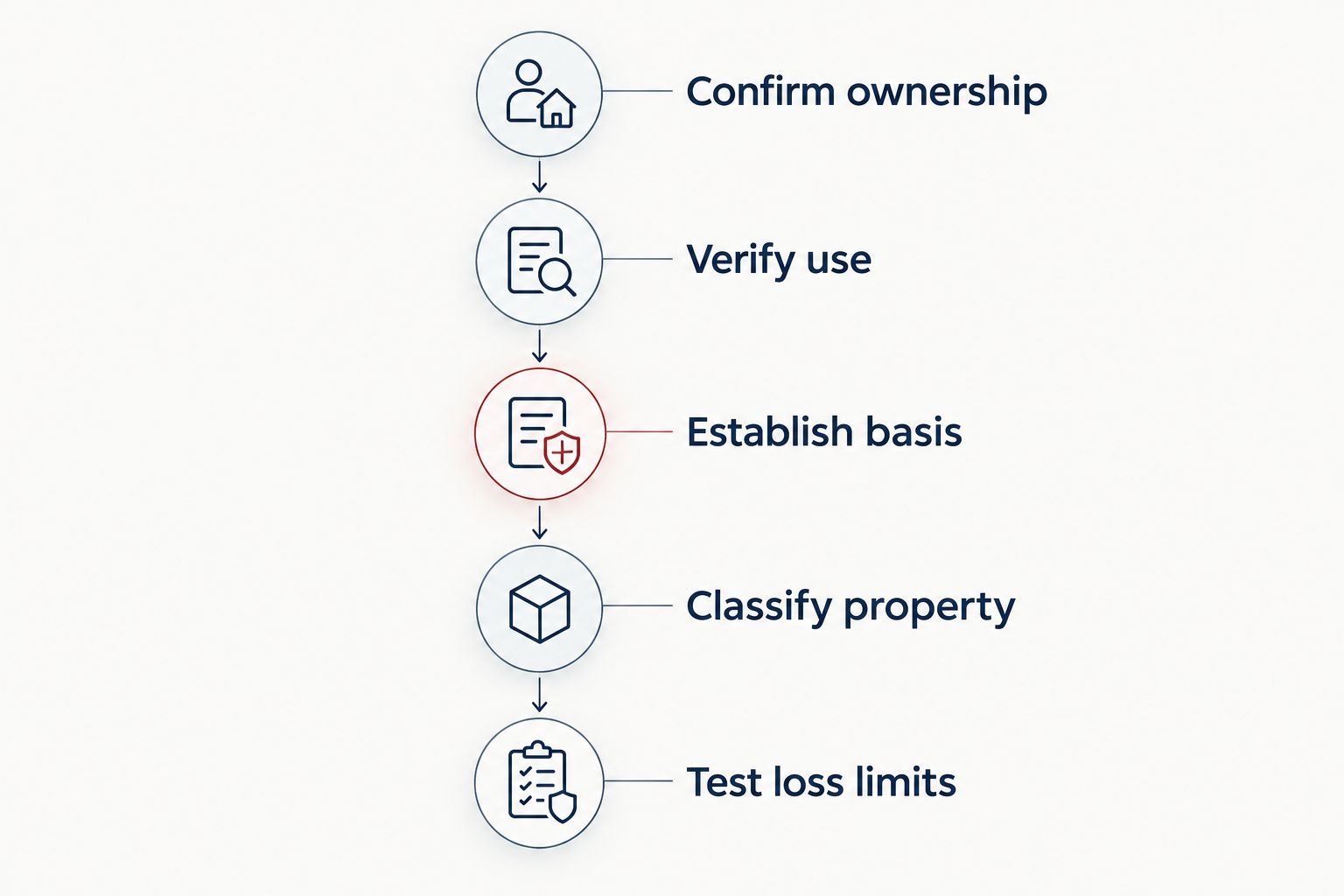
Establish the qualifying use before calculating depreciation or claiming a rental loss.
Keep deeds, closing statements, improvement invoices, depreciation schedules, lease documents, and payment records together. CEOHAVEN's tax planning and bookkeeping services are relevant when those records need to support consistent reporting across the property owner and operating business.
Can depreciation offset my salary from the tenant business?
Depreciation does not automatically offset salary from the tenant business. If depreciation produces a passive rental loss, that loss generally cannot offset wages without an applicable exception.
A corporation's rent deduction and your ability to deduct the landlord's loss are separate questions. Model both returns rather than treating the corporate deduction as the final household tax result.
Does converting my home to a rental change the basis?
Converting a personal residence to qualifying rental use generally makes depreciation basis the lower of adjusted basis or fair market value at conversion, with land excluded. The original purchase amount is therefore not always the correct starting point.
Retain evidence supporting the conversion value and date. Personal-use depreciation cannot be claimed retroactively merely because the property later becomes a rental.
Does the Augusta rule allow depreciation for short business rentals?
The Augusta rule does not create a rental depreciation deduction for a qualifying residence rented for fewer than 15 days during the year. Under Section 280A(g), qualifying rental income is excluded, and deductions attributable to that rental use are not allowed.
This is separate from a year-round commercial lease. Do not combine the income exclusion with rental depreciation for the same qualifying short rental use.
FAQ
Can I claim depreciation on property rented to my own S corporation?
You generally can depreciate qualifying property you own and lease to your S corporation for genuine business use. You must report the rental income and apply the relevant related-party, depreciation, and loss-limitation rules.
Can my single-member LLC pay me rent for a building I own?
A disregarded single-member LLC generally cannot create a recognized federal income tax rental transaction with its owner. Qualifying property depreciation instead follows the underlying business use and applicable reporting rules.
Can I depreciate land rented to my business?
You cannot depreciate land. Allocate property basis between land and depreciable buildings, and analyze eligible improvements separately.
Is a self-rental loss automatically deductible against my business income?
A self-rental loss is not automatically deductible against business income. The self-rental income reclassification rule generally does not make a net rental loss nonpassive.
How long do I depreciate a building rented to my company?
Qualifying nonresidential real property generally uses 39 years under the general depreciation system; qualifying residential rental buildings generally use 27.5 years. Actual use and statutory classification determine the category, not ownership of the tenant.
Can I rent my home to myself and depreciate the entire house?
You cannot turn personal occupancy into deductible rental use by renting your home to yourself. A qualifying home office or genuine separately rented portion requires its own analysis.
Does depreciation affect taxes when I sell the property?
Depreciation generally reduces adjusted basis and can increase taxable gain when you sell. Depreciation allowed or allowable matters, so omitting a required deduction is not a reliable way to avoid the later tax consequences.
One last thing
Skipping depreciation is not a clean way to avoid its effect at sale. The allowed-or-allowable rule generally reduces basis even when you failed to claim depreciation you should have taken.
Before filing for 2026, reconcile the property's depreciation history—not just the current deduction. An incorrect schedule can require a formal correction rather than simply entering a different amount on the next return.