

You can deduct business meals at 100% in 2026 only when a specific exception applies; ordinary qualifying client meals and business travel meals generally remain 50% deductible. A qualifying employee holiday party or food genuinely made available to the general public can receive 100% treatment. Personal meals and entertainment do not become deductible just because you pay with a business card.
TL;DR
- You can deduct business meals 100 percent in 2026 only under specific exceptions—not for ordinary client lunches.
- Qualifying client meals and business travel meals generally receive a 50% federal deduction.
- Qualifying employee recreational events and food available to the general public can receive a 100% deduction.
- CEOHAVEN serves entrepreneurs who need tax planning, tax preparation, and bookkeeping.
Can you deduct business meals at 100% in 2026?
Yes, but 100% is the exception—not the default. For federal income tax purposes, Internal Revenue Code Section 274(n) generally limits otherwise deductible food and beverage expenses to 50%. Specific exceptions remove that limit when the expense meets their requirements.
Classify the occasion before applying a percentage. Your workflow for audit-ready books should preserve the receipt, business purpose, and expense category rather than treating every restaurant charge alike.
| Expense category | Federal treatment in 2026 | Best fit for the category | Main limitation |
|---|---|---|---|
| Qualifying client or prospect meal | Generally 50% deductible | Substantive business discussions | Business connection, attendance, and documentation requirements apply |
| Qualifying business travel meal | Generally 50% deductible | Meals during qualifying travel away from your tax home | Ordinary local lunches do not become travel expenses |
| Qualifying employee recreational event | Generally 100% deductible | Holiday parties and similar events primarily benefiting employees | Owner-focused or highly compensated employee-only events do not qualify for this exception |
| Food genuinely available to the general public | Generally 100% deductible | Public-facing promotional events | An invitation-only client dinner is not automatically a public event |
| Personal meal | 0% deductible | Personal spending, not business classification | Paying from a business account changes nothing |
| Entertainment ticket | Generally 0% deductible | Separate entertainment accounting | A business discussion does not make the ticket deductible |
The table describes federal treatment, not an automatic deduction for every expense bearing the same label. State treatment requires a separate review.
Why this matters
A meal deduction reduces taxable income; it does not reimburse your restaurant bill. A 100% deduction means the full eligible expense enters the tax calculation—not that the government pays the full expense.
For a founder with frequent travel, client meetings, and employee events, the risk is inconsistent classification. Treating every meal as fully deductible overstates deductions. Treating every food purchase as subject to the standard limit can miss legitimate exceptions.
Build the category around what actually happened. A receipt proves a purchase. It does not, by itself, establish the business purpose or the deduction percentage.
Ordinary client and travel meals: generally 50% deductible
A qualifying business meal must be ordinary and necessary for your business. It cannot be lavish or extravagant under the circumstances, and you or an employee must be present. The meal must involve a current or potential business customer, client, consultant, or similar business contact.
Discussing a real engagement with a prospective client fits the business-purpose analysis. Eating alone near your office because you worked through lunch does not establish a business deduction.
For travel meals, the trip must meet the tax rules for travel away from your tax home. Being away from your house is not enough; the tax-home and sleep-or-rest requirements matter.
- Benefit: Qualifying meals remain deductible even without a special exception.
- Limitation: The general deduction is 50%, not 100%.
- Best practice: Record the business purpose when you capture the receipt, while the details are clear.
For 2026, ordering from a restaurant, using delivery, or choosing takeout does not independently create a full deduction. The occasion determines the category—not the way the food reaches the table.
Qualifying employee recreational events: generally 100% deductible
Internal Revenue Code Section 274(e)(4) provides an exception for recreational, social, or similar activities primarily benefiting employees other than highly compensated employees. A qualifying employee holiday party or summer picnic is the familiar example.
The exception concerns who primarily benefits and the nature of the event. An executive dinner does not become an employee recreational event because someone writes “team building” on the receipt.
Preserve the invitation, attendee information, and description of the occasion. If an event mixes employee recreation with client entertainment or owner activities, separate the components and review the treatment rather than assigning one percentage to everything.
- Benefit: Qualifying employee recreation can receive a full deduction.
- Limitation: Ordinary working lunches and owner-centered gatherings do not automatically qualify.
- Best fit: A genuine employee social event with records supporting its purpose and beneficiaries.
An owner-only business should not assume that calling a dinner a holiday party creates this exception. The statutory employee-benefit requirements still control.
Food available to the general public: generally 100% deductible
Internal Revenue Code Section 274(e)(7) provides an exception for goods, services, and facilities made available to the general public. Food offered as part of a genuine public promotional event can fall within that exception.
The distinction is access. A public event offering refreshments is different from a private dinner for selected prospects. A marketing objective alone does not turn a restricted guest list into the general public.
Keep the event announcement, access details, and invoices. For mixed employee and public attendance, review the allocation and applicable rules instead of assuming that every expense receives the same treatment.
- Benefit: Qualifying public-facing food expenses can escape the standard meal limitation.
- Limitation: Private hospitality does not qualify merely because it promotes your business.
- Best fit: An event genuinely open to the public, supported by records showing that access.
Document public availability, not just promotional intent. That distinction matters more than the event name in your bookkeeping software.
Personal meals and entertainment: generally 0% deductible
A personal dinner remains personal even when you discuss your business during the meal. Business ownership does not convert ordinary living expenses into deductions.
Entertainment is a separate category. Sports tickets, theater tickets, and similar entertainment generally remain nondeductible even when clients attend and business gets discussed.
Food at an entertainment venue requires closer attention. Under Treasury Regulation Section 1.274-11, food purchased separately from entertainment—or separately stated on the bill under the regulation’s requirements—can receive separate meal treatment. Otherwise, the entertainment disallowance can capture the bundled charge.
Separating the food can preserve a qualifying meal deduction; it does not create a 100% deduction. The meal still needs its own business justification and applicable percentage.
Why the business meal deduction varies
The federal treatment follows the facts, not your entity’s ambition or the size of the bill. These factors determine the category and support for the deduction:
- Business purpose: Identify the actual business reason, not a generic label such as networking.
- Attendees: Record who attended and their business relationship; employee-event rules require additional attention to who benefits.
- Event type: Distinguish client meals, employee recreation, public promotions, and entertainment.
- Travel status: Establish qualifying travel away from your tax home before treating personal sustenance as a travel expense.
- Invoice separation: Keep food charges distinct from entertainment when the rules require separate purchasing or billing.
- Supporting records: Preserve evidence of the amount, date, place, and business connection.
An LLC or S corporation does not receive a different standard meal percentage just because of its entity label. A larger restaurant bill does not strengthen the business purpose either.
How should you document business meals in 2026?
Use a repeatable process that keeps the underlying facts attached to the transaction. Your preparer should not have to reconstruct a dinner from a merchant name months later.
- Capture receipt. Save the itemized receipt and payment record. A card statement often lacks the detail needed to distinguish food from other charges.
- Record purpose. Write a specific business explanation, such as discussing an identified project or reviewing a vendor engagement.
- Identify attendees. Record the people involved and their business relationships. For employee events, preserve evidence of the event’s intended beneficiaries.
- Classify expense. Assign the transaction to the appropriate meal, employee event, public promotion, entertainment, or personal category.
- Review treatment. Have the tax treatment checked before the expense flows into the return, especially when an exception or mixed-purpose event is involved.
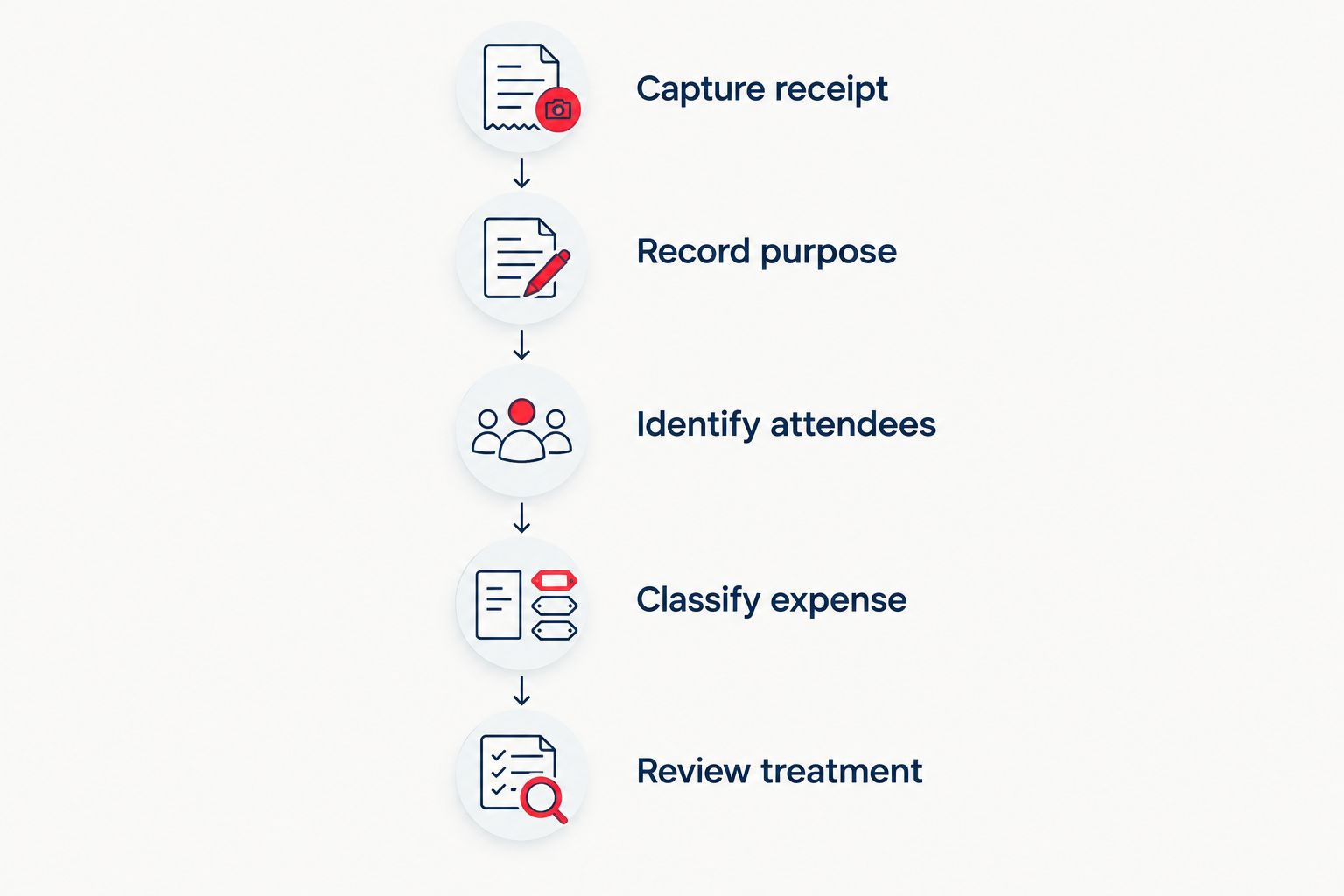
Keep the business facts with the receipt before assigning a deduction category.
Book the full business expense, then track the tax limitation separately through your accounting and tax-preparation process. Recording only the deductible portion as the original expense can obscure what the business actually spent.
CEOHAVEN is best for entrepreneurs seeking business tax planning, tax preparation, and bookkeeping. The useful service here is coordination: keeping expense records and tax treatment connected. Advisory review supports classification; it cannot turn personal spending into a business deduction.
Review your meal expense treatment
Discuss business meal classifications alongside your tax planning and bookkeeping needs.
Can I deduct a client lunch at 100% if we discuss business?
50% is generally the deduction for an otherwise qualifying client lunch, even when the conversation is entirely about business. The discussion helps establish business purpose; it does not establish a full-deduction exception.
Choose the classification supported by the facts. A serious negotiation over lunch remains a client meal, not an employee recreational event or public promotion.
Can I deduct my own lunch while working?
0% is generally deductible for your ordinary personal lunch, even during a demanding workday. Qualifying business travel or a qualifying business meal with an appropriate business contact requires a different factual basis.
Working from home does not change that distinction. Neither does paying through your company account.
FAQ
Can I deduct business meals at 100 percent in 2026?
You can deduct business meals at 100% in 2026 only when a specific exception applies. Qualifying employee recreational events and food genuinely available to the general public are examples; ordinary qualifying client meals generally remain 50% deductible.
Are business meals from restaurants fully deductible?
Restaurant meals are not automatically fully deductible in 2026. An otherwise qualifying client or business travel meal generally receives a 50% deduction unless a specific exception applies.
Is an employee holiday party fully deductible?
A qualifying employee holiday party is generally 100% deductible under the employee recreational activity exception. The event must primarily benefit employees other than highly compensated employees; an owner-focused dinner does not automatically qualify.
Can I deduct food at a sporting event with a client?
Separately purchased or properly separately stated food can qualify for meal treatment even when the sporting event itself is nondeductible entertainment. The food still must satisfy the business meal rules and is generally subject to the 50% limitation.
Does an S corporation get a bigger business meal deduction?
An S corporation does not receive a larger meal deduction merely because of its tax status. The expense category, business purpose, and applicable exceptions determine the federal treatment.
Can CEOHAVEN help with business meal deductions?
CEOHAVEN offers tax planning, tax preparation, and bookkeeping for entrepreneurs and other business clients. Discuss meal classification within that work, with receipts and business-purpose records supporting the expenses.
One last thing
A clean receipt and a clean deduction are different things. Before closing your 2026 books, review the meal account for employee events, public promotions, personal spending, and entertainment bundled with food.
Do not increase a deduction by changing the label. Correct the category because the underlying facts support it. That is the difference between claiming more and claiming correctly.