

Yes, you can change your S corp salary in the middle of 2026, provided your total compensation remains reasonable for the work you perform and you process the change correctly through payroll. A salary reduction does not erase wages already paid, and replacing pay with shareholder distributions does not remove the reasonable-compensation requirement.
TL;DR
- Can you change S corp salary mid year? Yes, with support for reasonable compensation and correct payroll processing.
- CEOHAVEN provides tax planning and bookkeeping for entrepreneurs who need salary decisions connected to business finances.
- Change future payroll prospectively; correct past payroll errors through the appropriate reporting process.
- Review shareholder distributions, retirement contributions, and withholding before approving a salary adjustment.
Why this matters
Your salary is not just a transfer from the business account. It affects employment taxes, retirement-plan calculations, personal withholding, and the distinction between wages and shareholder distributions.
The right salary is supported by your services, not selected solely to minimize payroll taxes. Before changing it, connect the decision to your books and your annual tax projection. The S corp salary compliance workflow explains how payroll fits into that process.
A midyear adjustment can be appropriate when your responsibilities or working hours change. It becomes harder to defend when the business keeps paying you distributions while your compensation no longer reflects the services you provide.
Can you change your S corp salary in the middle of the year?
Yes. Federal S corporation tax rules do not require a shareholder-employee to keep an unchanged salary throughout the calendar year. The central issue is reasonable compensation for services, together with accurate employment-tax reporting.
The IRS guidance titled S Corporation Compensation and Medical Insurance Issues describes the federal reasonable-compensation requirement. For a 2026 review, apply that framework to your actual duties, time, experience, and compensation evidence; there is no universal salary-to-distribution percentage that establishes compliance.
Use this sequence before the next affected payroll:
- Review your work. Document your responsibilities, hours, experience, and any change in your role.
- Support compensation. Compare the work with relevant compensation evidence, accounting for location and business circumstances.
- Project annual wages. Combine wages already paid with the proposed remaining payroll and any planned bonus.
- Review tax effects. Recalculate withholding, employer payroll obligations, and retirement-plan contributions.
- Approve the change. Record the business reason, effective date, and authorization required by your governing documents.
- Update payroll. Enter the new rate, verify the first affected payroll, and retain the supporting records.
The order matters. Set a defensible compensation decision first; enter the payroll change second. A payroll system can calculate withholding without deciding whether your salary is reasonable.
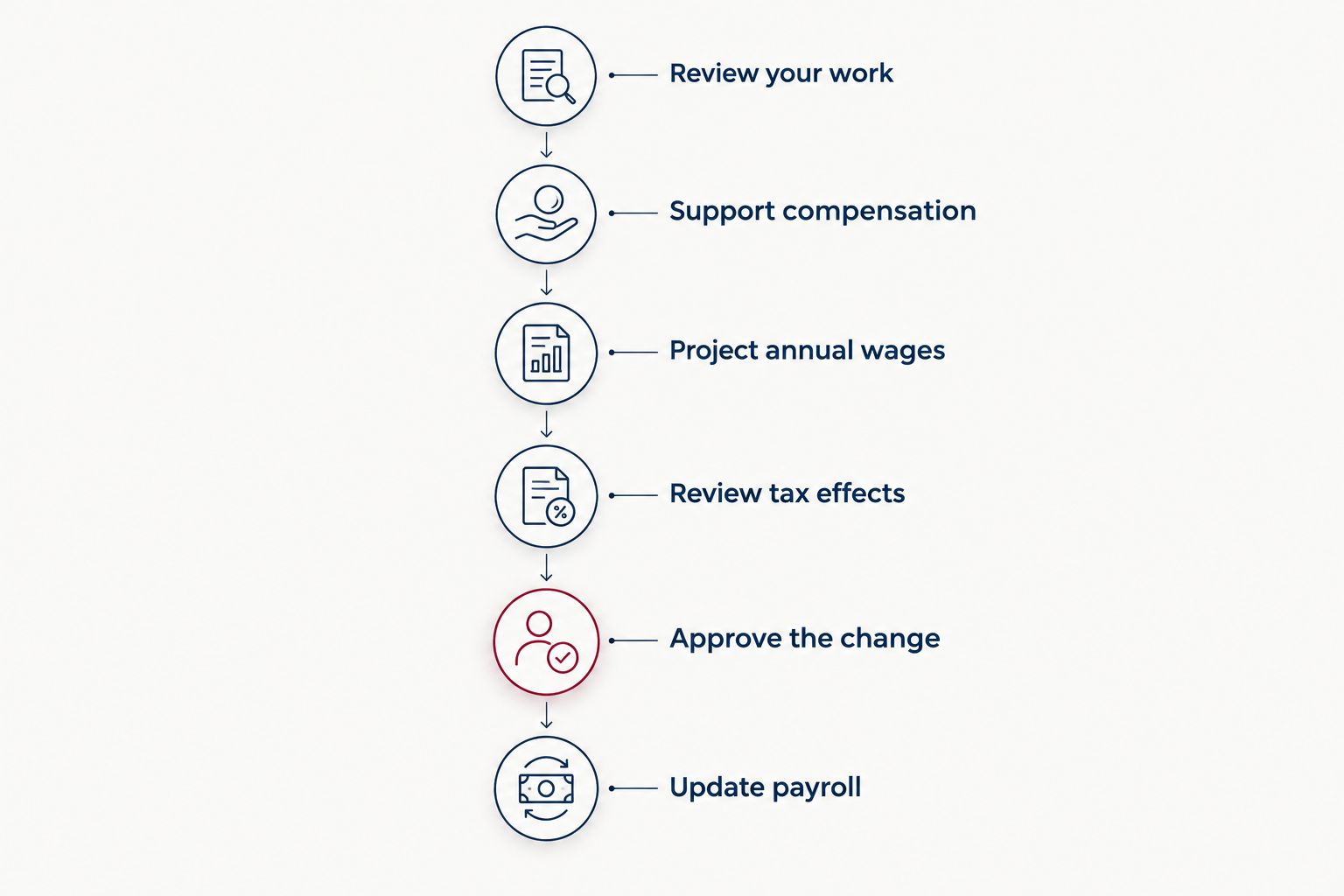
Document the compensation decision before changing the payroll rate.
Which type of salary adjustment fits your situation?
A prospective change and a correction serve different purposes. Choose the approach that matches the facts rather than using whichever payroll entry looks easiest.
| Approach | Best for | Advantage | Limitation |
|---|---|---|---|
| Salary increase | Expanded responsibilities or compensation that needs adjustment | Raises compensation through regular payroll | Increases payroll cash requirements and employment-tax obligations |
| Salary reduction | A documented reduction in services or a supported compensation reassessment | Changes future payroll commitments | Does not excuse unreasonable compensation or reverse prior wages |
| Payroll bonus | Additional compensation supported by the annual review | Adds wages without permanently changing the recurring rate | Requires payroll processing and does not automatically resolve earlier compliance issues |
| Payroll correction | An actual error in previously processed wages or taxes | Addresses inaccurate records | Can require amended returns and corrected wage statements |
These are administrative choices, not separate tax elections. Each needs a business explanation and reporting that matches what actually happened.
Increasing your S corp salary during the year
An increase fits when you take on more operating responsibility, work more hours, or determine that your existing compensation is inadequate. Business growth belongs in the review, but revenue alone does not establish the correct wage.
Distinguish revenue generated by your personal services from revenue attributable to employees, equipment, or capital. A founder doing nearly all client delivery presents a different compensation question from an owner whose business operates through a staffed team.
For a 2026 increase, record the effective date and update future payroll. Then revisit your annual withholding projection: increasing gross pay also changes the tax amounts moving through payroll.
The advantage is straightforward: regular wages can better reflect your current role. The trade-off is cash demand, including employer payroll taxes. Do not approve a gross salary increase without checking the full payroll funding requirement.
Reducing your S corp salary during the year
A reduction needs more than a preference for larger distributions. Document what changed: fewer working hours, narrower duties, a period away from the business, or compensation evidence supporting a different rate.
A decline in revenue is relevant context, not an automatic permission slip. If you continue performing substantially the same services and receiving distributions, reducing wages requires particular care.
Separate a cash-flow problem from a compensation decision. Your business might lack cash for a planned payment, but that does not establish that the value of your work fell by the same amount.
The benefit of a supported reduction is a lower recurring payroll commitment. The limitation is that it cannot retroactively turn wages already paid into distributions or justify avoiding compensation for ongoing services.
If your only explanation is “I want less payroll tax,” stop before changing the rate. Revisit the compensation analysis and distribution plan together.
Using a bonus instead of changing recurring salary
A payroll bonus can add compensation when an annual review identifies a shortfall. It is particularly relevant when your recurring salary remains appropriate but additional wages are supported by the year's work.
A bonus is still wages. Process it through payroll, apply the appropriate withholding method, and account for employment taxes rather than sending an owner transfer and labeling it later.
The advantage is flexibility without permanently increasing the recurring salary. The limitation is timing: a late bonus does not automatically fix inaccurate earlier reporting, missed deposits, or an unsupported compensation history.
Before a 2026 bonus, confirm that the corporation can fund both the payment and associated payroll obligations. Also check how the additional compensation affects retirement contributions under the plan's terms.
Why an S corp salary change varies by owner
The same payroll adjustment can be defensible for one founder and unsupported for another. These factors determine the analysis:
- Services performed: Sales, client delivery, operations, management, and administrative responsibilities all belong in the compensation review.
- Time devoted: A documented reduction in working hours is different from unchanged work at a lower wage.
- Relevant compensation evidence: Compare genuinely similar responsibilities, experience, locations, and business circumstances.
- Revenue sources: Distinguish income attributable to your services from income generated by other workers or capital.
- Financial condition: Review profitability and available cash without treating either as a substitute for reasonable compensation.
- Total remuneration: Consider wages, bonuses, and shareholder payments together rather than evaluating the recurring payroll rate alone.
Keep the explanation specific. “Compensation reviewed” says little; a record identifying changed responsibilities and the evidence considered explains the decision.
What should you check before the next payroll?
Wages already paid
Start with the payroll register, not a bank-account estimate. Confirm gross wages, withholding, employer taxes, and payments already classified as distributions.
Your annual projection must include wages already paid. A new recurring rate does not become your full-year wage simply because you change an annual-salary field in payroll software.
Payroll reporting
For employers filing Form 941, each quarterly return generally covers 3 months. A corporation filing quarterly has 4 reporting quarters in a calendar year; that does not mean its tax deposits are due only quarterly.
IRS Publication 15 explains federal employment-tax reporting and deposit rules. Check the rules applicable to your 2026 payroll, including your assigned deposit schedule, before processing an additional payment.
A future salary change alone generally does not require amending an accurate earlier return. An actual prior-period error requires a separate correction analysis.
Retirement contributions
For an S corporation shareholder-employee, retirement-plan contributions depend on eligible compensation under the plan, not shareholder distributions. Lower wages can reduce the compensation available for contribution calculations.
Review employee deferrals and employer contributions separately. The payroll-to-solo-401(k) workflow covers that connection without treating owner draws as retirement-plan wages.
Personal withholding and records
Recalculate your household tax projection after a material salary change. Your business profit, other income, and estimated payments still matter even when payroll withholding changes.
IRS employment-tax recordkeeping guidance generally calls for retaining employment-tax records for at least 4 years after the tax becomes due or is paid, whichever is later. Keep the compensation analysis with the related payroll records, subject to any longer applicable retention requirement.
Do you need IRS permission to change your S corp salary?
No separate IRS approval is generally required for a routine prospective salary change. You still need proper corporate authorization, payroll processing, and compliance with applicable employment and state wage-payment rules.
The absence of an approval form does not make every amount acceptable. The compensation must remain supportable, and the reporting must reflect the payments actually made.
Changing your salary also does not require changing your S corporation election. Those are different decisions with different requirements.
Can you replace your S corp salary with distributions?
No, shareholder distributions are not a substitute for reasonable compensation for services. The IRS can reclassify distributions as wages when an S corporation fails to pay reasonable compensation to a shareholder-employee.
Distributions also raise separate basis and tax questions. Calling a payment a distribution does not establish that it is tax-free or that the corporation has met its employment-tax obligations.
Review the entire payment pattern. A lower salary paired with larger distributions deserves more scrutiny, not less.
When professional review earns its place
CEOHAVEN's tax planning and bookkeeping services are best for entrepreneurs who want compensation decisions connected to their business finances. The relevant question is not simply which number to enter in payroll; it is whether that number fits your work, books, distributions, and tax plan.
The benefit of coordinated review is a decision informed by more than a payroll setting. The limitation is that advice cannot replace accurate records or make unsupported compensation defensible.
Bring your year-to-date payroll register, current financial statements, shareholder-payment history, and a description of your duties. That gives the discussion a factual starting point.
Review your compensation plan
Connect your salary decision with tax planning, tax preparation, and bookkeeping.
FAQ
Can I change my S corp salary more than once during the year?
Yes, federal S corporation tax rules do not impose a once-a-year limit on salary changes. Each adjustment still needs support, appropriate authorization, and accurate payroll processing.
Can I lower my S corp salary if business revenue drops?
Yes, a reduction can be appropriate, but lower revenue alone does not establish reasonable compensation. Review your services, working hours, financial condition, and shareholder distributions together.
Do I need to amend Form 941 after changing my salary?
A prospective salary change alone generally does not require amending an accurate Form 941. A prior payroll error is different and can require Form 941-X or other corrections.
Can I pay myself a year-end bonus to increase my S corp wages?
Yes, a payroll bonus can increase shareholder-employee compensation. Process it as wages and review withholding, employment taxes, deposit timing, and whether the resulting compensation is reasonable.
Will reducing my S corp salary affect my solo 401(k)?
Reducing S corporation wages can reduce the eligible compensation used to calculate retirement-plan contributions. Shareholder distributions do not replace wages for that calculation; review the plan's terms before changing payroll.
Does CEOHAVEN help with S corp salary planning?
CEOHAVEN offers tax planning, tax preparation, and bookkeeping for entrepreneurs and other high-income clients. Discuss your compensation question within that service scope, including the records needed for a salary review.
One last thing
An annual-salary field is not your annual wage record. Changing that field halfway through 2026 changes the payroll calculation prospectively; it does not rewrite the compensation already paid.
Before approving the adjustment, put wages already paid and projected remaining wages on the same schedule. Review the full-year result, not just the next paycheck.