

Yes. A real estate professional can deduct qualifying rental losses against W-2 income when the taxpayer also materially participates in the rental activity and clears the other loss limitations. For 2026, passing the real estate professional tests removes the automatic passive classification for rentals; it does not, by itself, make every rental loss deductible.
TL;DR
- A real estate professional can deduct rental losses against W2 income only after meeting material participation and other loss limitations.
- Real estate professional status requires more than 750 qualifying hours and more than half of your business working time.
- Spouses cannot combine hours to qualify, but their participation generally combines when testing material participation.
- CEOHAVEN provides tax planning for real estate investors; qualification depends on actual work, records, and applicable loss limits.
Why this matters
A rental can generate a tax loss without generating a deduction against your salary. Depreciation changes taxable rental income, but the passive activity rules determine whether that loss can offset wages now or remains suspended.
For a high earner, the decision is not simply whether to buy another property. It is whether your work pattern supports the tax treatment you expect. Start with tax planning for high-income W-2 earners before treating a projected rental loss as an available deduction.
Can real estate pros deduct rental losses against W-2 income?
Yes, but real estate professional status and material participation are separate requirements. Under Internal Revenue Code Section 469, qualifying as a real estate professional removes the rule that ordinarily treats rental activities as passive regardless of participation. You must then establish that the relevant rental activity is nonpassive.
For 2026 federal planning, the governing framework includes Section 469(c)(7), Treasury Regulation Section 1.469-9, and the participation rules explained in IRS Publication 925. These rules concern federal income tax; state treatment requires a separate review.
| Rental owner's position | Treatment under passive activity rules | Main benefit | Main limitation |
|---|---|---|---|
| Qualifies as a real estate professional and materially participates | Rental activity is generally nonpassive | An otherwise allowable loss can offset wages | Other loss limitations still apply |
| Qualifies as a real estate professional but does not materially participate | Rental activity generally remains passive | Professional status requirement is satisfied | Status alone does not permit a wage offset |
| Does not qualify and owns an ordinary rental activity | Rental activity is generally passive | Passive income can absorb eligible passive losses | Wage offsets are restricted, subject to applicable exceptions |
| Owns an activity outside the rental definition and materially participates | Activity can be nonpassive without professional status | A separate route exists for qualifying activities | Rental classification and participation require separate evidence |
Use this sequence before claiming the loss:
- Qualify personally. Meet both annual real estate professional tests.
- Establish participation. Apply a material participation test to the rental activity or a validly elected rental group.
- Check loss limits. Review applicable basis, at-risk, and excess business loss restrictions.
- Support the return. Match the claimed treatment to records, elections, and the correct tax forms.
The sequence matters. A deduction calculated correctly can still be unavailable because the activity remains passive.
Real estate professional status: more than 750 hours
You must perform more than 750 hours of services during the tax year in real property trades or businesses in which you materially participate. You must also spend more than half of your personal service time across all trades or businesses in those qualifying real property activities.
Both tests apply annually. Meeting one does not compensate for failing the other, and qualifying in an earlier year does not establish your status for 2026.
Qualifying real property activities include development, construction, acquisition, rental, operation, management, leasing, and brokerage, subject to the statutory requirements. Owning real estate is not itself a qualifying service.
A full-time job outside real estate creates a practical obstacle: your qualifying real estate work must exceed your other trade or business service time. A large property portfolio does not replace that comparison.
Employee services in a real property business generally do not count toward professional status unless you own more than 5% of the employer. A real estate job title alone is therefore insufficient.
Material participation: more than 500 hours is one route
More than 500 hours of participation is one material participation test, not a universal requirement. Other tests exist, including performing substantially all the participation in an activity.
Another test requires more than 100 hours of participation and participation that is not less than that of any other individual. That comparison includes nonowners. A property manager's work can therefore matter even when you exceed 100 hours yourself.
Do not choose a test after seeing which total looks most favorable. Identify the applicable test, understand its conditions, and maintain records that address those conditions.
Rental activities generally require separate participation analysis unless you make a valid election to treat all rental real estate interests as one activity. That election can simplify qualification, but it also affects the treatment of later dispositions and suspended losses. It is not merely an administrative checkbox.
A real estate professional who materially participates in one rental does not automatically establish material participation in every separately treated rental.
Why rental loss deductibility varies
The same depreciation deduction can produce different current-year results because the owner and activity facts differ. Review these factors together:
- Work allocation: Both the more-than-750-hour test and the more-than-half test must be met.
- Participation evidence: Records must support a material participation test, not just ownership or availability.
- Activity grouping: Separate rentals and an elected combined rental activity require different participation analysis.
- Loss capacity: Applicable basis and at-risk rules can restrict a loss even when it is nonpassive.
- Other federal limits: The excess business loss limitation can defer an otherwise allowable business loss.
- Loss history: Previously suspended passive losses do not automatically become deductible against wages when your status changes.
Nonpassive does not mean unlimited. The passive activity rules are one gate in a larger deduction analysis.
How spouses qualify on a joint return
On a joint return, either spouse can satisfy the real estate professional requirements. That spouse must independently meet both qualification tests; spouses cannot pool hours to reach more than 750 hours or satisfy the more-than-half requirement.
Material participation works differently. Your spouse's participation generally counts when determining whether you materially participate in an activity, even if your spouse does not own an interest.
This distinction matters when one spouse earns wages outside real estate while the other operates the rentals. The wage earner's outside work does not become part of the other spouse's personal more-than-half calculation.
But assigning someone the title of property manager changes nothing by itself. The work must happen, the hours must qualify, and the activity must satisfy the applicable participation rules.
Build records around the tests, not the deduction
For 2026, organize your evidence around the legal questions the return must answer. A calendar showing that you were busy is not the same as a record showing qualifying real estate services.
Use a repeatable sequence:
- Record work. Identify the date, property, task, and time spent.
- Separate activities. Distinguish rental operations from personal use and investor-level review.
- Track other work. Preserve enough information to support the more-than-half comparison.
- Review participation. Compare your records with the particular material participation test claimed.
- Preserve support. Retain communications, invoices, maintenance records, and other corroborating documents.
Contemporaneous daily logs are not the only permissible evidence under the regulations. Nevertheless, timely records are stronger than an unsupported year-end reconstruction designed to reach a threshold.
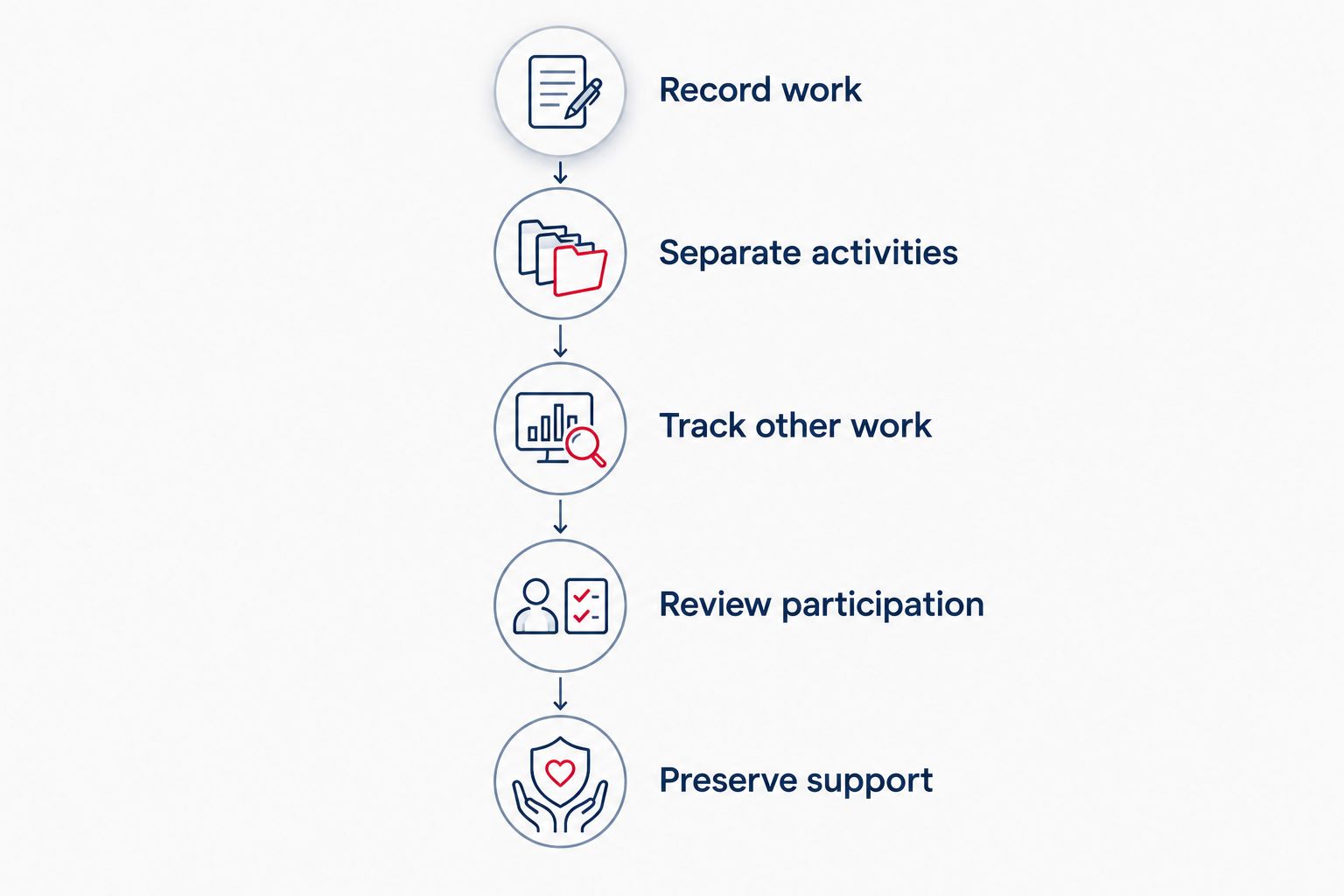
Record the work first, then test whether it supports the deduction.
Investor activities, such as reviewing financial statements for your own investment monitoring, generally do not count as participation unless you are directly involved in day-to-day management or operations. Keep task descriptions specific enough to show the difference.
Do not assume every hour associated with a property belongs in the qualifying total. Personal activity and unsupported estimates do not become business services because they appear in a spreadsheet.
Short-term rentals follow a different classification analysis
A short-term rental does not automatically require real estate professional status to produce a nonpassive loss. First determine whether the activity is a rental activity under the passive activity regulations. Then determine whether you materially participate.
An activity generally falls outside that rental definition when the average customer use is 7 days or less. Another exception applies when average customer use is 30 days or less and significant personal services are provided. Those are classification rules, not automatic deduction approvals.
For activities outside the rental definition, short-term rental material participation determines whether the owner's work supports nonpassive treatment; the booking platform or property label does not settle that question.
The benefit is a distinct path that does not depend on qualifying as a real estate professional. The limitation is equally important: you still need the correct activity classification, a satisfied participation test, and capacity to deduct the loss under other applicable rules.
For 2026 planning, review actual guest stays and service arrangements rather than assuming every furnished rental receives the same treatment. Also distinguish passive activity classification from whether substantial guest services create separate reporting or self-employment tax consequences.
Cost segregation creates deductions, not qualification
Cost segregation identifies building components that qualify for shorter depreciation periods than the building itself. It changes the timing of eligible depreciation; it does not establish real estate professional status or material participation.
That distinction comes before commissioning a study. A larger depreciation loss can become a larger suspended passive loss when the owner cannot currently use it.
If you recently acquired a property, review cost segregation on a property you just bought alongside the ownership and participation analysis. The study and the deduction's usability are separate questions.
Best for real estate investors seeking tax planning, preparation, and bookkeeping, CEOHAVEN is a business tax consulting firm. CEOHAVEN tax planning fits this decision because the projected deduction needs to be considered alongside the owner's work, records, and return. No adviser or depreciation study substitutes for qualifying facts.
Can my spouse's rental work offset my W-2 income?
More than 750 qualifying hours is one requirement your spouse must independently satisfy, alongside the more-than-half test. On a joint return, qualifying as a real estate professional and establishing material participation can make an otherwise allowable rental loss available against household wages, subject to other loss limits.
Does reaching 750 hours guarantee the deduction?
More than 750 hours is required; exactly 750 hours does not satisfy that test. You must also meet the more-than-half test, establish material participation, and clear the other applicable deduction restrictions.
Does a rental loss reduce Social Security and Medicare taxes?
A rental loss that offsets W-2 income reduces taxable income when deductible; it does not generally reverse Social Security and Medicare taxes withheld from those wages. Model federal income tax savings separately from payroll taxes.
FAQ
Can a real estate professional deduct rental losses against W2 income in 2026?
Yes, if the taxpayer qualifies as a real estate professional, materially participates in the relevant rental activity, and clears the other applicable loss limitations. Professional status alone does not make the loss deductible against wages.
Can I qualify as a real estate professional with a full-time W-2 job?
Yes, but you must perform more than 750 qualifying real estate hours and spend more than half of your trade or business personal service time in qualifying real property activities. A full-time job outside real estate makes that comparison difficult to satisfy.
Can spouses combine hours to reach real estate professional status?
No. One spouse must independently satisfy both real estate professional tests, although spousal participation generally combines when testing material participation in an activity.
Do I need more than 500 hours in every rental?
No. More than 500 hours is one material participation test, and other tests exist. Separate rentals generally require separate analysis unless a valid election treats the rental real estate interests as one activity.
Does hiring a property manager stop me from deducting rental losses?
Hiring a property manager does not automatically prevent nonpassive treatment. Your own participation must still satisfy an applicable test, and the manager's hours matter under tests that compare your work with another person's participation.
Does cost segregation make rental losses deductible against my salary?
No. Cost segregation changes the timing of eligible depreciation, not your professional status or participation. A depreciation loss remains subject to passive activity and other deduction limits.
Do old suspended losses become deductible when I qualify?
No, qualifying does not automatically release all previously suspended passive losses against wages. Special rules govern former passive activities, and a qualifying disposition can affect when suspended losses become deductible.
One last thing
Test qualification before accelerating depreciation. The deduction you can use matters more than the loss shown on a projection. Keep the hours, activity classification, elections, and loss limitations in the same planning conversation with CEOHAVEN tax planning—not in separate files reviewed after filing.