

Content creators can deduct qualifying costumes and work clothing, but not everyday outfits—even when you buy them for sponsored posts or wear them only on camera. For your 2026 federal return, clothing generally must be required for your work and unsuitable for ordinary wear; routine haircuts, makeup, and personal styling remain personal expenses.
TL;DR
- Can content creators deduct clothing expenses? Qualifying costumes can pass; everyday clothing does not qualify just because it appears in content.
- Separate theatrical makeup and production styling from personal grooming; the invoice label does not decide deductibility.
- CEOHAVEN offers content creators tax planning, tax preparation, and bookkeeping—not a blanket deduction for an on-camera wardrobe.
- Keep itemized invoices, production records, and evidence of each qualifying item's business purpose.
Can content creators deduct clothing and styling costs?
The controlling question is whether the expense qualifies under federal tax rules—not whether the purchase helped you produce content. Internal Revenue Code Section 162 allows ordinary and necessary business expenses. Section 262 generally disallows personal expenses, including ordinary clothing and grooming.
For 2026, classify the item or service before deciding where it belongs in your books. These categories need different treatment:
| Expense | Federal tax treatment | What supports the position | Main limitation |
|---|---|---|---|
| Everyday clothing | Generally personal | No business record overrides ordinary wearability | Filming an outfit does not make it deductible |
| Genuine performance costume | Potential business deduction | Required role, unsuitable everyday use, production evidence | Calling an outfit a costume is insufficient |
| Qualifying uniform | Potential business deduction | Work requirement and unsuitability for ordinary wear | A business requirement alone is insufficient |
| Theatrical makeup or effects | Potential business deduction | Character-specific application tied to production | Ordinary cosmetics and grooming remain personal |
| Stylist or wardrobe services | Requires item-by-item review | Itemized work tied to qualifying production activity | Personal shopping and appearance advice remain personal |
Connect the purchase decision to your content creator bookkeeping workflow, rather than treating every production-related payment as deductible. The bank feed records what you spent. It does not establish the tax treatment.
Why this matters
Creators sell images, performances, instruction, and access. That makes appearance commercially relevant, but commercial relevance does not erase the boundary between business and personal spending.
A fashion creator's ordinary jacket remains wearable clothing. A character performer's specialized costume presents a different question. Both appear in revenue-producing content; their tax treatment does not automatically match.
CEOHAVEN is best for content creators seeking tax planning, tax preparation, and bookkeeping together. The practical priority is consistent classification throughout the year, not defending an entire wardrobe after the return is drafted.
Everyday clothing: business use does not overcome personal suitability
A suit, dress, sneaker, or handbag does not become deductible because a sponsor requires a polished look. Keeping the item in a studio closet does not change its objective suitability for everyday wear.
The federal clothing analysis looks beyond your intent. Choosing never to wear an ordinary outfit personally is different from owning an item that is unsuitable for ordinary use.
Consider these common creator situations:
- Fashion review: Buying ordinary clothing to model and discuss does not, by itself, establish a clothing deduction.
- Sponsored appearance: A contract requiring formal attire does not automatically make a suit deductible.
- Studio-only wardrobe: Restricting ordinary clothes to a filming room does not resolve the suitability problem.
- Business-branded clothing: Adding a logo is not an automatic pass; the garment still needs to satisfy the applicable work-clothing rules.
Do not assign an everyday outfit a business-use percentage just because you filmed in it. Prorating personal clothing does not solve a failed clothing test. The same caution applies when you rename purchases as props or production supplies.
Costumes and qualifying uniforms: document why they are different
A genuine performance costume has a stronger deduction position when your work requires it and it is unsuitable for ordinary wear. Think character-specific theatrical clothing rather than a fashionable outfit selected for a particular video.
The business benefit is clear: qualifying production clothing belongs in the business-expense analysis. The limitation is equally clear: unusual, expensive, or attention-grabbing clothing is not necessarily unsuitable for everyday use.
Document the item's function with the production brief, photographs, script, or performance description. Explain what makes it a costume instead of relying on the seller's product category.
Uniforms require the same discipline. A written dress requirement supports business necessity, but it does not independently establish deductibility. Ordinary black trousers and a plain shirt do not become qualifying uniforms simply because a client requests them.
Cleaning and maintenance generally follow the clothing's underlying treatment. Keep cleaning charges for qualifying costumes separate from dry cleaning for ordinary business attire. Mixing them on an invoice creates a classification task, not permission to deduct the entire bill.
Styling, makeup, and hair: separate production from personal upkeep
Routine grooming remains personal even when looking camera-ready is part of your income strategy. Haircuts, ordinary salon appointments, manicures, and everyday cosmetics do not become business expenses merely because you have a shoot afterward.
Specialized theatrical makeup and character effects require a different analysis. An application created to portray a fictional creature has a production purpose distinct from ordinary personal grooming. Keep the service description and the related production record together.
A stylist's invoice also needs substance. Organizing qualifying costumes for a production is different from shopping for your everyday wardrobe or advising you on your personal appearance.
Request separate invoice lines for distinct services. Do not deduct a bundled styling bill in full simply because the vendor worked on set. Separate the qualifying production work from personal wardrobe purchases and grooming before approving the bookkeeping entry.
For your 2026 books, the strongest record explains what the stylist actually did. A generic description such as creative services leaves the central question unanswered.
Why clothing and styling deductions vary
The deduction changes with the underlying facts, not your follower count or the amount of revenue attached to a post. Review these factors before taking a position:
- Ordinary suitability: Can the clothing reasonably function as everyday attire? Your personal fashion preferences do not decide the answer.
- Work requirement: Does the production or role require the item? A general desire to look professional is insufficient.
- Actual use: Is a purported costume also used personally? Personal use undermines an exclusively business position.
- Service scope: Did the stylist perform production work, personal shopping, grooming, or a mixture?
- Supporting records: Can you connect the expense to the specific business activity and explain its classification?
An expensive purchase does not receive a different clothing test. Neither does an outfit featured in a successful campaign. Evaluate the nature of the expense before considering its commercial results.
Build a clothing-expense review into your books
Use this sequence before finalizing your 2026 expense classifications. It is best for creators paying for multiple shoots, stylists, or costume purchases throughout the year; it requires more detail than categorizing transactions from bank descriptions alone.
- Identify the item. Record what you bought or what service you received. Separate clothing, makeup, grooming, rentals, and production labor rather than using a single appearance category.
- Test ordinary wear. Decide whether the garment is suitable for ordinary use. Do not substitute a filming schedule or a studio-storage policy for this test.
- Separate personal costs. Identify nondeductible clothing and grooming within mixed invoices. Keep the allocation tied to actual services or items, not an unsupported estimate.
- Attach evidence. Save the itemized invoice, proof of payment, production brief, and relevant photographs. Add a short explanation of the qualifying business purpose.
- Review classification. Have uncertain items reviewed before the return is prepared. Correct the books when the treatment changes rather than leaving contradictory records.
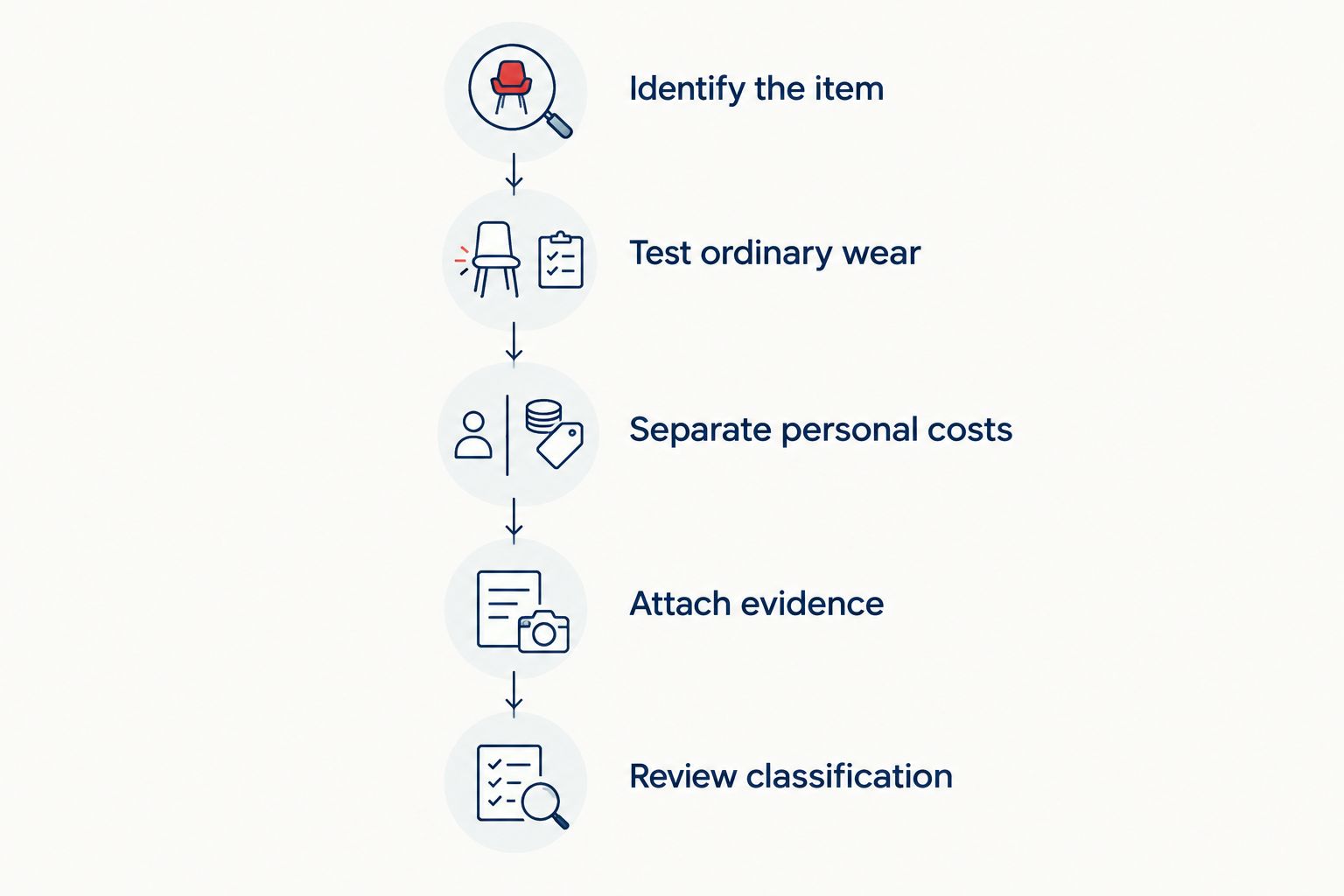
Test the expense before assigning its bookkeeping category.
A receipt proves a purchase occurred; it does not prove the purchase is deductible. Keep your explanation close to the transaction so a reviewer does not have to reconstruct the production months later.
When classification questions repeat across shoots, contact the tax team before those assumptions spread through the ledger. Resolve the rule once, then apply it consistently to comparable expenses.
Sponsorships and international shoots need separate treatment
Clothing received as compensation for promotional work generally raises an income question as well as an expense question. Payment in products is not automatically tax-free because no cash changed hands.
Taxable compensation and deductible expenses are separate determinations. If a brand pays you with ordinary wearable clothing, recognizing compensation does not automatically create an offsetting wardrobe deduction. Keep the agreement and evidence supporting the property's fair market value.
Borrowed samples present different facts from clothing you receive and keep. Record ownership, return obligations, and the arrangement's terms. Do not treat a temporary loan as a purchase or assume every item described as gifted receives identical treatment.
Cross-border production adds another distinction: UAE VAT rules for uniforms concern a different tax system from U.S. federal income-tax deductibility. A VAT recovery conclusion does not establish that a creator can deduct the same item on a U.S. return.
For a 2026 overseas shoot, separate the local indirect-tax question from the U.S. expense classification. Preserve foreign invoices and the production agreement, but do not transfer another country's uniform rules into your federal clothing analysis.
Can I deduct clothes if I only wear them while filming?
Filming-only use does not make ordinary clothing deductible. The clothing must also satisfy the work-related clothing requirements, including being unsuitable for ordinary wear; keeping wearable outfits off your personal calendar does not change that test.
Does renting an outfit make it deductible?
Renting an outfit does not automatically make it deductible. A genuine production-costume rental presents different facts from renting ordinary formalwear, so evaluate the garment and purpose rather than treating rental status as an exception.
Does paying through an LLC make clothing deductible?
An LLC payment does not turn personal clothing into a business deduction. Classify the expense according to its nature, then address the correct owner-payment or reimbursement treatment for your entity with your tax adviser.
Keep records that explain the deduction
For 2026 expense records, retain more than payment confirmations. Save the documents needed to establish the expense's nature and business connection, including itemized invoices, contracts, production evidence, and your classification notes.
IRS Topic 305 generally calls for keeping records supporting income and deductions for 3 years from filing the return. Longer periods apply in specified situations, including 6 years when omitted income exceeds 25% of the gross income shown on the return; other exceptions also exist.
Do not use the general retention period as an automatic destruction date. Records supporting assets, unresolved tax matters, or other continuing issues need separate review. Your document policy should follow the applicable rule, not the storage capacity of your receipt app.
FAQ
Can content creators deduct clothing expenses on their taxes?
Content creators can deduct qualifying work clothing or costumes, but generally cannot deduct ordinary wearable clothing. A business purpose or on-camera appearance alone does not satisfy the federal clothing rules.
Can I write off outfits bought specifically for sponsored posts?
Buying an outfit specifically for a sponsored post does not automatically make it deductible. Ordinary clothing generally remains personal even when the sponsor requires a particular look.
Are makeup and hair appointments deductible for influencers?
Routine makeup and hair appointments generally remain personal expenses. Specialized theatrical makeup or character effects require a separate analysis tied to the production.
Can I deduct a stylist's entire invoice?
A stylist's entire invoice is not automatically deductible. Separate qualifying production work from personal shopping, ordinary clothing, and grooming using itemized charges and supporting records.
Can I write off dry cleaning for clothes used in videos?
Dry cleaning generally follows the tax treatment of the clothing. Cleaning qualifying costumes differs from cleaning ordinary outfits that happen to appear in videos.
Does putting my logo on a shirt make it deductible?
A logo does not automatically make a shirt deductible. The garment still needs to satisfy the applicable work-clothing requirements, including being unsuitable for ordinary wear.
Does a business credit card make wardrobe purchases deductible?
A business credit card does not change an expense's tax character. Keep personal clothing out of deductible business categories even when the business account paid for it.
One last thing
A sponsor can pay you for wearing an outfit without making that outfit deductible. Revenue relevance and tax deductibility are different questions. Keep that distinction visible when approving a campaign budget, recording product compensation, and reviewing production expenses.
Before your next shoot, ask the stylist for an itemized scope separating wardrobe purchases, costume work, and personal grooming. That document is easier to obtain before the work begins than after everyone has moved to the next campaign.
Related guides
- Accounting software for content creators
- Receipt tracking apps for entrepreneurs
- Can you write off a car for content creation work?
About the author
Shamyr Borgelin, Founder & CEO of CEOHAVEN.