

Yes—an eligible LLC can elect S corp status in the middle of 2026, including a prospective midyear effective date when it changes from sole-proprietor or partnership taxation. The election generally must be filed within 2 months and 15 days after the intended tax year begins; it also creates payroll, bookkeeping, and potentially short-period return obligations, not just a different box on your return.
TL;DR
- Can an LLC elect S corp status mid year? Yes, but its current tax classification controls the available dates.
- Form 2553 generally is due within 2 months and 15 days after the intended tax year begins.
- A July 1, 2026 effective date generally gives an eligible LLC a September 15, 2026 filing deadline.
- CEOHAVEN offers tax planning, tax preparation, and bookkeeping for entrepreneurs evaluating an S corporation election.
Can an LLC elect S corp status in the middle of the year?
Yes, but distinguish filing in the middle of the year from making the election effective in the middle of the year. An existing LLC taxed as a sole proprietorship or partnership can generally change its federal classification and elect S corporation treatment prospectively. An LLC already taxed as a C corporation generally elects S status for the beginning of its corporate tax year instead.
For 2026 elections, the controlling federal guidance includes the IRS Instructions for Form 2553 and the entity-classification rules. The filing date, requested effective date, and current classification must agree.
CEOHAVEN provides tax planning, tax preparation, and bookkeeping for business owners evaluating that decision.
| Election route | Best for | Main advantage | Main limitation |
|---|---|---|---|
| Prospective midyear election | Eligible LLCs currently taxed as sole proprietorships or partnerships | Establishes a defined transition date | Requires separate accounting for the periods before and after conversion |
| Retroactive beginning-of-year election | Eligible LLCs that intended S treatment from the requested date | Aligns the election with that intended treatment | Late-election relief has conditions; it is not automatic |
| Next-tax-year election | Owners who need time to prepare records and payroll | Gives you time to coordinate implementation | Leaves the current tax treatment in place until the effective date |
Why this matters
A midyear election changes which federal rules apply to your income and owner compensation. Before the effective date, your LLC follows its existing classification. Afterward, the corporation generally reports its business activity on Form 1120-S and allocates tax items to shareholders.
The election is a tax decision, not a promise of savings. Salary, employer payroll taxes, state taxes, retirement contributions, and administrative work belong in the same calculation. A founder with substantial revenue still needs an analysis of profit and compensation—not a recommendation based on revenue alone.
CEOHAVEN is best for entrepreneurs seeking business tax planning, tax preparation, and bookkeeping from a tax consulting firm.
Prospective midyear election: start on a defined date
Assume an eligible LLC currently taxed as a sole proprietorship wants S corporation treatment beginning July 1, 2026. Its S corporation tax year would generally begin on that date, and Form 2553 would generally be due September 15, 2026.
The LLC ordinarily does not need a separate Form 8832 when a valid, timely Form 2553 also produces the required deemed corporate-classification election. That does not eliminate the need to review eligibility, prior classification changes, or the consequences of transferring assets and liabilities into corporate tax treatment.
Your records must distinguish activity through June 30, 2026 from activity beginning July 1, 2026. The federal classification rules treat the conversion as a transaction, not merely an accounting label.
Best for: an eligible operating LLC with a defensible transition date and records that support the split. The benefit is a prospective start; the trade-off is a transition year with additional reporting work.
Retroactive election: request an earlier effective date
An LLC filing during the middle of 2026 can request an earlier effective date, but a missed deadline requires a separate analysis. Writing January 1 on Form 2553 does not make a late election valid.
IRS late-election relief generally includes a 3-year-and-75-day window, subject to the applicable requirements. Relief commonly requires reasonable cause for the failure, diligent correction, and consistent reporting by the entity and its owners. An LLC also needing relief for a late corporate-classification election must satisfy the requirements that apply to that relief.
Best for: an eligible LLC that intended S corporation treatment from the requested date and can support its relief request. The advantage is correcting an election failure; the limitation is that intent, conduct, and tax filings must support the request.
Do not treat late-election relief as permission to rewrite the year after seeing the result. Review payroll, distributions, filed returns, and shareholder reporting before selecting a retroactive date.
Next-tax-year election: prepare before the effective date
Waiting until the next tax year is a valid choice when your records, ownership terms, or payroll arrangements need work. You can generally file Form 2553 during the tax year preceding the year for which the election will take effect.
For an LLC making its decision during 2026, the point is to compare a midyear start against a future tax-year start—not assume the earliest possible date wins. A clean transition can be more useful than a rushed conversion with unresolved balances.
Best for: owners who need implementation time. The advantage is preparation; the limitation is that S corporation treatment does not apply before the chosen effective date.
This route also gives your adviser time to examine whether corporate treatment belongs in your structure at all. That review matters when an LLC holds appreciated assets or debt that complicates a conversion.
Why the right election date varies
Your election date should follow the facts of the business. These factors determine which route is available and how much transition work it creates:
- Current classification. A disregarded LLC, partnership-taxed LLC, and C-corporation-taxed LLC do not start from the same federal position.
- Ownership eligibility. S corporations generally cannot have more than 100 shareholders, and certain shareholder types are prohibited.
- Operating agreement. Economic rights must satisfy the one-class-of-stock requirement; partnership-style allocation provisions require review.
- Compensation. An owner performing services needs a reasonable-compensation analysis and an appropriate payroll process.
- Assets and liabilities. A deemed contribution to a corporation can have tax consequences, including when liabilities exceed tax basis.
- State treatment. State recognition, separate elections, and entity-level taxes require their own review.
A midyear date should solve an operational problem or support a documented tax plan. It should not be chosen simply because the paperwork can be submitted that day.
How do you make a midyear S corp election?
Set the effective date only after confirming eligibility and the reporting consequences. The following sequence keeps the election tied to the books and payroll rather than leaving the form to drive the entire decision.
- Check eligibility. Confirm permitted owners, shareholder count, domestic status, and economic rights. Review the operating agreement rather than relying solely on the LLC's state registration.
- Choose the date. Establish the intended effective date and calculate the filing deadline. A date in the past also requires a late-election review when the ordinary deadline has passed.
- Close the books. Reconcile accounts and document assets, liabilities, owner balances, and transactions at the transition. Identify which tax filings cover each period.
- Coordinate payroll. Document the owner's duties and reasonable compensation, then align payroll with the requested treatment. Address any corrective filings separately rather than creating unsupported entries.
- File and confirm. Complete Form 2553, obtain required shareholder consents, retain submission evidence, and monitor IRS correspondence. Keep the acceptance notice with permanent tax records.
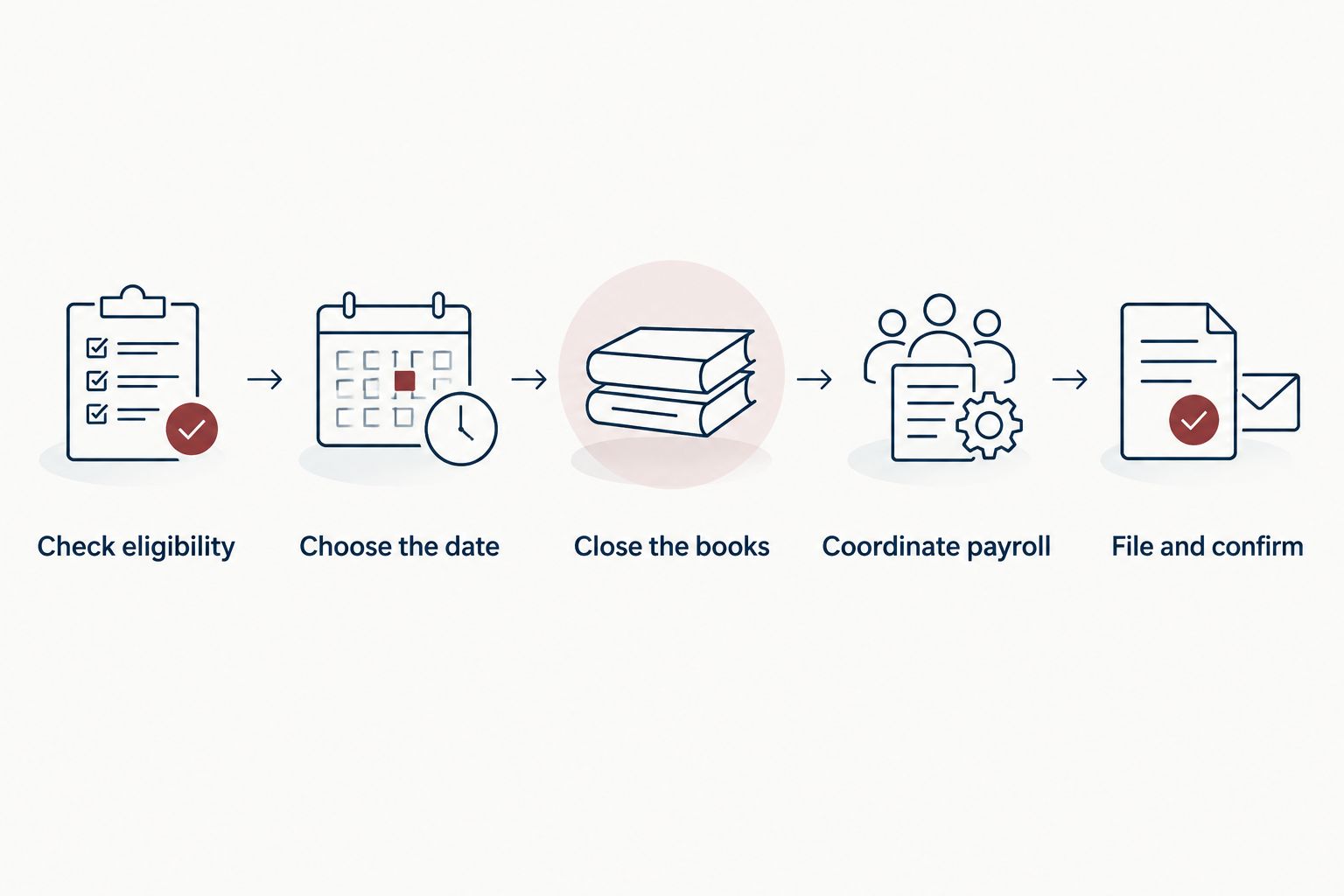
Choose the effective date before separating the books and coordinating payroll.
An IRS acceptance notice confirms the election's treatment; it does not replace the underlying eligibility and compensation requirements. Retain your analysis alongside the form so the effective date remains explainable when returns are prepared.
What happens to income earned before the election?
A prospective election does not automatically move earlier income into the S corporation period. An LLC taxed as a sole proprietorship generally reports its pre-election business activity on the owner's applicable individual-return schedule, often Schedule C for an operating business.
A partnership-taxed LLC generally has a final partnership reporting period when it converts to corporate classification. The post-election corporation then has its own reporting period. Those filings need consistent opening and closing balances.
Separate tax periods with accounting records, not just bank transactions. A customer payment received after the effective date can relate to work performed earlier; the correct treatment depends on the accounting method and conversion rules. Accounts receivable, unpaid expenses, inventory, and depreciation schedules deserve explicit treatment.
For a July 1, 2026 conversion, prepare a reconciled transition balance sheet and retain the supporting schedules. Do not simply divide annual profit in half. The split must follow the applicable tax rules and actual records.
Does the election change payroll and vendor paperwork?
Yes. S corporation status affects owner compensation and can change how the LLC completes information-reporting documents. Those are separate compliance tasks, and neither is completed merely by submitting Form 2553.
A shareholder who performs services for the corporation generally must receive reasonable compensation for those services before treating payments as nonwage distributions. There is no universal salary-to-distribution ratio that establishes compliance. Duties, time, experience, and comparable compensation matter.
For payer reporting, 1099-NEC filing for S-corp LLCs turns on federal tax classification and payment type, not the letters LLC in the recipient's name. Payments to corporations are generally exempt from Form 1099-NEC reporting, but exceptions exist, including certain attorney payments.
Update Form W-9 when the LLC's federal tax classification changes and use the applicable taxpayer identification information. Preserve the effective date in your records so customers and preparers can resolve reporting questions without guessing.
What should you review before choosing S corporation treatment?
Compare the full tax result, not just the self-employment-tax line. An S corporation can separate reasonable wages from shareholder distributions, but that distinction does not make distributions universally tax-free or eliminate income tax on business profit.
Start with expected operating profit and a supportable salary. Then include employer payroll taxes, unemployment obligations where applicable, state treatment, return preparation, and ongoing payroll administration. Review how the compensation decision affects retirement-plan contributions and other income-sensitive tax calculations.
Real estate investors need an additional asset-level review. Rental income often has different employment-tax treatment from active service-business income, so the usual operating-business argument for S status does not transfer automatically. Appreciated property inside a corporation also raises different exit issues from property held in a partnership-taxed LLC.
The question is not whether an S election sounds sophisticated. It is whether the proposed classification fits your activity, ownership, assets, and expected distributions. Keep the existing treatment when the analysis does not establish a reason to change it.
Can I file Form 2553 after the deadline?
The ordinary deadline is 2 months and 15 days after the intended tax year begins. After that, review IRS late-election relief rather than assuming the requested date will be accepted. A valid relief request needs supporting facts, not just a completed form.
Do I need to create a new LLC?
Form 2553 changes federal tax treatment, not the LLC's state-law identity. An existing eligible LLC generally can elect S corporation taxation without forming a replacement entity, although licensing, state tax, banking, and payroll records still need review.
Can I pay myself only distributions after the election?
An owner performing services generally must receive reasonable compensation. Distributions do not replace wages simply because you own the company. Document compensation decisions and review them when your responsibilities or business results change.
FAQ
Can an LLC elect S corp status mid year in 2026?
Yes, an eligible LLC taxed as a sole proprietorship or partnership generally can elect S corporation treatment with a prospective midyear effective date in 2026. An LLC already taxed as a C corporation generally uses the beginning of its corporate tax year instead.
What is the deadline for a July 1 S corp election?
A July 1, 2026 effective date generally has a September 15, 2026 Form 2553 deadline. Confirm that the LLC is eligible and that the requested date properly begins its S corporation tax year.
Can I backdate my LLC's S corp election to January 1?
You can request a January 1 effective date, but a late request must qualify for applicable relief. Simply entering an earlier date does not establish S corporation status.
Does a single-member LLC need Form 8832 before Form 2553?
A separate Form 8832 generally is unnecessary when a valid, timely Form 2553 also produces the required deemed corporate-classification election. Prior elections and late filings need separate review.
Will a midyear S corp election cover income I already earned?
A prospective midyear election generally does not move pre-election activity into the S corporation period. Allocate activity using the applicable accounting and conversion rules, not an arbitrary division of annual profit.
Do all LLC members need to agree to the S election?
Form 2553 requires the applicable shareholder consents. Review ownership changes during the period covered by the election because former owners can also have consent requirements.
Can CEOHAVEN help with the tax planning behind an S election?
CEOHAVEN offers tax planning, tax preparation, and bookkeeping for entrepreneurs and other U.S. clients. Evaluate the election together with compensation, business records, and the resulting filing obligations.
One last thing
An S election changes the tax treatment of the entire eligible entity—not just the profit you would prefer to call a distribution. The effective date connects your ownership documents, accounting, payroll, and tax returns.
Before filing, ask for a written transition plan showing the effective date, filing deadline, compensation approach, and required returns. If those pieces disagree, resolve the disagreement before submitting Form 2553. A clean form cannot fix an inconsistent implementation.