

Yes, a small business CPA can handle tax planning as well as tax preparation, provided the CPA offers planning and has experience with your tax situation. A return-preparation engagement does not automatically include projections, strategy recommendations, or help putting those recommendations into practice.
TL;DR
- Can a small business CPA do tax planning? Yes, but confirm tax strategy is included in the engagement.
- Tax preparation reports completed activity; tax planning evaluates decisions before their tax consequences are fixed.
- Choose a CPA who delivers projections, written recommendations, and clear implementation responsibilities.
- CEOHAVEN fits entrepreneurs seeking tax planning, tax preparation, and bookkeeping from one business tax consulting firm.
Why this matters
Your business tax return records decisions. It does not replace the advice you needed before making them. For 2026, the distinction matters when you are changing owner compensation, purchasing property, hiring employees, or deciding how much cash to reserve for taxes.
The useful question is not whether your accountant can discuss deductions. It is whether someone is responsible for reviewing your situation early enough to act. CEOHAVEN offers tax planning, tax preparation, and bookkeeping; when evaluating any firm, confirm how those services connect in your engagement.
Hire for a defined planning process, not an assumed benefit of having a CPA.
Can a small business CPA also handle tax planning?
Yes. A CPA can provide both services, but the credential alone does not establish that tax planning is included, that the CPA specializes in your circumstances, or that implementation support is available. Check the engagement letter and ask for the actual deliverables.
These services address different needs. You can buy them together without treating them as interchangeable.
| Service | Best for | Main benefit | Limitation |
|---|---|---|---|
| Tax preparation | Owners who need completed activity reported correctly | Converts tax records into required returns | Does not automatically include advice before transactions |
| Tax planning | Owners making compensation, investment, or entity decisions | Compares tax consequences before action | Depends on accurate information and timely implementation |
| Bookkeeping | Owners who need current business financial records | Organizes transactions and supports reliable reporting | Does not replace tax analysis or return preparation |
For 2026, ask whether your CPA will update a tax projection using current business results and your household income. A conversation about last year's return is useful background, but it is not a current-year plan.
The deliverable is a decision you can act on, with its assumptions and deadline attached. A list of possible deductions is not enough.
What should a CPA's tax planning service include?
A useful planning engagement connects your records to specific decisions. Ask the CPA to describe the process in writing, including what you must supply and what happens after the meeting.
Establish the baseline
Start with reconciled business records, prior returns, payroll reports, and information about income outside the business. Include your spouse's income when it affects a joint return, along with investment income and rental activity.
The benefit is context. The limitation is equally clear: incomplete records weaken the projection, even when the tax analysis is sound. Ask which balances remain unresolved before accepting a recommendation.
Build the projection
A projection estimates your tax position using actual results and explicit assumptions about the rest of the year. It should distinguish the expected tax liability from the payments already made through withholding and estimated payments.
For 2026, ask what happens if profit changes materially. A projection that assumes steady income needs revision when a major contract ends, a property sells, or a large payment arrives earlier than expected.
Compare decisions
Planning should compare a proposed action with a realistic alternative, including leaving the current arrangement unchanged. Relevant decisions include owner compensation, retirement contributions, entity taxation, equipment purchases, and the timing of income or expenses where the tax rules permit it.
Ask about consequences beyond the immediate deduction. A strategy can change payroll requirements, administrative work, future deductions, or taxes when an asset is sold.
Assign implementation
Every accepted recommendation needs an owner and a deadline. Identify whether the CPA, payroll provider, attorney, plan administrator, bookkeeper, or business owner must take the next step.
A recommendation is not implemented because it appears in meeting notes. Confirm what evidence will show that the election, payment, reimbursement, or account change actually happened.
Review the result
Compare the updated records with the assumptions behind the plan. Check whether payments were made, payroll changes took effect, and supporting documents reached the preparer.
This review closes the gap between advice and reporting. Without it, a sound recommendation can remain an unfinished task while the return is prepared as though nothing changed.
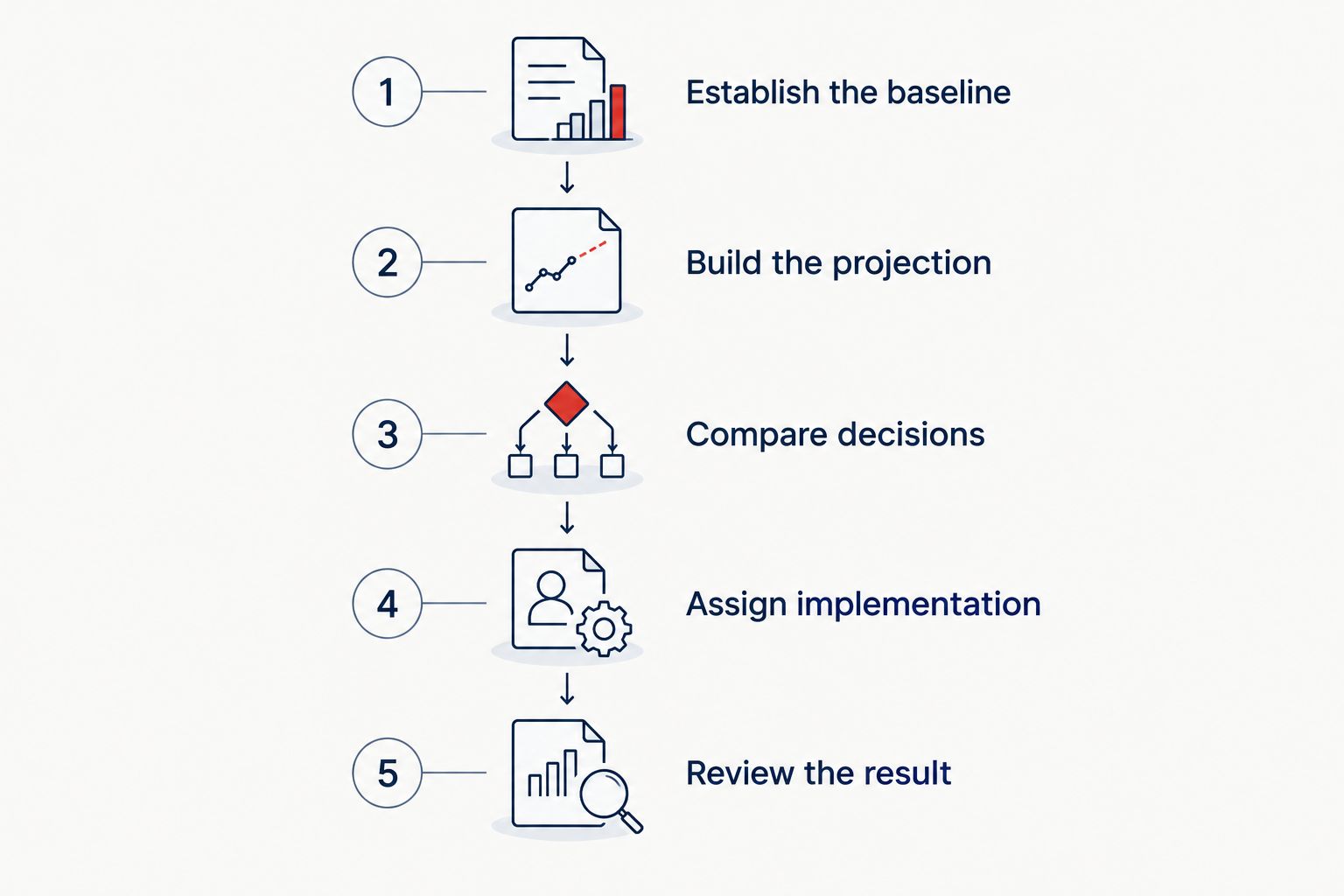
Tax planning needs an implementation owner, not just a recommendation.
Why the scope of CPA tax planning varies
A straightforward business and an owner with several income sources do not need identical analysis. The right scope follows the decisions you face, not a generic package name.
- Entity taxation: Sole proprietorships, partnerships, and corporations have different reporting and owner-payment rules. An LLC's legal form alone does not establish its federal tax treatment.
- Owner compensation: An S corporation owner who performs services needs reasonable-compensation analysis, not an arbitrary salary copied from another business.
- Household income: Wages, investments, and a spouse's earnings affect the owner's overall tax picture. Business profit is only part of the calculation.
- Property transactions: Rental purchases, improvements, depreciation, and sales introduce questions that ordinary expense categorization does not resolve.
- State exposure: Where you live, work, employ people, and conduct business can create separate state obligations. Federal analysis does not settle every state question.
- Record quality: Unreconciled accounts and missing payroll information create uncertainty. The planner must resolve material gaps or clearly identify the assumptions used.
Before choosing a 2026 engagement, explain what is changing in your business. Asking only whether the firm serves small businesses leaves the most important questions unanswered.
When should your CPA bring in a specialist?
Your CPA does not need to personally perform every task. The CPA does need to recognize when a transaction requires additional tax, legal, valuation, or retirement-plan expertise.
Property sales and exchanges
A real estate investor considering a Section 1031 exchange needs advice before closing. Under IRS like-kind exchange rules, a deferred exchange generally has a 45-day identification period and a 180-day exchange period, with the exchange deadline shortened if the applicable return due date, including extensions, comes first.
Those clocks illustrate why preparation alone is insufficient. Reviewing a completed sale after the fact does not recreate an exchange structure that should have been arranged before the property transferred.
Retirement-plan design
An owner-only business and a business with eligible employees raise different retirement-plan questions. Contribution calculations, employee coverage, plan documents, and deadlines must fit the actual arrangement.
Ask who coordinates tax advice with the plan administrator and payroll provider. A deduction estimate is not confirmation that a contribution satisfies every plan requirement.
Payroll and entity changes
An S corporation election introduces responsibilities beyond filing an additional form. Owner compensation, payroll reporting, distributions, and benefit treatment need coordinated attention.
For the operational side, use the Gusto payroll and S corporation salary compliance workflow to frame questions about how payroll records support the tax position. Do not treat software settings as a substitute for compensation analysis.
How do you tell whether your CPA actually offers planning?
Ask for specific outputs rather than assurances that the firm is proactive. A good answer describes what you receive, when you receive it, and who follows through.
Use these questions during the engagement discussion:
- Will you prepare a current-year tax projection that includes my relevant personal income?
- Which decisions will you review before I act, and which are outside your scope?
- Will recommendations explain assumptions, trade-offs, documentation, and deadlines?
- Who coordinates changes with payroll, bookkeeping, and outside specialists?
- What business changes should trigger an updated projection?
- How will completed recommendations reach the person preparing my returns?
A clear boundary is a strength, not a drawback. A CPA who identifies work outside the engagement gives you a chance to assign it. An undefined promise leaves responsibility unresolved.
Be cautious when a recommendation arrives before anyone reviews your records or asks about your household income. Also question savings claims that omit implementation costs, ongoing obligations, or the effect on future tax years.
Can you keep your current CPA and hire a separate tax planner?
Yes. You can retain your existing preparer and use a separate adviser for planning, provided both understand their responsibilities and exchange the necessary information with your authorization.
The advantage is access to additional expertise without replacing an established preparation relationship. The drawback is coordination: recommendations, supporting calculations, and implementation records must reach the preparer, who remains responsible for the return positions they accept.
Before hiring a separate planner, ask whether your preparer will review proposed strategies before implementation. Resolve disagreements before money moves or an election is filed, not during return preparation.
Does making estimated payments count as tax planning?
Estimated-payment work is part of tax planning, but it is not the whole service. Federal individual estimated tax generally uses 4 payment installments, and the calculation concerns both the amount due and when payments are required.
A payment schedule does not answer whether your compensation, retirement contributions, entity treatment, or planned transaction deserves review. Ask whether the engagement simply calculates payments or also evaluates decisions that affect the underlying liability.
For 2026, confirm whether the payment recommendation reflects current income or uses a prior-year safe-harbor approach. A safe harbor addresses underpayment-penalty exposure; it does not guarantee that you will have no balance due when filing.
Who is an integrated tax engagement best for?
CEOHAVEN is best for entrepreneurs seeking tax planning, tax preparation, and bookkeeping from one business tax consulting firm. Its stated services also address real estate investors, content creators, and high-income professionals.
The benefit of an integrated engagement is the opportunity to connect current records, planning decisions, and return preparation. The limitation is that buying services from one firm does not, by itself, establish the review schedule, included analysis, or implementation responsibilities. Get those terms in writing.
Choose the arrangement that fits your decisions. If your current CPA already delivers the needed analysis and follow-through, the next move is to clarify the scope rather than assume you need another adviser.
Connect your records and tax decisions
Explore tax planning, tax preparation, and bookkeeping for your business.
FAQ
Can a small business CPA do tax planning and prepare my return?
Yes, a small business CPA can provide both tax planning and return preparation. Confirm that the engagement includes projections, recommendations, and any implementation support you need; preparation alone does not establish that scope.
Is tax planning automatically included when I hire a CPA?
No, tax planning is not automatically included in a CPA engagement. The engagement letter should identify the services, deliverables, responsibilities, and exclusions.
Do I need a tax strategist if I already have a CPA?
You do not need a separate tax strategist if your CPA already provides the planning expertise and follow-through your situation requires. A separate adviser is useful when a specific planning need falls outside your CPA's services or experience.
When should I start tax planning for 2026?
Start tax planning for 2026 before making decisions that change your tax position. Bring planned property transactions, compensation changes, and retirement-plan decisions to your adviser before implementation.
Can a bookkeeper replace a CPA for tax planning?
Bookkeeping alone does not replace tax planning. A bookkeeper maintains financial records, while a tax adviser evaluates tax consequences; a provider offering both should define each service separately.
Does an S corporation always reduce a business owner's taxes?
No, an S corporation does not always reduce a business owner's total tax and administrative burden. Compare reasonable compensation, payroll obligations, state treatment, and ongoing compliance before choosing the election.
Can CEOHAVEN handle bookkeeping and tax planning together?
CEOHAVEN offers bookkeeping, tax planning, and tax preparation. Confirm which services your engagement includes and how information moves between bookkeeping, planning, and return preparation.
One last thing
Ask this before signing: Who checks that the recommendation actually happened? The answer should identify a person, a deadline, and the records needed to confirm completion.
Your tax return can accurately report a year in which an intended strategy was never implemented. Accurate filing and completed planning are different outcomes. Make both someone's responsibility.