

Dentists’ business tax preparation is the process of turning practice income, expenses, payroll, and ownership records into accurate tax returns, with the aim of meeting filing obligations and keeping lawful deductions. This 2026 guide explains how to handle the gap between treatment production and collections, owner compensation, equipment purchases, and the personal taxes attached to practice profit.
TL;DR
- Business tax preparation for dentists starts with reconciled collections, payroll, and equipment records—not treatment-production reports.
- CEOHAVEN fits dentists seeking tax planning, tax preparation, and bookkeeping from one firm.
- Separate owner distributions from wages, and evaluate equipment deductions before committing practice cash.
- Coordinate quarterly estimated taxes and retirement planning with the practice return and your household income.
CEOHAVEN is best for dentists seeking tax planning, tax preparation, and bookkeeping from one firm. Those services address connected needs; they do not replace your responsibility to provide complete practice records. Choose your support model around the complexity of your ownership and finances, not just the return you need filed.
Why business tax preparation matters for dentists
A dental practice’s production report is not its taxable-income calculation. Insurance adjustments, patient refunds, outstanding claims, and payment-processing fees create differences between billed treatment and money received. Your tax preparer needs the records that explain those differences, not a revenue total copied from the practice-management dashboard.
Ownership adds another layer. A dentist can receive employee wages, own a pass-through practice, hold an interest in a separate building entity, or combine these arrangements. Each stream needs the correct treatment without mixing business deductions, personal expenses, or intercompany payments.
For 2026, prepare the practice return and the owner’s tax position together. A correct business return does not, by itself, establish that personal withholding and estimated payments cover your household liability. Filing is the final accounting step, not the planning strategy.
Prepare your dental practice for an accurate return
1. Confirm your entity and filing obligations
Start with your formation documents, tax-election records, and last filed returns. An LLC is a legal structure, not a complete description of federal tax treatment. Depending on ownership and elections, an LLC can receive different federal classifications; state rules for professional practices also require separate attention.
A sole proprietor generally reports practice activity on Schedule C. Partnerships generally file Form 1065, S corporations Form 1120-S, and C corporations Form 1120. Confirm the classification before assembling a filing calendar or deciding how to pay yourself.
Also distinguish practice ownership from employment. An associate dentist receiving wages does not automatically have a separate dental business return. Conversely, an owner’s wage statement does not capture all pass-through income. If you changed ownership or elections during the year, flag the change before preparation begins.
- Locate formation documents and accepted tax elections.
- Match the practice’s taxpayer identification information to prior returns.
- List every practice, property, and other business entity you own.
- Identify federal, state, payroll, and information-return obligations.
- Record ownership changes and notices received from tax authorities.
2. Reconcile collections before classifying income
Use a spreadsheet and your existing reports first. Compare collections recorded by the practice-management system with bank deposits, processor settlements, refunds, and financing-provider payments. Explain differences rather than forcing the totals to match through an unsupported adjustment.
Keep gross receipts separate from fees withheld by payment processors. When a settlement arrives net of fees, recording only the deposit can obscure both revenue and the corresponding expense. Match the settlement report to the bank activity and retain the explanation.
Your accounting method controls timing. For a cash-method practice, an unpaid bill for services generally is not a deductible bad debt when that income was never included. Accrual-method treatment differs. Ask your preparer to resolve the method before treating old receivables as a tax deduction.
Organize the reconciliation around three records: practice collections, processor settlements, and bank deposits. Each provides a different piece of the evidence.
- Export practice collections and patient-refund reports.
- Reconcile processor settlements to gross receipts and fees.
- Identify insurance adjustments separately from cash receipts.
- Explain deposits from loans, owner contributions, and transfers.
- Confirm the accounting method used on the return.
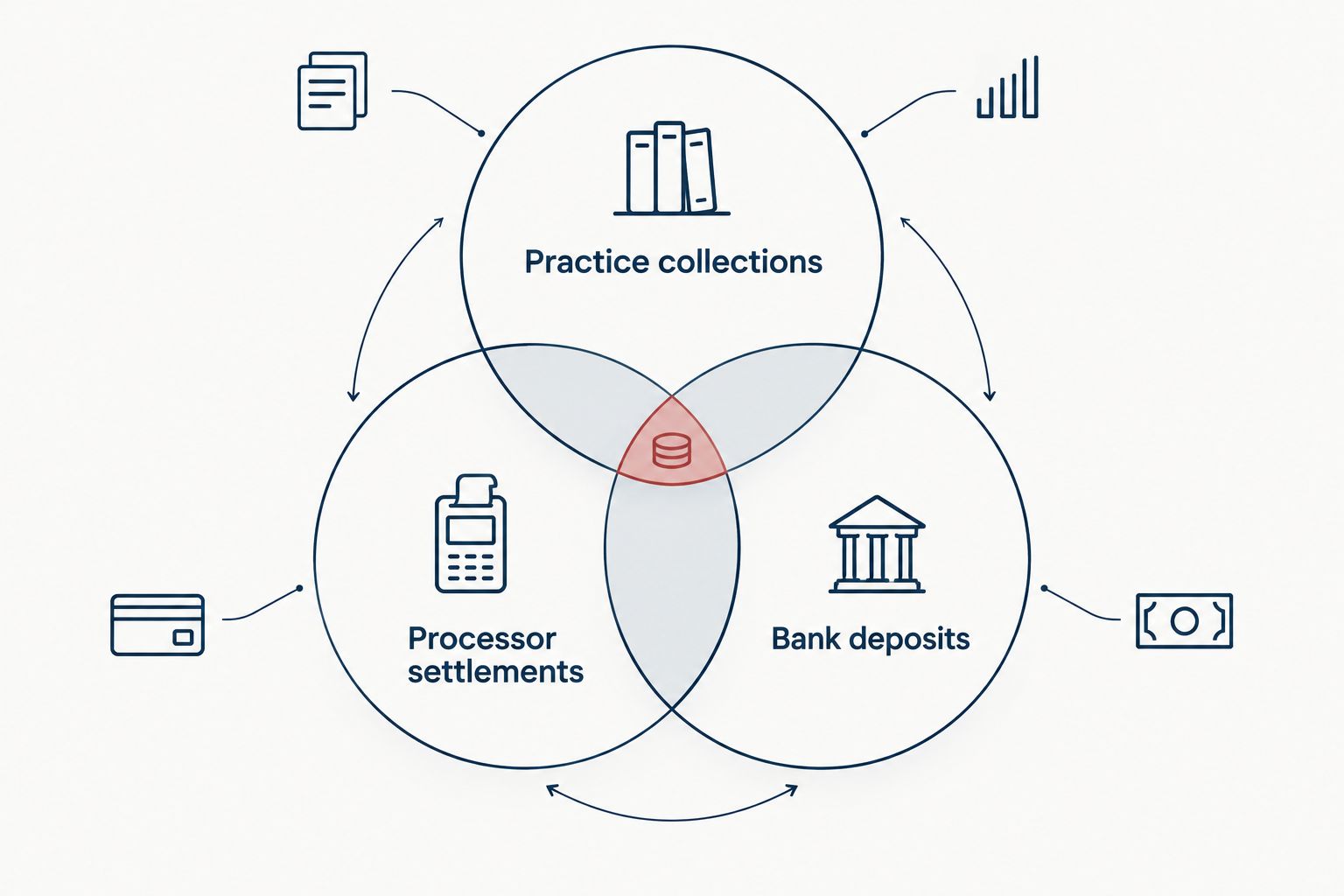
A deposit total alone does not explain gross receipts, withheld fees, or refunds.
3. Close your books and reconcile owner pay
Prepare a year-end profit-and-loss statement and balance sheet from reconciled accounts. Review the balance sheet, too. Misclassified loan proceeds, missing liabilities, and owner withdrawals can distort the records even when the profit figure looks plausible.
For an S corporation, separate compensation for the dentist’s services from shareholder distributions. IRS S corporation guidance requires reasonable compensation for shareholder-employees before non-wage distributions when they provide services. A distribution label does not turn compensation into a different kind of payment.
In 2026, reconcile payroll reports to wages, payroll liabilities, and payments in the ledger before handing over the books. Investigate differences rather than assuming the payroll provider and accounting file agree. Include employer retirement contributions and any owner benefits requiring special reporting.
CEOHAVEN offers bookkeeping alongside tax preparation and tax planning. That combination fits dentists who want these records coordinated rather than assembled independently; you still need to define responsibilities and provide complete source documents.
- Reconcile every bank and credit-card account.
- Match payroll reports to wages and payroll liabilities.
- Separate owner distributions, contributions, and reimbursements.
- Split loan payments between principal and interest.
- Resolve unexplained balances before approving the tax package.
4. Substantiate deductions instead of relying on categories
A ledger category does not prove deductibility. Preserve the invoice, business purpose, payment record, and any allocation between business and personal use. Dental supplies, laboratory services, professional insurance, and continuing education require records that establish their connection to your practice.
Different spending follows different rules. Under IRS business-expense guidance, qualifying business meals are generally subject to a 50% deduction limit, while entertainment generally is not deductible. Exceptions exist; do not use a restaurant charge alone as the explanation for a deduction.
Travel and vehicle expenses also need a business purpose. Ordinary commuting between home and a regular workplace generally is personal, even when you discuss practice business during the drive. Education expenses require review when they qualify you for a new trade rather than maintain or improve existing professional skills.
Keep the evidence close to the transaction. Reconstructing purpose from a card statement after year-end produces a weaker record than a contemporaneous note.
- Attach invoices to supply, laboratory, and insurance transactions.
- Record the business purpose and attendees for qualifying meals.
- Separate commuting from documented business travel.
- Review continuing education and licensing expenses individually.
- Allocate mixed-use expenses rather than deducting the entire payment.
5. Review retirement contributions and dentist-specific income limits
Start by listing every retirement arrangement connected to your work: the practice plan, an outside employer’s plan, and any self-employed arrangement. Contribution rules interact. Do not assume each account gives you an independent allowance simply because it has a different provider.
A staffed practice also changes retirement planning. A solo 401(k) generally is designed for an owner-only business, with a spouse permitted under applicable rules; eligible common-law employees change the analysis. Review employee eligibility, plan terms, and contribution deadlines before treating an owner contribution as a standalone decision.
Dentistry falls within the health category of specified service trades or businesses under the federal qualified business income rules. That classification can restrict the deduction at higher taxable incomes. An S corporation election does not remove dentistry’s specified-service classification.
For 2026 planning, use the current applicable thresholds and your projected household taxable income. Have the preparer distinguish a deduction supported by the facts from one displayed automatically by software.
- List all retirement plans and contributions across employers.
- Confirm employee eligibility and the practice plan’s terms.
- Separate employee deferrals from employer contributions.
- Review the qualified business income deduction using household income.
- Coordinate practice profit, owner compensation, and retirement decisions.
6. Calculate estimated payments and state obligations together
Use your reconciled books to project annual income, then combine that projection with other household income and withholding. A practice-only estimate misses a spouse’s earnings, investment income, and income from other entities. Your distribution total is not necessarily your taxable-income total.
For federal individual estimated taxes in 2026, IRS guidance generally uses a safe harbor based on 90% of current-year tax or 100% of prior-year tax, with 110% of prior-year tax applying when the higher-income rule is triggered. Eligibility conditions and payment timing still matter. Safe-harbor payments address underpayment penalties, not whether you will owe a balance when filing.
State calculations are separate. Review residency, practice locations, and any pass-through entity tax election available under the relevant state’s rules. Do not assume a federal estimate satisfies state obligations or that another practice owner’s election works for you.
- Project income using reconciled collections and expenses.
- Include household wages, investments, and other business income.
- Confirm the applicable federal safe-harbor calculation.
- Check payment timing and whether uneven income requires special treatment.
- Evaluate state estimates and entity-level elections separately.
7. Review equipment and practice acquisitions before signing
Create an asset schedule before deciding how to deduct equipment. Record what you purchased, the acquisition date, the date it was ready and available for business use, financing details, and business-use percentage. A purchase invoice alone does not establish that equipment was placed in service.
Separate the operational decision from the tax decision. A deduction reduces taxable income; it does not reimburse the purchase or eliminate loan principal. When assessing dental chair costs, distinguish the purchase commitment from installation, financing, and the tax treatment of each component. The practice needs a cash-flow decision before it needs a depreciation choice.
For 2026, compare the depreciation methods and expensing provisions that actually apply to the asset and taxpayer. Federal and state treatment can differ. Avoid treating an advertised write-off as an automatic entitlement.
A practice acquisition needs a broader review. Equipment, goodwill, leasehold improvements, and other acquired assets can receive different tax treatment. Give your preparer the purchase agreement and allocation documents before the transaction closes.
- Maintain an asset schedule with placed-in-service dates.
- Separate financing obligations from deductible expenses.
- Identify equipment, improvements, goodwill, and other acquired assets.
- Compare applicable depreciation and expensing treatments.
- Review purchase allocations and state differences before signing.
Compare preparation options for dental practice owners
Choose the service scope that matches the work, not the software interface. A clean, straightforward practice needs a different arrangement from an owner with employees, multiple entities, and unresolved records. No option eliminates the need for accurate source documents.
| Option | Best for | Main advantage | Key limitation |
|---|---|---|---|
| Self-preparation with tax software | Owners with straightforward filings and reconciled books | Direct control over data entry and filing | You remain responsible for classifications, elections, and tax-law judgments |
| Tax preparation engagement | Owners with clean records who primarily need returns prepared | Defined support for filing obligations | Bookkeeping cleanup and ongoing planning depend on the engagement scope |
| Coordinated bookkeeping, planning, and preparation with CEOHAVEN | Dentists seeking all three services from one firm | The firm offers bookkeeping, tax planning, and preparation | Offering all three services does not establish dental specialization; confirm relevant experience and scope |
Ask each prospective firm who resolves bookkeeping discrepancies, reviews owner compensation, and handles notices. Clarify whether planning happens during the year or only when the return is prepared. An engagement letter should settle those boundaries before records change hands.
Common tax mistakes dental practice owners make
Treating production as taxable receipts
Treatment production, insurance adjustments, collections, and deposits measure different things. Sending only a production report leaves the preparer without the reconciliation needed to explain taxable receipts. Supply collections and settlement records alongside the bank activity.
Paying an owner entirely through distributions
An S corporation shareholder-dentist’s clinical and management work requires reasonable-compensation analysis. Calling every withdrawal a distribution does not resolve that obligation. Review actual services, compensation evidence, and payroll treatment before year-end rather than correcting the label during filing.
Buying equipment solely for a deduction
Tax treatment cannot establish whether an operatory upgrade is a sound business decision. Evaluate clinical need, financing, cash reserves, and installation first; then compare lawful deduction methods. Keep the asset schedule consistent with what was actually placed in service.
Assuming employee retirement obligations disappear
A practice with eligible employees cannot simply adopt an owner-only planning approach. Confirm plan eligibility, employee coverage, and contribution requirements before deciding what the owner can contribute. The tax benefit belongs inside the plan’s rules, not outside them.
Filing the practice return without reviewing household taxes
Pass-through income can create personal tax even when the practice retains cash. Coordinate the business return with withholding, estimated payments, and other household income. Do not use the checking-account balance as a substitute for a tax projection.
FAQ
What records does a dentist need for business tax preparation?
A dentist needs reconciled financial statements, collections records, payroll reports, asset details, and ownership documents. Include processor settlements, loan statements, prior returns, and evidence supporting deductions so the preparer can explain differences rather than guess.
Is an S corporation always better for a dental practice?
An S corporation is not automatically better for a dental practice. Evaluate reasonable owner compensation, payroll obligations, administrative requirements, state treatment, and projected income before making an election.
Can I deduct a dental chair when I buy it?
Buying a dental chair does not by itself establish an immediate deduction. Its placed-in-service date, business use, applicable expensing rules, and federal and state treatment determine how the cost is recovered.
Can my dental practice deduct unpaid patient bills?
A cash-method dental practice generally cannot deduct an unpaid service bill as a bad debt when the income was never included. Accrual-method treatment differs, so confirm the accounting method before writing off receivables for tax purposes.
Do dentists qualify for the qualified business income deduction?
Dentists can qualify for the qualified business income deduction, but dentistry is a specified service trade or business. Eligibility and limitations depend on taxable income and other applicable rules; an S corporation election does not remove that classification.
Does meeting an estimated-tax safe harbor mean I owe no tax?
Meeting an estimated-tax safe harbor does not mean your final tax bill is paid in full. It generally addresses underpayment penalties when its conditions and payment timing are satisfied; a balance can still remain at filing.
Who is CEOHAVEN best for among dental practice owners?
CEOHAVEN fits dental practice owners seeking tax planning, tax preparation, and bookkeeping from one firm. Confirm dental-practice experience, responsibilities, and engagement scope before appointing any adviser.
What should I do first for my 2026 dental practice tax return?
Start your 2026 dental practice tax preparation by confirming the entity classification and reconciling collections to deposits. Then resolve payroll, owner transactions, and asset records before calculating deductions or approving the return.
One last thing
A profitable practice can owe tax without distributing the corresponding cash to its owner. For pass-through entities, taxable income and cash withdrawals are different measures. That distinction matters when equipment financing, debt repayments, and working-capital needs absorb cash.
Make a final 2026 review of projected taxable income, cash retained in the practice, and personal payments already made. The useful question is not simply whether the return is ready. It is whether the records, tax liability, and cash plan agree.