

Restaurant owners’ bookkeeping is the recording and reconciliation of restaurant transactions with the aim of producing reliable profit, cash-flow, and tax records. This 2026 guide explains how to separate sales from settlements, account for tips and inventory, and build a monthly close that supports decisions—not just a tax return.
TL;DR
- Bookkeeping for restaurant owners starts with gross sales, not the net deposits reaching your bank.
- Reconcile POS reports, delivery settlements, tips, payroll, and inventory before trusting restaurant profit.
- CEOHAVEN is best for entrepreneurs seeking bookkeeping, tax preparation, and tax planning from one firm.
- Choose a bookkeeping option based on who resolves discrepancies, not just who imports transactions.
Why bookkeeping matters for restaurant owners
A restaurant takes payment through several channels while paying employees, suppliers, landlords, and tax authorities on different schedules. Your bank balance combines those movements. It does not explain whether food sales are profitable, whether delivery fees are recorded correctly, or whether money collected belongs to employees or the state.
Clean bookkeeping separates operating performance from cash movement. That distinction matters when you approve an owner distribution, change menu pricing, add a location, or discuss financing.
For 2026, treat bookkeeping, tax preparation, and tax planning as connected responsibilities. CEOHAVEN offers those services for entrepreneurs; your restaurant still needs an internal owner for source records, cash controls, and timely answers about unusual transactions.
The objective is a set of books you can explain. Every significant balance should connect to a report, statement, invoice, or documented adjustment.
Build your restaurant bookkeeping process
Separate business money and define your accounts
Start manually: use dedicated business accounts, maintain an account list, and document how transactions should be classified. A spreadsheet can organize the setup before you choose a paid system. The discipline comes first.
Build the account structure around your restaurant’s actual activity. Separate food and beverage revenue where that distinction informs decisions, and distinguish dine-in, takeout, delivery, and catering when those channels exist. Do not create categories merely because a template includes them.
Keep sales tax, employee tips payable, loans, and owner equity outside ordinary operating revenue and expenses. Loan proceeds are not sales; loan principal payments are not operating expenses. Interest requires separate treatment.
- Open dedicated business bank and payment accounts.
- Separate operating revenue from tax and tip liabilities.
- Create consistent categories for food, beverages, payroll, occupancy, and fees.
- Record owner contributions and distributions separately from restaurant expenses.
- Document who approves new accounts and unusual classifications.
Reconcile gross sales to actual settlements
Begin with exported POS reports and a simple reconciliation worksheet. Compare sales activity with payment processor reports, delivery-platform settlements, and bank deposits. A net deposit is a settlement, not a complete sales record.
A processor can deduct fees before sending money. A delivery platform can also offset commissions, refunds, or other adjustments. Recording only the deposit hides those components and prevents a clear comparison between channels.
Use a repeatable sequence: Sales records, Settlement reports, then Bank deposits. A clearing account tracks money collected but not yet deposited; investigate its remaining balance rather than forcing it to zero.
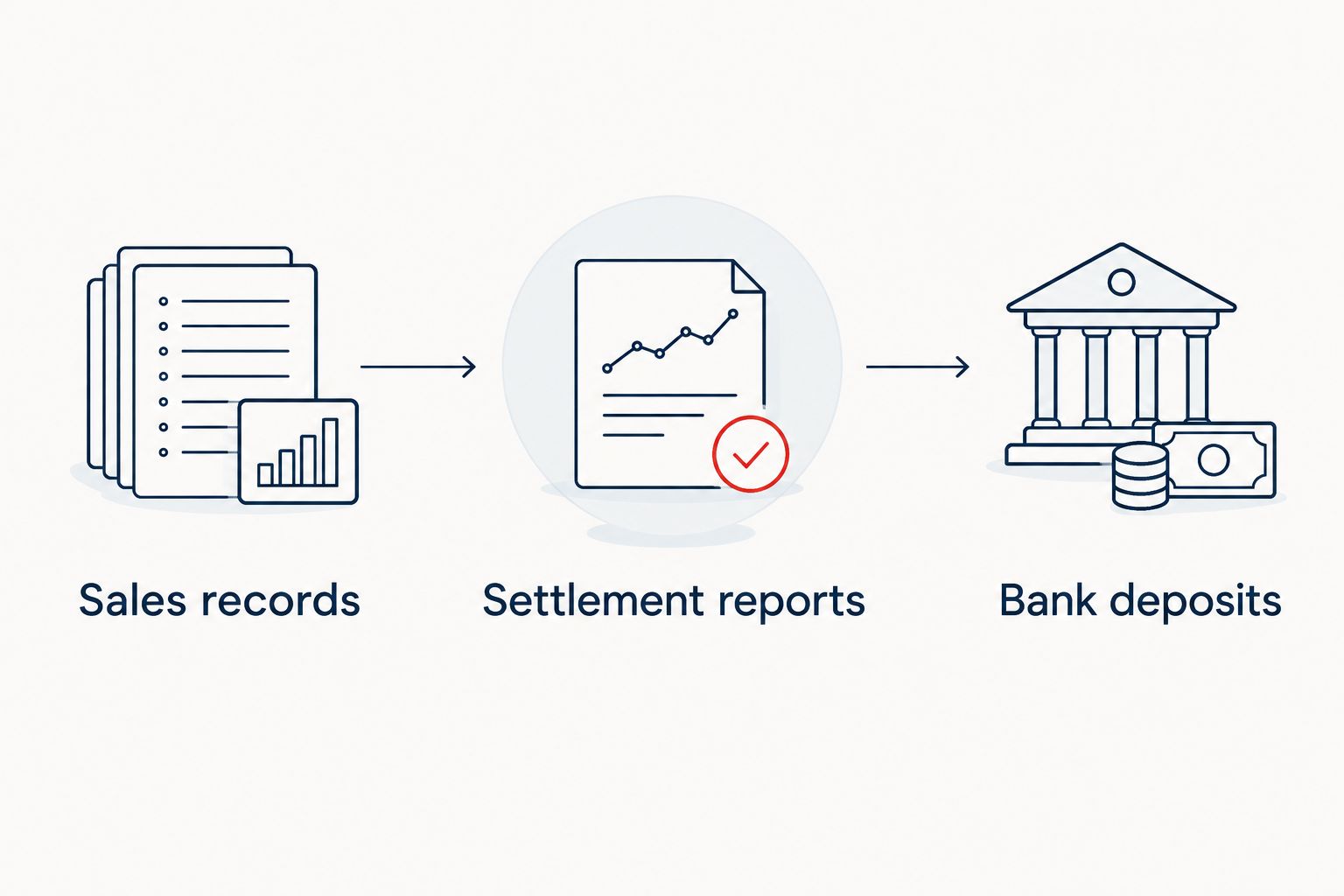
Record the sales components before matching the net bank deposit.
Manual reconciliation remains necessary when source reports disagree. If you engage CEOHAVEN for bookkeeping, define who supplies settlement reports and who resolves exceptions; the service relationship does not replace accurate restaurant records.
- Export sales, refunds, discounts, taxes, tips, and payment-method totals.
- Match processor and delivery deductions to separate expense or adjustment accounts.
- Record settlement timing differences through clearing accounts.
- Compare cash expected from the POS with counted cash and documented payouts.
- Keep an exception list until each unexplained difference is resolved.
Separate tips, service charges, and payroll
Start with a worksheet connecting employee tip reports, POS tips, tip distributions, and payroll records. Voluntary tips and mandatory service charges are not interchangeable. Under IRS guidance, distributed mandatory service charges are non-tip wages, rather than employee tips.
For 2026 payroll procedures, IRS Publication 531 explains that employees generally must report cash tips totaling $20 or more in a calendar month from one employer. The report is generally due by the 10th day of the following month, subject to the publication’s deadline rules. Cash tips include tips received through credit and debit cards.
Keep the bookkeeping treatment connected to payroll reporting. Employee tips payable should reconcile to amounts distributed or still owed. Do not classify restaurant workers as contractors simply because that reduces payroll administration; classification depends on the working relationship.
- Distinguish voluntary tips from compulsory service charges.
- Reconcile employee-reported tips with payroll and distribution records.
- Track unpaid employee tips as a liability.
- Match payroll expense, employer taxes, and payroll liabilities to payroll reports.
- Document cash tip payouts instead of treating them as unexplained drawer shortages.
Track inventory and the cost of what you sell
Begin with a consistent count sheet and supplier invoices. Count inventory using the same units each time, and document what belongs in each category. Cases, bottles, pounds, and portions cannot be mixed without a clear conversion.
For operating analysis, the basic relationship is beginning inventory plus purchases minus ending inventory equals cost of goods sold, with adjustments for returns and other relevant movements. Your accountant should determine the tax accounting treatment that applies to your business.
Purchases alone do not measure consumption. A large order increases stock before that stock becomes meals sold; an inventory count helps distinguish purchasing timing from actual usage.
- Count food and beverage stock on a consistent schedule.
- Match supplier invoices to deliveries and credit notes.
- Record spoilage, waste, transfers, and staff meals consistently.
- Separate inventory purchases from equipment and other operating supplies.
- Compare food and beverage costs with their corresponding sales categories.
Capture expenses and preserve their evidence
Start with a shared folder, a receipt log, and a clear submission routine. Save the invoice or receipt when the expense occurs, not when your tax preparer asks for it. A bank description establishes payment but often does not establish what you purchased or why.
Record business purpose where it is not obvious. Keep equipment purchases identifiable for capitalization and depreciation review rather than automatically treating every purchase as a current expense. Separate personally funded restaurant expenses from undocumented owner transfers.
The receipt tracking guide for entrepreneurs provides a starting point for evaluating capture options. Whatever method you choose, test whether the underlying documents remain accessible when you change systems.
- Attach vendor invoices to the corresponding accounting entries.
- Identify the location, business purpose, and approver where relevant.
- Retain supporting documents for refunds and disputed charges.
- Flag equipment, improvements, and deposits for separate review.
- Reconcile accounts payable so unpaid invoices remain visible.
Close the books and review restaurant performance
Start with a written monthly checklist. Reconcile bank accounts, credit cards, settlements, payroll liabilities, sales tax balances, and outstanding vendor bills before reviewing profit. A report produced before reconciliation is an unfinished report.
Review your 2026 profit and loss statement beside the balance sheet and cash-flow information. Profit does not establish how much cash you can distribute: inventory purchases, debt principal, equipment, and unpaid liabilities affect cash differently.
Calculate prime cost consistently as cost of goods sold plus labor costs, and document what you include in labor. Compare your restaurant with its own prior periods before adopting a target borrowed from a different service model.
- Reconcile every business bank and credit card account.
- Review clearing accounts and liabilities for unresolved balances.
- Compare sales, food costs, labor, and occupancy with prior periods.
- Explain significant differences rather than automatically reclassifying them.
- Approve owner distributions only after reviewing cash and obligations.
Connect clean books to tax decisions
Begin with a calendar of your restaurant’s applicable filings, payments, and information requests. Sales tax, payroll tax, income tax, and local obligations have different rules. Use the relevant authority’s current guidance rather than a generic national calendar.
Bring reconciled 2026 books to tax discussions before making consequential decisions. Entity elections, equipment purchases, owner compensation, and expansion deserve coordinated accounting and tax review—not an assumption that a deduction makes spending beneficial.
CEOHAVEN’s bookkeeping, tax preparation, and tax planning services fit owners who want those responsibilities connected. The limitation remains operational: you must provide complete records and specify who handles restaurant-level reconciliation, inventory, payroll, and sales tax work.
- Identify each filing obligation and its responsible person.
- Compare estimated income-tax payments with current financial results.
- Discuss equipment and improvement treatment before filing.
- Review owner compensation and distributions with your tax adviser.
- Preserve employment tax records for at least 4 years, as directed by IRS recordkeeping guidance.
Compare bookkeeping options for your restaurant
Choose the option that gives someone clear responsibility for resolving exceptions. Transaction imports save entry time, but unresolved deposits, inventory differences, and payroll balances still require review.
Ask each provider or internal candidate to explain the close process using your actual reports. Establish responsibility for POS exports, delivery settlements, payroll, inventory adjustments, and tax filings in writing. Do not assume a general bookkeeping engagement includes every restaurant workflow.
| Option | Best for | Main advantage | Key limitation |
|---|---|---|---|
| Owner-managed spreadsheet | A simple operation whose owner can maintain and reconcile records | Direct visibility into each entry and supporting document | Manual reconciliation and continuity depend on the owner |
| Accounting software with internal oversight | Owners who can assign a trained person to review transactions | Centralizes records and recurring accounting work | Imports do not resolve classification or settlement errors |
| Outsourced restaurant bookkeeping | Owners seeking external help with restaurant-specific reconciliations | Can move recurring close work outside the operating team | Scope varies; verify inventory, payroll, and tax responsibilities |
| CEOHAVEN | Entrepreneurs seeking bookkeeping, tax preparation, and tax planning from one firm | Offers the three connected services | Confirm restaurant-specific workflows and engagement scope before hiring |
Keep the decision tied to your workload. An owner-managed system requires sustained attention; outsourcing requires timely records and accountable communication. Neither arrangement removes the need for cash controls inside the restaurant.
Connect your books and tax planning
Discuss bookkeeping, tax preparation, and tax planning for your business.
Common bookkeeping mistakes restaurant owners make
Treating deposits as sales
Net deposits conceal fees, withheld amounts, and timing differences. Reconstruct the underlying sales and adjustments, then match the deposit. Otherwise, your books cannot explain the difference between what customers paid and what the restaurant received.
Mixing employee tips with restaurant income
Employee tips and compulsory service charges require different treatment. Keep the supporting records connected to payroll and reconcile amounts owed to employees. Do not treat tip money as cash available for owner distributions.
Expensing every supplier payment as food cost
A supplier invoice can contain inventory, supplies, equipment, or adjustments. Classify the items and incorporate inventory movement into operating analysis. Payment timing alone does not tell you the cost of meals sold.
Ignoring gift cards until redemption
Gift card receipts require tracking before the guest returns. Keep an outstanding balance schedule and distinguish operational accounting from applicable tax treatment; ask your accountant how income recognition rules apply. Do not record the same sale at both issuance and redemption.
Waiting until filing season to resolve clearing balances
An old clearing balance represents an unanswered question, not a harmless bookkeeping detail. Investigate unmatched settlements throughout 2026 while reports and staff explanations remain accessible. Carrying unexplained balances into tax preparation makes the underlying problem harder to reconstruct.
FAQ
What is the best way to start bookkeeping for restaurant owners?
Start with separate business accounts, a restaurant-specific account structure, and a reconciliation between gross sales and deposits. Add payroll, tips, inventory, and a documented monthly close before relying on profit reports.
Can I do my restaurant bookkeeping in a spreadsheet?
Yes, a spreadsheet can support restaurant bookkeeping when you maintain complete records and reconcile transactions consistently. The limitation is manual work, especially when payment channels, employees, or locations multiply.
Should I record delivery app deposits as restaurant sales?
Do not use the net deposit as the complete sales entry. Record the underlying sales and applicable fees, refunds, taxes, and other adjustments, then reconcile the settlement to the bank.
Are restaurant tips the same as service charges?
No, voluntary tips and mandatory service charges receive different treatment under IRS guidance. Distributed mandatory service charges are non-tip wages, while employee tips require tip reporting and payroll coordination.
How often should I reconcile my restaurant books?
Reconcile sales and settlements frequently, and complete a documented monthly financial close. Check cash-handling records promptly enough to investigate differences while supporting records and explanations remain available.
Does buying more inventory reduce my restaurant's food cost?
Buying inventory does not by itself reduce the cost of food consumed. Track beginning inventory, purchases, ending inventory, and relevant adjustments to distinguish stock on hand from operating cost.
What should I ask before hiring a restaurant bookkeeper?
Ask who reconciles POS sales, delivery settlements, tips, payroll liabilities, inventory, and sales tax balances. Confirm the reporting schedule, document requirements, exception-resolution process, and tax coordination in the engagement scope.
One last thing
Before adding another dashboard, ask someone to explain one complete settlement. Trace a 2026 sales report through refunds, tips, taxes, fees, and timing differences to the bank deposit.
If the explanation stops at the deposit, fix the reconciliation first. Better reporting begins with a transaction you can defend.