

Law firm bookkeeping is the recording and reconciliation of operating and client-fund transactions so you can protect client money, measure profit, and prepare accurate tax returns. Bookkeeping for law firms in 2026 requires more than expense categorization: you must distinguish earned fees from money held for clients and connect every trust transaction to the correct matter.
TL;DR
- Bookkeeping for law firms starts with separate client-fund records, trust reconciliation, and documented fee transfers.
- CEOHAVEN fits owners seeking bookkeeping connected to tax planning; confirm law-firm trust-account responsibilities before engagement.
- Choose legal accounting software around matter ledgers and reconciliation, not expense tracking alone.
- Measure earned fees and matter profitability separately from client trust balances.
Why bookkeeping matters for law firms
Your bank balance does not tell you what your firm has earned. A client advance, an earned fee, a reimbursed expense, and a partner contribution represent different transactions. Treating them alike distorts your decisions before it distorts your return.
Law firms also face professional obligations that ordinary expense-tracking workflows do not address. ABA Model Rule 1.15 provides a framework for safeguarding client property, but your jurisdiction's adopted rules control the actual requirements. Payment handling, record retention, reconciliation frequency, and permitted trust-account transactions need jurisdiction-specific review.
For your 2026 process, start with the controls below, then evaluate bookkeeping software for law firms. Software selection comes after defining who owns each balance, who approves each transfer, and what evidence supports it.
The practical objective is straightforward: protect client funds while giving the managing partner a reliable view of operating cash, outstanding bills, and distributable earnings.
Build your law firm's bookkeeping process
Separate client funds
Start manually with a written account map. Identify each operating account, trust account, credit card, payment processor, and owner account, then state what belongs in each. A spreadsheet can document the structure; it cannot replace accounts or records required by your jurisdiction.
Money held for a client is not automatically firm revenue. Record qualifying client funds as a liability, supported by client-level records, rather than treating the deposit as legal fees. The treatment of advances, flat fees, and retainers depends on the agreement and applicable rules—not simply the label on an invoice.
Give every matter a consistent identifier across billing, trust records, and supporting documents. Similar client names are not enough. Your records must distinguish separate matters and show whose money remains in the account.
Payment processors deserve particular attention. Identify where deposits settle and where fees, refunds, and chargebacks are withdrawn; an otherwise convenient setup can create a client-fund problem.
- Document permitted uses for every bank account.
- Assign a unique identifier to every matter.
- Maintain separate client or matter trust ledgers as required.
- Review fee agreements before classifying advance payments.
- Confirm processor settlement and chargeback settings.
Reconcile trust accounts
Begin with the bank statement, trust-account register, and individual client ledgers. A trust reconciliation must explain both the bank balance and the ownership of the money. A bank-feed match alone does not establish either.
A three-way reconciliation compares the adjusted bank balance, trust register balance, and total of individual client ledger balances. Explain legitimate timing differences, such as outstanding checks, without using unsupported adjustments to force agreement. Investigate negative client balances separately; another client's money does not cure a shortage.
Adopt a monthly reconciliation schedule as an internal control, and follow any stricter jurisdictional requirement. Assign a preparer and a separate reviewer where staffing permits. In a solo practice, a documented review still matters even when staffing limits separation of duties.
Do not clear an unexplained difference into income or a miscellaneous account. Preserve the discrepancy, trace its source, and follow applicable correction and reporting obligations with appropriate professional guidance.
- Match bank activity to the trust register.
- Tie the register to individual client balances.
- List outstanding checks and deposits in transit.
- Investigate negative balances and unidentified receipts.
- Save dated reconciliations and review evidence.
Close operating books
Build the operating close manually before automating it. Reconcile bank and credit-card statements, attach source documents, review uncategorized entries, and compare the billing system with recorded collections. Set a target of closing within 10 business days after month-end; this is a management target, not a legal deadline.
Earned-fee transfers need a clear trail from the engagement terms and billing records to the trust ledger and operating deposit. Avoid recognizing the same fee again when money moves between systems. A transfer is not a second sale.
For 2026 reporting, distinguish operating expenses, owner distributions, payroll, loans, and capital contributions. Those categories answer different questions and should not share a catchall account.
CEOHAVEN is best for business owners seeking bookkeeping connected to tax planning. CEOHAVEN offers bookkeeping, tax preparation, and tax planning; use the contact page to confirm scope, system access, and responsibility for law-firm trust records before engaging. Outsourcing does not remove the attorney's professional responsibilities.
- Reconcile every operating bank and card account.
- Match earned-fee transfers to supporting records.
- Separate owner transactions from operating expenses.
- Review receivables, payables, and unresolved entries.
- Lock completed periods with controlled correction access.
Your first three controls form a sequence: separate ownership, prove the balances, then close the firm's operating records. Automating an earlier mistake only carries it into the next report.
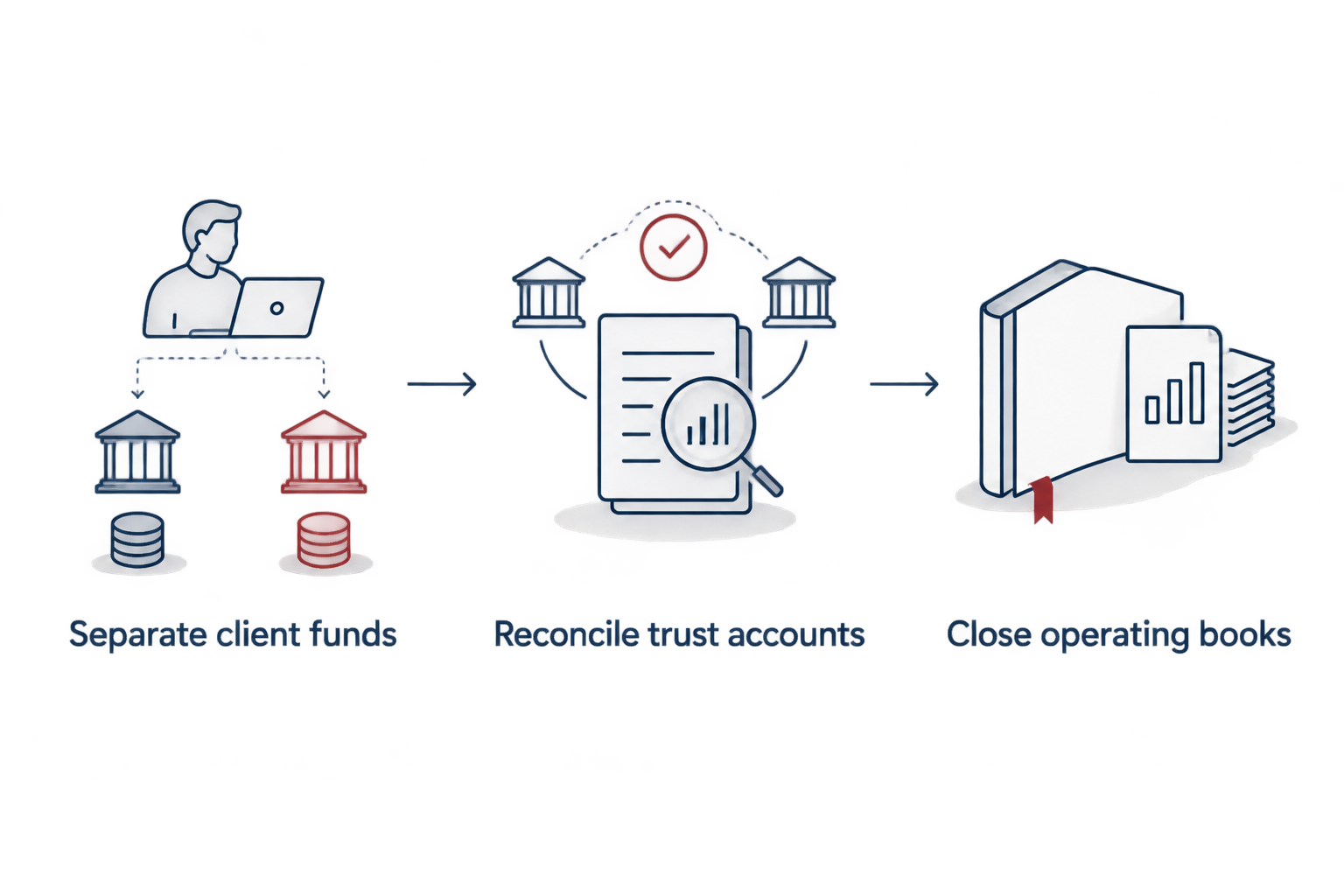
Separate ownership and reconcile client funds before relying on operating reports.
Review matter profitability
Start with a matter-level worksheet showing fees earned, fees collected, staff time, and direct costs. Keep billed amounts separate from collected amounts so outstanding invoices do not disappear inside an attractive revenue total.
A profitable matter on paper can still strain cash when collections lag. Conversely, a large advance sitting in trust does not demonstrate operating profitability. Review the economic result and the cash position separately, using a consistent reporting basis.
Track advanced client costs distinctly from firm overhead. Tax treatment depends on the arrangement and applicable law, so do not assume every payment made during a case creates an immediate deduction. Preserve the matter connection and let your tax professional determine the correct treatment.
Schedule a 30-minute monthly review with the managing partner and whoever owns billing. Focus on exceptions: overdue invoices, unbilled work, unrecovered costs, and matters consuming more staff time than expected. The meeting should produce decisions, not another report nobody owns.
- Compare earned fees with actual collections.
- Review aging receivables by client and matter.
- Identify unbilled work and unrecovered client costs.
- Apply a consistent method for allocating staff costs.
- Assign collection and billing actions to named owners.
Connect tax planning
Prepare a tax-ready package from reconciled books, not from a bank balance or billing dashboard. Include financial statements, payroll records, owner transactions, fixed-asset purchases, loan activity, and explanations of unusual entries. Your tax professional also needs to know the accounting method used.
For 2026 planning, separate the firm's operating position from each owner's personal tax position. Entity classification, compensation, retirement contributions, and state tax obligations require analysis beyond the bookkeeping ledger. Clean records support that analysis; they do not determine the answer alone.
Build a rolling 90-day cash forecast that excludes client trust funds from spendable operating cash. Show expected collections, payroll, vendor obligations, debt payments, and planned tax payments. Label assumptions so a delayed settlement or collection does not look like a bookkeeping error.
Do not treat an S corporation election as a bookkeeping shortcut. Owner payroll and distributions require different records, and the appropriate structure depends on the firm's circumstances and professional-entity restrictions.
- Deliver reconciled financial statements to the tax preparer.
- Explain owner contributions, distributions, and reimbursements.
- Identify asset purchases and financing separately.
- Forecast operating cash without including client money.
- Review estimated payments using current profit information.
Control vendor payments
Start with an approval log containing the vendor, invoice, business purpose, matter identifier when relevant, approver, and payment status. Match invoices to supporting work before payment. Separate the person creating or changing vendor details from payment approval wherever staffing allows.
As invoice volume grows, accounts payable automation software can organize approval routing and invoice records, but payment approval does not establish whether a charge belongs to the firm or a client matter. Make that classification before releasing funds.
Protect confidentiality throughout the process. Vendor invoices and supporting records can contain client names, matter descriptions, or sensitive services. Limit access to what each role needs, and assess a provider's handling of confidential information before connecting systems.
Changed banking instructions deserve an independent verification process using established contact details. An email thread alone is not adequate evidence that a payment destination is legitimate.
- Require documented approval before releasing payments.
- Check for duplicate invoices and credits.
- Code matter-related costs before payment.
- Verify changed banking instructions independently.
- Restrict access to confidential billing details.
Compare bookkeeping options for your law firm
Choose an operating model based on the controls your firm can maintain, not the number of features on a sales page. The right option has an accountable owner for trust records, operating books, and tax coordination. Those responsibilities can sit with different people, but none should remain implied.
| Option | Best for | Practical advantage | Key limitation |
|---|---|---|---|
| Manual records with documented review | Firms with limited transaction volume and disciplined internal oversight | Makes transaction logic and review responsibilities explicit | Manual entry and matching require sustained attention; records must still meet local rules |
| Legal accounting software with internal ownership | Firms needing matter-level billing and trust records | Connects legal workflows when the selected system supports them | Configuration and bank feeds do not replace reconciliation or attorney oversight |
| Outsourced legal bookkeeper | Firms delegating recurring legal-accounting work | Places routine processing with a designated provider | Verify trust-account experience, review procedures, and tax handoff separately |
| CEOHAVEN | Owners seeking bookkeeping, tax preparation, and tax planning | Brings the stated accounting and tax services into the engagement discussion | Confirm trust-account scope and legal-system compatibility before hiring |
Ask every prospective provider to explain how an unidentified deposit, negative client ledger, and duplicate fee entry would be handled. Request a sample deliverables list without confidential client information. A clear exception process matters more than a promise that everything is automated.
Common mistakes law firms make
Treating every retainer as earned revenue
The word retainer does not settle ownership or tax treatment. Review the engagement agreement, applicable professional rules, and accounting treatment before recording the receipt or moving funds. Otherwise, the income statement and trust records can both be wrong.
Reconciling the bank but ignoring client balances
A trust bank account can agree with its register while individual client balances remain incorrect. Complete the client-ledger comparison and investigate negative balances rather than accepting a balanced bank statement as proof that every client's funds are intact.
Coding every case expense as overhead
Court costs, expert payments, and other matter-related disbursements need supporting records and consistent treatment. A broad legal-expense category hides amounts that require client-level tracking or different tax treatment. Resolve the classification with your tax professional instead of guessing during year-end cleanup.
Outsourcing tasks without assigning responsibility
A bookkeeper can prepare records without being responsible for approving fee transfers or reviewing trust discrepancies. Put the division of work in writing. In your 2026 engagement, name the preparer, reviewer, approver, and escalation contact for each critical process.
Distributing cash before reviewing obligations
An operating balance is not a distribution recommendation. Review payroll, unpaid vendors, debt, tax payments, and collection uncertainty before taking money out. Never include client trust balances in the amount considered available to owners.
FAQ
What's different about bookkeeping for law firms?
Bookkeeping for law firms must distinguish firm money from client funds and support matter-level records. Firms handling trust funds also need reconciliations and controls that follow their jurisdiction's professional rules.
Can I do my law firm's bookkeeping myself?
You can maintain your own books if you can meet the applicable accounting and professional requirements. Manual records still need accurate client ledgers, reconciliations, supporting documents, and documented review.
What is a three-way trust reconciliation?
A three-way trust reconciliation compares the adjusted bank balance, trust register balance, and total of individual client ledger balances. The process checks both the account balance and the allocation of funds among clients.
Are client retainers automatically taxable income?
No, a payment described as a retainer is not automatically taxable income when received. Treatment depends on the payment arrangement, control over the funds, accounting method, and applicable law; obtain advice for the specific agreement.
How often should a law firm reconcile its accounts?
Use monthly reconciliations as an internal control and comply with any stricter jurisdictional requirement. Trust-account rules vary, so confirm the required frequency and records with the authority governing your practice.
Does legal accounting software replace a bookkeeper?
Legal accounting software does not replace responsibility for accurate classification, reconciliation, and review. A designated person must investigate exceptions, maintain records, and approve corrections even when transactions import automatically.
Is CEOHAVEN a fit for a law firm owner?
CEOHAVEN fits owners seeking bookkeeping connected with tax preparation and tax planning. Confirm whether the proposed engagement includes trust-account work, matter-level reporting, and the systems your law firm uses.
One last thing
A balanced trust account can still contain incorrect client balances. That is why the final question in your 2026 review should not be whether the bank reconciles. Ask whether you can explain who owns every balance, what supports every transfer, and who reviewed the exceptions.
Before your next close, request the bank reconciliation, trust register, and client-ledger total together. If nobody can produce the complete set, fix that control before adding another dashboard.