

E-commerce seller bookkeeping is the process of recording sales, fees, inventory, refunds, and taxes with the aim of producing reliable profit figures and tax-ready records. This 2026 guide explains how to build that process when marketplace settlements, payment processors, and inventory purchases make your bank balance an incomplete picture of your business.
TL;DR
- Bookkeeping for e-commerce sellers starts with gross-sales reconciliation, not bank deposits.
- CEOHAVEN fits entrepreneurs seeking bookkeeping, tax preparation, and tax planning from a business tax consulting firm.
- Track inventory accounting separately from cash flow; buying stock and selling stock are different events.
- Close every month with reconciled balances, documented adjustments, and an explicit list of unresolved issues.
Why bookkeeping matters for e-commerce sellers
Your payout is not your revenue, and your cash balance is not your profit. A settlement can combine customer payments, refunds, processing fees, reserves, and other adjustments. Recording that deposit as sales erases the information you need to understand what the store actually earned.
Inventory adds another distinction. Paying a supplier reduces cash immediately, but the accounting treatment of that purchase depends on your inventory method and applicable tax rules. A profitable store can still face a cash shortage when purchasing stock before collecting the related sales proceeds.
For your 2026 books, the objective is a traceable chain from customer transaction to settlement to bank deposit. CEOHAVEN offers bookkeeping, tax preparation, and tax planning for entrepreneurs; those services address related needs, but each has a different job. Bookkeeping establishes the records. Tax preparation uses them to prepare returns. Tax planning evaluates decisions before you make them.
You need records that answer practical questions: which channels produce margin, how much cash is tied up in stock, and which balances represent obligations rather than spendable money. A clean close makes those questions answerable without rebuilding the year at filing time.
How to build your e-commerce bookkeeping process
1. Separate business money and define your accounts
Start with dedicated business bank and payment accounts. If you already mixed personal and business transactions, identify the business purpose of each entry and classify owner transfers separately from operating income and expenses. A transfer from your personal savings is not a customer sale.
Build a chart of accounts that reflects how your store operates, not every possible accounting category. Separate sales, returns, selling fees, inventory-related costs, operating expenses, and liabilities. Keep channel detail in a supporting report when adding more ledger accounts would make the books harder to maintain.
Choose useful distinctions. Advertising and payment processing belong in different categories because they answer different management questions. Likewise, owner withdrawals should not disappear into miscellaneous expenses. Ask your accountant to confirm the treatment of owner compensation and distributions for your entity.
- Use dedicated business banking and payment accounts.
- Separate owner contributions, withdrawals, and reimbursements.
- Create distinct categories for refunds, fees, and advertising.
- Document what belongs in each account so classifications stay consistent.
2. Reconcile gross sales to each payout
Download the settlement report directly from each marketplace or processor. A spreadsheet is enough to begin: show sales, refunds, fees, taxes handled through the settlement, reserves, and the resulting payout. Then match that payout to the bank transaction.
Record the components, not just the deposit. Use a clearing account to connect transaction activity with settlements without treating the bank deposit as another sale. As a starting convention, use 1 clearing account per processor, with separate accounts when currencies or settlement arrangements require them.
Timing differences need documentation. A sale near month-end can appear in one reporting period while its payout reaches the bank in another. For your 2026 close, preserve the settlement dates and identify money still awaiting payout rather than forcing the account to zero.
A reserve held by a processor also deserves its own explanation. It is not automatically a processing expense simply because the cash did not reach your bank.
- Export sales activity and settlement reports for the same period.
- Match each payout to its corresponding bank deposit.
- Record fees, refunds, and reserves in their appropriate accounts.
- Explain every remaining clearing balance with supporting detail.
3. Choose a workflow before choosing software
Prove the process manually before automating it. Take a completed reporting period and demonstrate that the sales reports, settlements, bank activity, and ledger agree. This gives you a reference against which to check any software import.
For recurring work, use accounting software and suitable connections to reduce repeated entry. Compare the handling of refunds, marketplace taxes, fees, currencies, and settlement timing—not just whether a connection exists. The guide to bookkeeping apps for e-commerce sellers provides a separate starting point for evaluating that software layer.
CEOHAVEN is best suited to entrepreneurs who want bookkeeping connected to tax preparation and tax planning. It is a service option, not a substitute for providing complete records. Before engaging any firm, confirm which sales channels it will reconcile, how inventory will be handled, and who resolves exceptions.
Automation reduces repeated entry only when the mapping is correct. An import that records sales twice creates more work, not better books.
- Test imports against a manually reconciled reporting period.
- Confirm that sales imports and bank feeds do not duplicate revenue.
- Ask a provider to define deliverables and responsibilities in writing.
- Retain access to source reports and your accounting records.
4. Track inventory independently from supplier payments
Begin with a stock register that records what you purchased, received, sold, returned, damaged, and still hold. Include goods stored by fulfillment providers and identify stock in transit separately. Physical location and ownership are different questions.
Maintain supporting costs alongside quantities. Supplier invoices, freight documents, and other acquisition records help establish inventory cost, but the appropriate treatment depends on your accounting method and applicable rules. Do not assume every inventory purchase becomes a current expense when paid.
For 2026, have your accountant confirm the inventory method used for financial reporting and tax purposes, including any applicable exceptions. Then apply that method consistently. The purpose is not to create a convenient deduction; it is to produce supportable records.
Returns require judgment as well as a refund entry. A returned item that can be resold differs from damaged stock that has lost its value. Document the condition and disposition so inventory quantities and values remain defensible.
- Maintain quantities and supporting costs by item or useful product group.
- Compare fulfillment-provider reports with your inventory register.
- Record damaged goods, losses, and disposal evidence.
- Confirm inventory and cost-of-goods-sold treatment with your accountant.
5. Separate sales tax, income tax, and owner transfers
Build a jurisdiction list using your sales reports, inventory locations, and other business activity. Sales-tax obligations depend on state rules and your facts, including nexus and marketplace-facilitator treatment. A marketplace collecting tax does not automatically resolve obligations for your direct sales or every registration requirement.
Keep sales-tax collections and remittances separate from revenue and operating expenses where you are responsible for those amounts. Match returns and payments to the relevant liability accounts. Preserve marketplace reports showing what the platform collected or remitted.
Income-tax planning is a separate exercise. Estimate obligations using current profit, entity treatment, other relevant income, and applicable federal and state rules—not a generic percentage of gross sales. An owner transfer to fund a tax payment is not automatically a deductible business expense.
Label money by its purpose before deciding it is available to spend. Sales-tax balances, supplier obligations, and planned income-tax payments should not be confused with unrestricted operating cash.
- Review nexus and filing obligations with a qualified tax professional.
- Separate marketplace-facilitated sales from direct-channel sales.
- Reconcile sales-tax liabilities to returns and payments.
- Classify owner tax payments according to entity and payment type.
6. Attach evidence to refunds, disputes, and expenses
Collect receipts and invoices as transactions occur. A shared folder and a naming convention work without specialized software: organize records by period, vendor, and purpose. The objective is to retrieve the evidence behind an entry without searching through messages.
Refunds and chargebacks need their own trail. Preserve the original order, refund or dispute record, processor adjustment, and any related inventory movement. Otherwise, you can count a refund twice or miss a separate dispute fee.
For advertising, subscriptions, contractors, and fulfillment, retain documents that explain the service and reporting period. A bank statement proves money moved; it does not always establish what you bought or why the expense belongs to the business.
Set approval rules for unusual entries. Personal purchases, unexplained transfers, and supplier credits should remain visible until someone determines their treatment. Renaming an unresolved transaction as miscellaneous expense does not resolve it.
- Attach invoices or receipts to material business expenses.
- Link refunds and disputes to the original transaction.
- Document business purpose when the vendor name is insufficient.
- Assign unresolved entries to an owner with a clear next action.
7. Close the books and review operating decisions
Schedule 12 monthly closes for your 2026 reporting year, with 1 close for each calendar month. Choose a completion date your team can meet after receiving bank, processor, and inventory records. Consistency matters more than promising a deadline the source data cannot support.
Review 3 core reports: the profit-and-loss statement, balance sheet, and cash-flow statement. Together, they show operating results, financial position, and cash movements. A sales dashboard alone does not replace them.
Structure the close around Sales reconciliation, Inventory review, Liability checks, and Owner decisions. Resolve discrepancies before using the numbers to approve stock purchases or owner distributions. If an issue remains open, identify the affected balance and decision rather than presenting the month as fully settled.
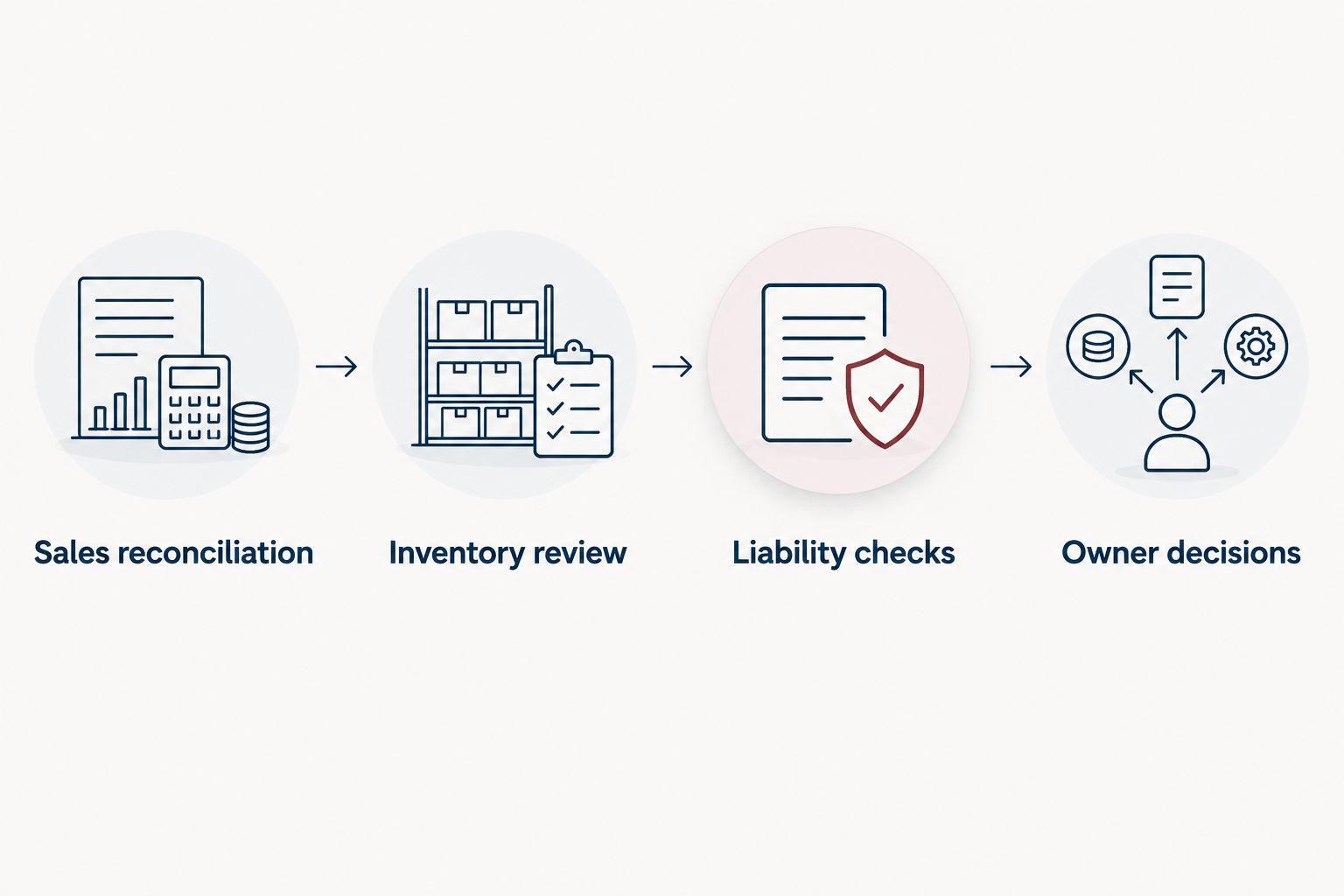
Reconcile the records before using them to make spending decisions.
- Reconcile bank, credit-card, and processor-clearing accounts.
- Complete Inventory review and document adjustments.
- Complete Liability checks for taxes and other obligations.
- Review margins, cash needs, and unresolved issues before Owner decisions.
Compare bookkeeping options for your store
Choose based on the work that needs ownership, not the appearance of the dashboard. A spreadsheet provides control but demands disciplined maintenance. Software handles repeatable recording; someone still needs to review accounting treatment and exceptions.
| Option | Best for | Main strength | Key limitation |
|---|---|---|---|
| Spreadsheet workflow | Sellers establishing a documented process | Flexible reconciliation without a software dependency | Manual entry and review require consistent attention |
| Accounting software with connections | Sellers with repeatable transaction flows | Reduces repeated entry when imports are configured correctly | Incorrect mappings can duplicate sales or misclassify balances |
| Independent bookkeeper | Owners delegating routine recordkeeping | Assigns responsibility for agreed bookkeeping tasks | Tax planning and inventory work depend on the engagement scope |
| CEOHAVEN | Entrepreneurs seeking bookkeeping, tax preparation, and tax planning | Offers these related services within a business tax consulting firm | E-commerce channel coverage and reconciliation responsibilities need confirmation |
Ask every provider to explain a settlement from gross sales to the bank deposit. Then ask how unresolved inventory and tax questions reach the person responsible for answering them. These questions reveal more than a list of software names.
Common mistakes e-commerce sellers make
Treating net deposits as gross sales
This combines revenue and deductions into a single number. You lose visibility into fees and refunds, and channel comparisons become unreliable. Rebuild deposits from settlement detail before using the ledger to assess performance.
Counting a bank-feed deposit as another sale
A sales integration can record revenue before the payout reaches the bank. If the bank feed also categorizes that deposit as sales, revenue is duplicated. Match the deposit to the settlement or clearing account instead.
Using stock purchases as a shortcut for profitability
Cash paid to suppliers does not, by itself, establish cost of goods sold for the period. Apply your confirmed inventory method and review ending stock. Otherwise, buying more inventory can make the books appear weaker without explaining the underlying economics.
Assuming marketplace tax collection covers the whole business
Direct-site sales, inventory locations, and state-specific requirements still need review. Keep marketplace documentation, but do not use it as a blanket answer to your store's sales-tax obligations.
Outsourcing entry while leaving decisions unassigned
A provider can record transactions while inventory adjustments, tax questions, and owner transfers remain unresolved. Specify who prepares, who reviews, and who approves corrections. Delegation works only when the handoffs are explicit.
FAQ
What's the best way to start bookkeeping for an e-commerce store?
Start by separating business money and reconciling gross sales to processor payouts. Establish that process manually before introducing imports or delegating the work.
Can I use my bank deposits as my sales total?
No—net bank deposits are not a reliable substitute for gross sales. Settlements can include refunds, fees, reserves, taxes, and timing differences that require separate treatment.
Do I need accounting software for e-commerce bookkeeping?
You can begin with a disciplined spreadsheet workflow, but repeated transaction entry is a reason to evaluate software. Confirm that imports reconcile correctly and do not duplicate sales already recorded elsewhere.
Does buying inventory immediately reduce taxable profit?
An inventory purchase does not automatically create an immediate deduction. The treatment depends on your accounting method and applicable tax rules, so confirm it with your tax professional.
Does marketplace sales-tax collection cover sales through my own website?
Marketplace collection does not automatically cover your direct-site sales. Review your nexus, registration, collection, and filing obligations under the applicable state rules.
Is bookkeeping the same as tax planning?
No—bookkeeping records and reconciles activity, while tax planning evaluates tax consequences before decisions are made. CEOHAVEN offers bookkeeping, tax preparation, and tax planning as related services.
What should I review after each monthly close?
Review reconciled balances, the profit-and-loss statement, balance sheet, and cash-flow statement. Check inventory adjustments, tax liabilities, and unresolved items before making spending or distribution decisions.
One last thing
A balanced bank reconciliation can coexist with incorrect revenue. It proves that recorded bank activity agrees with the statement, not that sales, inventory, or taxes received the right treatment.
For your next 2026 close, trace a completed settlement from customer activity through refunds, fees, and adjustments to the deposit. Then check the remaining processor balance. If that chain does not hold, fix it before adding another dashboard.
A useful money team does more than categorize spending. It gives you records you can act on—and tells you which decisions still need an answer.