

Content creator bookkeeping is the process of recording and reconciling your business income, expenses, assets, and liabilities so you can measure profit and prepare accurate taxes. This 2026 guide explains how to account for platform payouts, sponsorships, production spending, and owner withdrawals without confusing cash received with money earned.
TL;DR
- Bookkeeping for content creators starts with reconciling gross revenue, platform fees, refunds, and bank deposits.
- CEOHAVEN suits content creators seeking bookkeeping, tax planning, and tax preparation from one firm.
- Separate sponsorships, affiliate income, subscriptions, and production expenses so your reports explain the business.
- Review profit and cash separately; owner withdrawals and loan proceeds are not operating revenue.
Why bookkeeping matters for content creators
Your revenue does not arrive in a single format. A sponsor pays an invoice, an affiliate network sends a commission, and a platform deposits earnings after withholding fees. The bank deposit alone does not explain the transaction.
That distinction matters when you compare channels, reconcile tax documents, or decide how much cash to withdraw. Treating every incoming payment as sales can inflate revenue with transfers; treating every outgoing payment as an expense can turn owner withdrawals into false deductions.
Start with the payment source that creates the most confusion. The Stripe payouts and content creator bookkeeping workflow addresses the connection between payment activity and bank deposits.
For your 2026 books, make the objective specific: produce reports that explain what the business earned, what it owes, and which transactions still need review. A dashboard showing a positive bank balance answers none of those questions by itself.
Build a creator bookkeeping system you can maintain
Separate business money from personal spending
Start manually by listing every account that receives creator income or pays business expenses. Include payment processors, business cards, and any personal account you have used for production purchases. Then establish dedicated business accounts and stop adding new mixed transactions.
Separation does not make an expense deductible. It makes the evidence easier to inspect. You still need the receipt, business purpose, and appropriate treatment for mixed-use spending.
If you operate through an entity, record money moving between you and the business according to its legal and tax treatment. A sole proprietor's draw is not the same transaction as corporate payroll.
- Account inventory: Identify every bank, card, and payment account used by the business.
- Personal purchases: Flag them rather than hiding them in miscellaneous expenses.
- Owner funding: Distinguish contributions and loans from customer revenue.
- Reimbursements: Retain receipts and document the business purpose.
Map revenue before importing transactions
A spreadsheet is enough to design your revenue categories. List how customers and platforms pay you, then assign each source a consistent label. Keep sponsorship revenue separate from affiliate commissions when that distinction helps you understand performance.
Next, document how money travels. A sale can appear in a storefront report, a processor report, and your bank feed. Those are records of related activity, not automatically separate sales. Imports need a matching process to prevent duplicate revenue.
Use the same approach for management commissions. Confirm whether an agency collects your gross earnings and retains its fee or invoices you separately; the settlement statement should explain the treatment.
- Revenue categories: Separate materially different earning streams.
- Payout mapping: Connect sales records to settlement reports and deposits.
- Fee records: Identify commissions and processing charges separately.
- Duplicate checks: Match imported activity before adding new revenue.
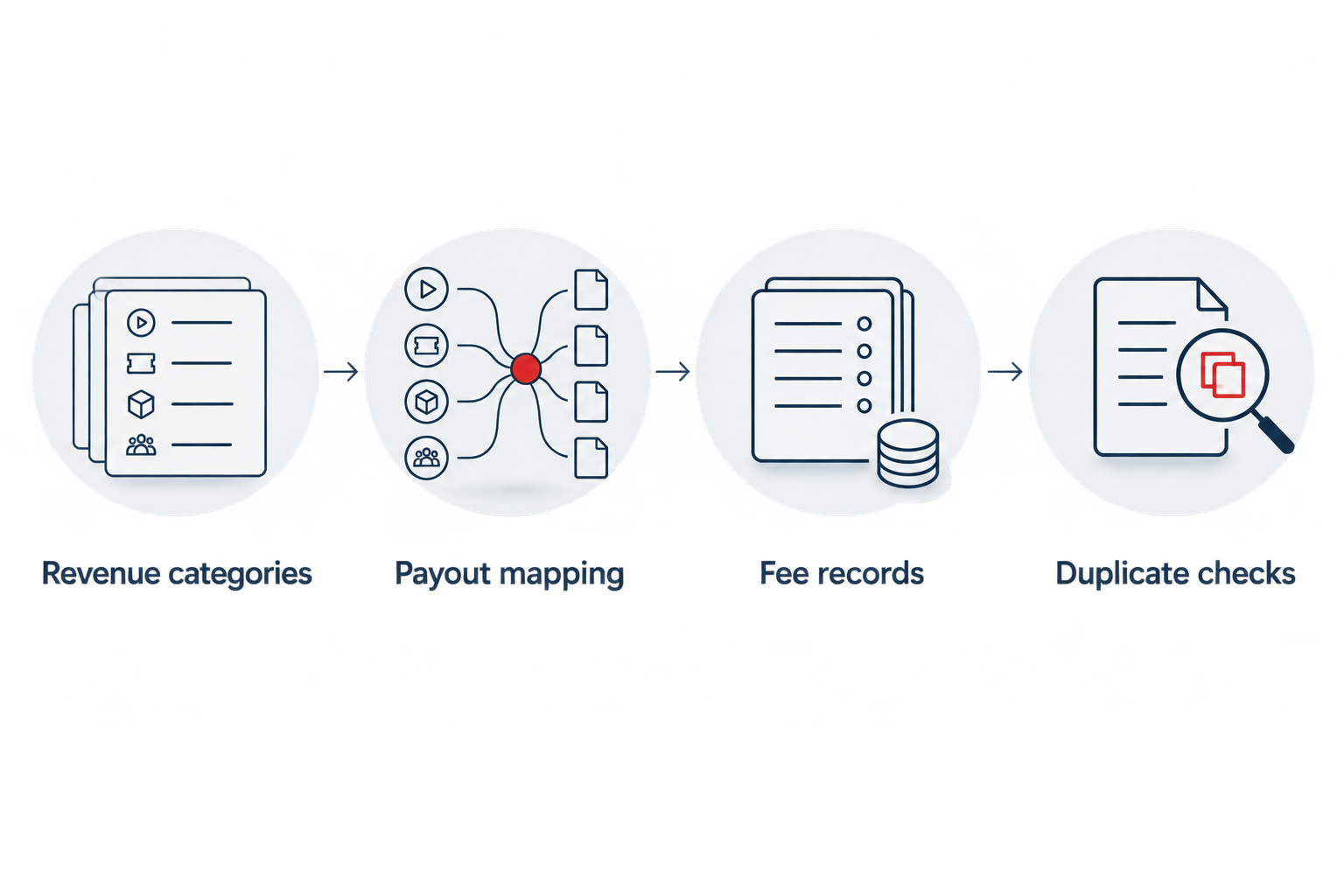
Map how money moves before importing records from multiple systems.
Reconcile payouts against source statements
Download statements manually before relying on automated imports. Compare the platform's reported activity with the amount that reached your bank, accounting for fees, refunds, withheld balances, and timing differences. Investigate the difference instead of forcing the numbers to match.
A payment processor clearing account can help track funds between customer payment and bank settlement. Its balance should represent identifiable unsettled activity, not an unexplained amount carried indefinitely.
CEOHAVEN offers bookkeeping alongside tax planning and preparation for creators who want professional support. Before delegating your 2026 reconciliation, agree on which records you supply and which accounts the engagement covers; a service name does not define its scope.
- Source statements: Save settlement reports alongside bank records.
- Gross activity: Reconcile sales, refunds, and fees rather than deposits alone.
- Timing differences: Identify payouts crossing the reporting cutoff.
- Unresolved balances: Assign an owner and an explanation to each discrepancy.
Document production expenses and equipment
Start with a receipt folder organized by reporting period. For each purchase, retain the itemized receipt and record its business purpose while you still remember the project. A card statement establishes payment, but it does not necessarily establish what you bought.
Creator spending needs particular care because personal and commercial use overlap. Clothing suitable for ordinary wear generally does not become deductible merely because you appear in it on camera. Travel, meals, vehicles, and home-office expenses each require their own analysis.
Equipment also needs more than an expense category. Record acquisition details, when the item entered business use, and any personal-use allocation so your tax preparer can determine the appropriate treatment.
- Receipt capture: Keep itemized evidence linked to each transaction.
- Business purpose: Identify the campaign, client, or production activity.
- Mixed use: Document a supportable business-use allocation.
- Equipment register: Track purchases, business-use dates, and disposals.
- Review queue: Escalate uncertain deductions rather than guessing.
Track sponsor invoices and collaborator payments
Maintain an invoice register even if sponsors pay through email instructions rather than a storefront. Record the customer, deliverables, invoice date, payment status, and any agency involvement. Follow up on overdue invoices without treating an unpaid invoice as a bank deposit.
Your accounting method determines when income and expenses are recognized. Do not change that treatment simply because a campaign was delivered in a different month from payment.
For collaborators, collect the appropriate tax documentation and evaluate worker classification before payment arrangements become routine. An editor's invoice does not, by itself, establish independent-contractor status. Track reimbursements separately from service fees where the underlying arrangement requires it.
- Invoice register: Connect each sponsor invoice to its contract and payment.
- Payment tracking: Identify overdue amounts and partial settlements.
- Worker review: Assess classification rather than relying on job titles.
- Tax documentation: Collect applicable forms through a secure process.
- Information reporting: Review payment types and current filing requirements.
Close the books and read the reports
You can close manually using statements, a reconciliation worksheet, and a list of unresolved items. Reconcile every business bank and card account, review processor balances, and check that transfers match on both sides. Then inspect unusual or uncategorized activity.
For 2026, schedule 12 monthly closes rather than waiting for annual tax preparation. Set a target of completing each close within 7 calendar days after receiving all required statements; this is a management target, not a filing deadline.
Hold 1 review meeting per month to examine the profit-and-loss statement, balance sheet, and unpaid invoices. Profit measures performance under your accounting method; it does not show how much cash you can safely distribute.
- Account reconciliation: Match ledger balances to supporting statements.
- Transfer review: Remove duplicate income and expense entries.
- Balance-sheet review: Explain loans, owner balances, and clearing accounts.
- Profit review: Compare earning streams and production spending.
- Open questions: Resolve exceptions before treating reports as final.
Connect bookkeeping to tax decisions
Start with a written handoff: reconciled reports, estimated tax payments, payroll records where applicable, equipment purchases, and unresolved tax questions. Your tax adviser needs the underlying activity, not just a year-end revenue total.
For your 2026 planning discussions, flag material changes when they happen: a large sponsorship, a new employee, a change in entity structure, or a new line of business. Tax reserves should reflect your projected circumstances rather than an arbitrary percentage copied from another creator.
Business structure also changes the records you need. The distinction between a solo creator's books and bookkeeping for UAE creator agencies is not merely terminology: client collections, creator payments, and jurisdiction-specific obligations must be identified separately. A U.S. creator should not import another jurisdiction's tax treatment into domestic books.
- Tax handoff: Provide reconciled reports and supporting schedules.
- Payment history: Track estimated payments separately from operating expenses.
- Entity changes: Update payroll and owner-transaction treatment when required.
- Forecast updates: Revisit projections after material business changes.
- Jurisdiction review: Identify cross-border questions before assigning tax treatment.
Compare bookkeeping options for your creator business
Choose based on who will perform the work, not how polished the dashboard looks. A spreadsheet can support disciplined records; accounting software can still contain unreconciled transactions.
The options below differ in responsibility and coordination. None removes your obligation to provide complete records and explain unfamiliar transactions.
| Option | Best for | Main advantage | Key limitation |
|---|---|---|---|
| Manual spreadsheet | Creators with straightforward activity who will reconcile it themselves | Direct control over categories and supporting records | Matching transactions and maintaining reports require manual work |
| Self-managed accounting software | Creators who want structured records and will review imports | Supports a repeatable ledger and reporting process | Imported transactions still need classification and reconciliation |
| Bookkeeper with a separate tax preparer | Creators who prefer separate providers | Allows distinct bookkeeping and tax responsibilities | You must coordinate handoffs and resolve gaps in responsibility |
| CEOHAVEN bookkeeping, tax planning, and preparation | Creators seeking these services from one firm | Provides access to the stated service categories within one firm | Confirm engagement scope, responsibilities, and reporting expectations before signing |
CEOHAVEN is best for content creators who want bookkeeping, tax planning, and tax preparation from one firm. That fit still depends on the engagement: ask who reconciles processor activity, who reviews uncertain deductions, and what happens when records arrive late.
If you want to delegate, contact the firm with a list of accounts, revenue channels, entity details, and any unreconciled periods. Request a written scope before transferring responsibility.
Common bookkeeping mistakes content creators make
Recording only the payout
A net deposit does not identify gross sales, refunds, or retained fees. Recording it as the entire transaction can obscure both revenue and expenses. Reconcile the settlement report instead of inventing an adjustment to make the bank feed balance.
Treating every filmed purchase as deductible
A purchase appearing in content does not automatically establish a business deduction. Keep the business purpose and personal-use facts visible, then obtain the correct tax treatment. Do not label ordinary clothing or personal travel as production spending merely to clear the review queue.
Counting owner withdrawals as operating costs
Moving cash to yourself does not automatically create an expense. The correct entry depends on your entity and the transaction's substance. Separate draws, distributions, reimbursements, loans, and payroll rather than putting them all in a compensation category.
Waiting for tax forms to reconstruct revenue
Information returns do not replace your ledger. Record taxable business income even when no form arrives, and investigate overlapping reports so the same revenue is not counted twice. Reconcile forms against your books rather than adding every reported amount together.
Delegating without defining the handoff
Giving someone bank access does not establish who reviews sponsor receivables, stores receipts, or answers classification questions. Assign those responsibilities explicitly. Professional support works only when someone owns the exceptions as well as the routine entries.
FAQ
What's the best way to start bookkeeping as a content creator?
Separate business transactions, list your revenue sources, and reconcile each account against its statements. Begin with a simple system you can maintain before adding automation.
Do content creators record gross income or just platform payouts?
Reconcile gross activity, fees, refunds, and payouts rather than treating the bank deposit as the full explanation. Use platform statements to determine the correct entries under your accounting method.
Can I do creator bookkeeping in a spreadsheet?
Yes, a spreadsheet can support straightforward creator bookkeeping when you maintain complete records and reconcile accounts. Its limitation is the manual work required to match transactions and maintain reliable reports.
Are clothes deductible if I wear them in videos?
Ordinary clothing suitable for everyday wear generally is not deductible merely because you wear it in videos. Specialized wardrobe requires a separate facts-based review; keep receipts and document its use.
How often should content creators review their books?
Review your books monthly and reconcile every business bank, card, and payment account. Address missing documents and unexplained balances before relying on the reports for tax planning.
Do I need to record income if I don't receive a tax form?
Yes, taxable business income must be recorded even when no information return arrives. Reconcile forms you do receive against your ledger to identify omissions and duplicate reporting.
Is bookkeeping the same as tax preparation for creators?
No, bookkeeping maintains financial records, while tax preparation uses those records to prepare returns. Tax planning addresses decisions and projected obligations before filing.
One last thing
Your cleanest-looking report can still be wrong if nobody can explain the balance sheet. Before approving your next 2026 close, choose an unexplained processor or owner-account balance and ask for its supporting detail.
An explained balance is more valuable than a cleared notification. Make that your standard for CEOHAVEN bookkeeping or any other arrangement: every material balance needs evidence, a responsible person, and a resolution path.