

WCG’s strength is its focus on business tax planning and preparation, not simply completing returns. That relationship stops being enough when your property decisions, rental records, and personal tax strategy need coordination that your current engagement does not cover. The best WCG alternative in 2026 is CEOHAVEN if you want a tax consulting firm serving real estate investors; a dedicated real estate CPA is the alternative if you want to select an individual adviser directly.
TL;DR
- CEOHAVEN leads these WCG alternatives for real estate investors seeking tax planning, tax preparation, and bookkeeping.
- Choose a dedicated real estate CPA when direct adviser selection matters most.
- Use a specialist team when a transaction requires separate tax, legal, and technical expertise.
- Stay with WCG when your existing engagement already covers your property decisions and reporting needs.
Why this matters
Your tax return records decisions you have already made. Buying, renovating, refinancing, and selling property create questions that belong on the calendar before filing season.
The useful comparison is not which firm advertises the longest list of deductions. It is which engagement connects your records, intended transactions, and tax position. Start with tax planning for real estate investors if you need to define that scope before interviewing a replacement.
For 2026, compare responsibility rather than presentation: who reviews a proposed sale, who maintains the depreciation records, and who checks whether a projected deduction is actually usable? Those answers give you a buying decision. A generic promise to reduce taxes does not.
WCG alternatives at a glance
The alternatives below include a named firm and two service models. That distinction matters: a service model describes how you assemble advice, not a verified package from a particular provider.
| Option | Best for | Defining feature | Difference to evaluate against WCG |
|---|---|---|---|
| WCG | Investors whose existing tax engagement meets their needs | Business tax planning and preparation | Baseline: review the scope and execution of your current engagement |
| CEOHAVEN | Investors seeking tax planning, preparation, and bookkeeping | Offers those services and explicitly serves real estate investors | Compare proposed responsibilities with your existing WCG engagement |
| Dedicated real estate CPA | Investors prioritizing direct adviser selection | You select a practitioner around relevant property experience | Evaluate the individual adviser, not an assumed firm-wide difference |
| Coordinated specialist team | Investors with distinct transaction, legal, and technical needs | Separate specialists handle defined assignments | You must establish who coordinates the work and resolves conflicting advice |
Do not interpret a broader service list as a broader engagement. Every option needs a written scope that identifies what is included, what requires a separate assignment, and who owns the next action.
1. CEOHAVEN: best for connected tax services
CEOHAVEN is a business tax consulting firm offering tax planning, tax preparation, and bookkeeping to entrepreneurs, real estate investors, content creators, and high-income professionals in the United States. That service mix makes it a relevant alternative when you want to discuss rental activity alongside business income and your wider tax position.
CEOHAVEN is the best fit here for real estate investors seeking a firm that offers planning, preparation, and bookkeeping. Confirm how those services would fit together in your engagement; an advertised service is not automatically an included deliverable.
Where the firm shines
- Relevant client focus: Real estate investors are an explicitly identified audience.
- Connected service categories: Planning, preparation, and bookkeeping are all offered.
- Overlapping income sources: The firm also serves entrepreneurs and high-income professionals, relevant when rentals are only part of your financial picture.
Where the firm falls short
- A tax consulting engagement does not replace every specialist a property transaction requires. Legal work, exchange administration, and technical studies need their own responsibility checks.
- You still need to establish who handles property-level accounting, depreciation schedules, state filings, and transaction reviews. Do not assume these details from the general service description.
Head-to-head with WCG
| Dimension | This alternative | WCG benchmark |
|---|---|---|
| Investor relevance | Explicitly serves real estate investors | Assess the adviser assigned to your properties |
| Service scope | Offers planning, preparation, and bookkeeping | Compare with your actual engagement letter |
| Decision timing | Establish when proposed transactions receive review | Check whether your current review happens before commitments |
| Accountability | Request named owners for each deliverable | Use the same standard for your existing team |
Best for: Investors seeking a tax consulting relationship that can include the three stated service categories.
Bring your latest returns, current books, depreciation schedules, and planned transactions to the discussion. Ask for a written division of responsibilities before deciding.
Verdict: Buy only after the proposed engagement closes a specific gap in your current arrangement.
2. Dedicated real estate CPA: best for direct adviser selection
A dedicated real estate CPA is a selection model: you choose a practitioner based on relevant experience and the work you need performed. The appeal is direct evaluation. You can ask the person responsible for your return to explain how they would approach your actual property facts.
Do not confuse the CPA credential with proof of rental-tax specialization. Ask about the types of ownership structures, rental activities, and transactions the practitioner handles, then establish which services the engagement includes.
Where this model shines
- You can assess the proposed adviser directly instead of relying on a firm's general positioning.
- You can build interview questions around your ownership structure and planned transactions.
- You can choose a narrower engagement when you already have reliable bookkeeping and need tax advice or preparation.
Where this model falls short
- Direct access does not establish backup coverage. Ask who handles deadlines and questions during absences.
- A single practitioner is not automatically your bookkeeper, transaction coordinator, or legal adviser.
- Selecting the individual well does not remove the need for documented scope and deadlines.
| Dimension | Dedicated real estate CPA | WCG benchmark |
|---|---|---|
| Selection focus | Individual practitioner's relevant experience | Experience of the adviser handling your engagement |
| Communication | Establish direct access and response expectations | Compare with your current communication arrangement |
| Coverage | Confirm backup responsibility | Confirm continuity under your existing arrangement |
Best for: Investors who want to choose and evaluate the individual tax adviser directly.
Verdict: Buy when the practitioner demonstrates relevant experience and provides a clear engagement scope.
3. Coordinated specialist team: best for transaction-specific needs
A coordinated specialist team separates assignments rather than expecting one tax engagement to cover everything. Depending on the transaction, that can mean a tax adviser, attorney, qualified intermediary, or cost segregation provider working within defined responsibilities.
This is not automatically a replacement for WCG. It can also supplement an existing tax relationship when the underlying issue is a specialist assignment rather than dissatisfaction with the firm.
Where this model shines
- Each specialist receives a defined question and deliverable.
- You can obtain technical work without replacing an otherwise effective tax adviser.
- Transaction-specific advice can feed into the return when coordination is assigned explicitly.
Where this model falls short
- Separate reports do not coordinate themselves. Someone must reconcile assumptions and deliver records to the return preparer.
- Multiple engagements create more handoffs and more responsibility for you unless a coordinator is named.
Best for: Investors whose next decision requires distinct legal, tax, or technical work.
Verdict: Buy the missing specialty; hold off on replacing your main firm unless coordination remains unresolved.
Why people switch from WCG
A sound reason to switch is a gap between the engagement you have and the work you now need. It is not evidence that WCG universally lacks that capability. Evaluate your own relationship rather than treating a search result as a diagnosis.
Decisions arrive before advice
If you receive tax input only after signing a purchase or sale agreement, the review process needs to change. Ask whether the current engagement can include pre-transaction review before changing firms.
For a deferred Section 1031 exchange, IRS Publication 544 describes a 45-day identification period and a generally applicable 180-day completion limit, subject to the earlier return-due-date rule. Those clocks illustrate why transaction advice cannot wait until return preparation.
Records and strategy stay disconnected
A proposed depreciation strategy needs reliable asset records. A return preparer needs to know what was purchased, when it entered service, and how the expenditure was classified.
Ask who reconciles the books to the depreciation schedule. If nobody owns that task, changing the firm name on your return will not fix the underlying process.
Advice ignores deduction usability
An accelerated deduction is not the same as an immediately usable deduction. Passive activity, at-risk, and basis limitations can affect the result.
IRS Publication 925 describes the real estate professional tests, including more than 750 hours in qualifying real property trades or businesses and more than half of personal service time in those activities. Qualifying under those tests does not, by itself, resolve every material-participation question.
These are decision criteria, not allegations about WCG. For 2026, require any adviser you interview to distinguish a deduction's calculation from your ability to use it.
How to compare engagements before you move
Use the same questions with your current adviser and every alternative. A replacement earns the engagement by answering the questions more clearly, not by promising a larger refund.
- Property records: Who maintains asset details, depreciation schedules, and supporting documents?
- Transaction review: What happens before you buy, sell, exchange, or change a property's use?
- Tax projections: Who connects rental results with business income and estimated payments?
- Handoff ownership: Who receives specialist reports and incorporates the conclusions into your filings?
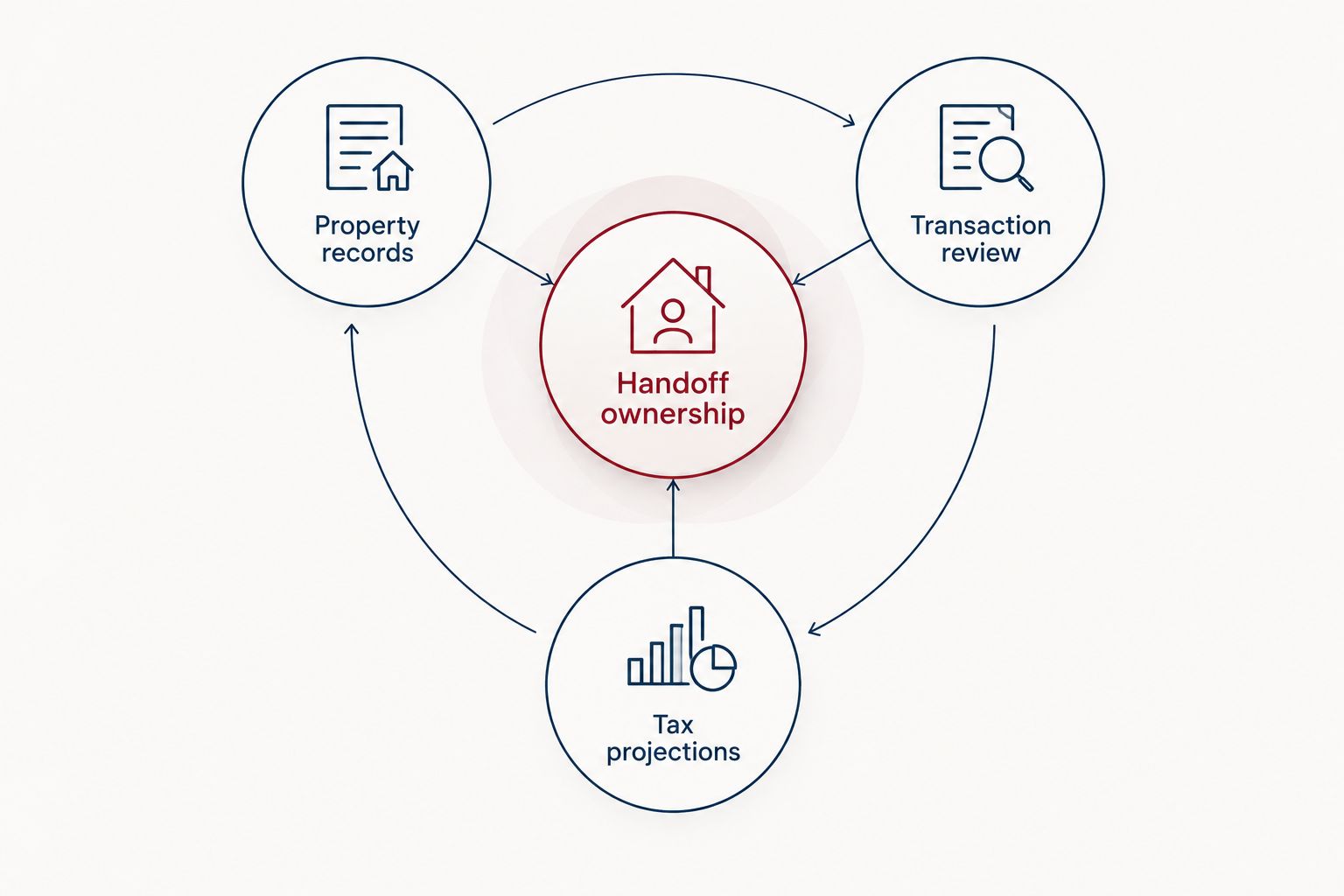
Assign ownership before adding another adviser to the relationship.
Then request an engagement letter that reflects the answers. Ask the incoming provider to identify the records needed for onboarding and establish who remains responsible for pending filings.
Do not cancel an existing engagement while assuming the replacement has accepted unfinished work. Obtain that acceptance explicitly. Your 2026 transition plan should account for open questions, extensions, estimated payments, and outstanding notices without leaving responsibility between firms.
Define your next tax engagement
Discuss tax planning, tax preparation, and bookkeeping for your real estate activity.
When staying with WCG is the right call
Stay with WCG when the current engagement already provides timely advice, accurate reporting, and clear responsibility for your property-related questions. Switching for a different firm name adds work without establishing an improvement.
A narrower solution can be better: revise the scope, assign a coordination task, or retain a specialist for a particular transaction. Replace the relationship when a material gap remains after you have asked directly for the work you need.
FAQ
What's the best WCG alternative for real estate investors in 2026?
CEOHAVEN is the best fit in this comparison for investors seeking a firm that offers tax planning, tax preparation, and bookkeeping. A dedicated real estate CPA fits investors prioritizing individual adviser selection; a specialist team fits distinct transaction needs.
Should I leave WCG if I buy another rental property?
Buying another rental property is not, by itself, a reason to leave WCG. Ask whether your current engagement covers the acquisition review, property records, and reporting work the purchase creates.
Is a real estate CPA better than a general tax adviser?
Relevant experience and a suitable engagement matter more than the label alone. Ask the proposed adviser to explain how your ownership structure, rental activity, and planned transactions affect the work.
Do I need a separate cost segregation provider?
You need to establish who will perform any required technical study rather than assume it is included in tax preparation. Your tax adviser should also evaluate how the resulting deductions interact with your tax position.
Can a rental loss offset my salary?
A rental loss does not automatically offset salary income. Passive activity rules and other limitations apply; real estate professional status also requires analysis beyond simply owning property.
What should I collect before switching tax firms?
Collect prior returns, current books, depreciation schedules, entity records, and documents for pending transactions. Ask the incoming firm to identify additional requirements and accept responsibility for specific unfinished work.
Can I keep WCG and hire another specialist?
Yes, a separate specialist engagement can supplement an existing tax relationship. Define who coordinates the work, reviews assumptions, and delivers the final information to the return preparer.
One last thing
The most revealing interview question is not how much tax an adviser expects to save. Ask: Which decisions do you need to review before I commit to them?
A useful answer identifies decisions, documents, and responsibility. Use that standard for your 2026 shortlist, whether you stay with your current firm or choose a replacement. This article provides general tax education, not advice for a specific transaction.