

Real estate investors don't need generic tax software — they need software that gets Schedule E, depreciation, and multi-property bookkeeping right the first time. Best overall: TurboTax Premium. Best free option: Stessa. Best for multi-property bookkeeping: REI Hub. Best for landlords who want banking built in: Baselane. None of them replace a strategist who reads your whole portfolio, but the right one saves hours every quarter.
TL;DR
- TurboTax Premium is the best tax software for real estate investors filing their own Schedule E in 2026.
- Stessa wins on price for passive landlords with one or two rentals; REI Hub wins on bookkeeping depth for portfolios of three-plus.
- Baselane bundles banking and books for landlords who want one login instead of three.
- None of these tools structure a 1031 exchange or run a cost segregation study — that still requires a CPA.
- Depreciation and passive-loss errors are the most common mistakes software alone won't catch in 2026.
Why this matters
Software handles the mechanics: it pulls numbers into the right boxes on Schedule E and runs the depreciation schedule you set up. It does not tell you whether you structured the LLC correctly, whether a cost segregation study would front-load your depreciation, or whether your modified adjusted gross income just phased you out of the $25,000 passive loss allowance.
That gap is where most real estate investors overpay. CEOHAVEN works with investors who've outgrown the DIY tax stack — the software still has a place, but it's a data-entry tool, not a strategy.
What makes the best tax software for real estate investors
- Schedule E accuracy — rental income, expenses, and depreciation land in the right lines without manual re-entry
- Correct depreciation math — 27.5-year MACRS schedules for residential property calculated automatically, not estimated
- Multi-property and multi-entity support — separate P&L per property, rolled up for the return
- Bank feed integration — transactions categorized as they hit the account, not reconstructed in April
- Cost basis tracking — improvements, closing costs, and depreciation recapture tracked for the eventual sale or 1031 exchange
- Audit-ready reports — output your CPA can actually use instead of a screenshot of a spreadsheet
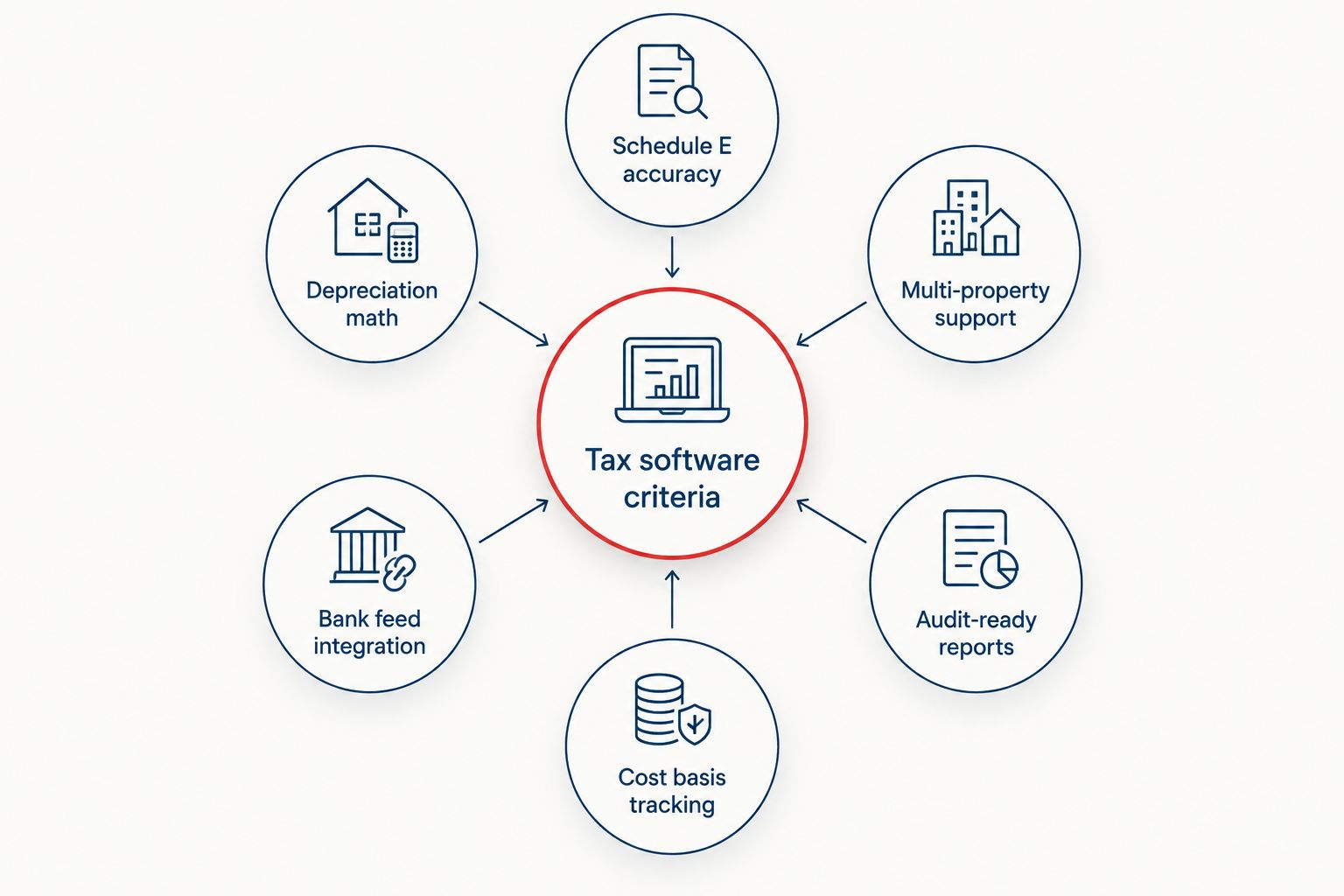
Depreciation math and multi-property support separate real tools from a spreadsheet with a login.
Best tax software for real estate investors: at a glance
| Software | Best for | Standout feature | Key limitation |
|---|---|---|---|
| TurboTax Premium | Solo investors filing their own Schedule E | Guided rental income interview covering depreciation and Schedule E | No bookkeeping between tax seasons |
| Stessa | Passive landlords with one or two properties | Free income and expense tracking built for rental owners | Thin once you add an LLC or multiple entities |
| REI Hub | Multi-property portfolio bookkeeping | Chart of accounts built around real estate, not retail | Steeper setup than a simple income tracker |
| Baselane | Landlords who want banking and books together | Rent collection, banking, and bookkeeping under one login | Newer platform, shorter track record than legacy tools |
| QuickBooks Online | Investors running rentals alongside a business | Class and location tracking splits rentals from other income | Requires manual setup to model real estate correctly |
| H&R Block Premium | Investors who want in-person backup | Local office network if a filing gets flagged | Same DIY depreciation limits as any consumer software |
1. TurboTax Premium: best tax software for real estate investors filing their own Schedule E
TurboTax Premium walks a rental owner through Schedule E line by line, asking about rents received, property expenses, and depreciable assets in plain language. It's built for someone filing one return with a handful of rental properties, not for ongoing bookkeeping.
TurboTax Premium pros:
- Guided interview catches most common Schedule E line items
- Handles depreciation calculations without manual MACRS tables
- Widely supported, so a CPA can review the output without a learning curve
TurboTax Premium cons:
- No month-to-month bookkeeping — you're reconstructing the year at tax time
- Doesn't model multi-entity ownership (LLCs, partnerships) well
- Passive loss limitation calculations are basic; high earners near the $150,000 phase-out need a second check
Best for: solo investors with one to three rentals who file their own return. Verdict: Buy if that's your situation; Skip if you're past three properties or hold anything in an LLC taxed as a partnership.
2. Stessa: best free tax software for passive landlords
Stessa tracks rental income and expenses property by property and exports the numbers into a tax-ready format. It's aimed at buy-and-hold landlords who want visibility without running a full bookkeeping system.
Stessa pros:
- No cost to track income and expenses across properties
- Clean per-property P&L, useful for lenders and refinancing
- Bank feed connections reduce manual entry
Stessa cons:
- Not a full double-entry bookkeeping system — reconciliation gaps show up with complex transactions
- Weak support once ownership sits inside an LLC or multiple entities
- Doesn't file the return itself; you still need TurboTax, H&R Block, or a preparer
Best for: passive owners of one or two rentals who want free tracking, not accounting. Verdict: Buy for simplicity; Hold if you're about to add a third property or an entity structure.
3. REI Hub: best tax software for multi-property bookkeeping
REI Hub is built around a chart of accounts designed for landlords, not retail businesses, and it scales across a growing portfolio without the workarounds Stessa or generic bookkeeping tools require.
REI Hub pros:
- Chart of accounts mapped to real estate from day one
- Handles multiple properties and multiple entities cleanly
- Reports built for a CPA to hand straight to a preparer
REI Hub cons:
- Steeper learning curve than a simple income tracker
- Overkill for someone with a single rental
- Requires discipline to keep transactions categorized monthly
Best for: investors with three or more properties who need real bookkeeping, not just a tax export. Verdict: Buy at scale; Skip if you own one rental.
4. Baselane: best tax software for landlords who want banking built in
Baselane combines a business bank account, rent collection, and bookkeeping in a single login, which cuts down on the reconciliation work landlords usually do across three separate tools.
Baselane pros:
- Banking, rent collection, and bookkeeping in one system
- Automatic categorization tied directly to the bank account
- Useful for landlords tired of stitching together three apps
Baselane cons:
- Newer platform than REI Hub or Stessa, shorter track record
- Ties your banking to the platform, which is a bigger switch than adding a tracking tool
- Tax-time output still needs a preparer to finalize the return
Best for: landlords who want one system instead of a bank, a spreadsheet, and a tax app. Verdict: Buy if you're consolidating tools; Wait if you're not ready to move banking.
5. QuickBooks Online: best for investors mixing rentals with a business
QuickBooks Online isn't built for real estate specifically, but its class and location tracking lets an investor separate rental income from other business income inside one system — useful if you also run a flipping business, a management company, or a consulting practice.
QuickBooks Online pros:
- One system for rentals and other business income
- Class tracking splits properties cleanly once set up correctly
- Broad accountant familiarity — most CPAs already know it
QuickBooks Online cons:
- Requires manual setup to model real estate; it's not the default use case
- Easy to misclassify transactions without real estate-specific templates
- No built-in depreciation schedule for rental property
Best for: investors who also run a separate business and want everything under one login. Verdict: Hold — good only if you're already set up correctly or willing to pay someone to set it up right.
6. H&R Block Premium: best for investors who want in-person backup
H&R Block Premium covers the same rental income territory as TurboTax Premium, with the difference being access to a physical office network if a return gets flagged or you want a second set of eyes.
H&R Block Premium pros:
- Same Schedule E and depreciation support as TurboTax Premium
- Local office access if you want in-person review
- Competitive with TurboTax on guided rental income questions
H&R Block Premium cons:
- Same DIY depreciation limits as any consumer software
- No ongoing bookkeeping between filings
- Office quality varies by location
Best for: investors who want a physical office as backup, not just an app. Verdict: Buy if in-person access matters to you; otherwise TurboTax Premium does the same job.
Talk to a real estate tax strategist
See what the software misses in your specific portfolio.
How we ranked these
Each tool was measured against the six criteria above: Schedule E accuracy, depreciation math, multi-property support, bank feed integration, cost basis tracking, and audit-ready reporting. Tools that only handle one or two of those six landed lower on the list regardless of brand recognition.
If you also run a property management company or flip properties as a side business, whether that entity should file as an S-corp is a separate question worth running the numbers on — see when an S-corp is worth it at break-even income before you assume it helps.
Which tax software should you choose?
File one or two rentals yourself: TurboTax Premium is the default pick for 2026. Want free tracking without committing to a full bookkeeping stack: Stessa. Running three or more properties and need real books, not just a tax export: REI Hub. Want banking and bookkeeping under one login: Baselane.
None of these substitute for a plan that accounts for depreciation recapture, entity structure, and passive activity rules across your whole portfolio — that's the layer software was never built to handle.
FAQ
What is the best tax software for real estate investors in 2026?
TurboTax Premium is the best overall pick for investors filing their own Schedule E in 2026. Investors with larger portfolios usually pair it with dedicated bookkeeping software like REI Hub.
Is TurboTax Premium good enough for rental property taxes?
TurboTax Premium handles Schedule E and standard depreciation correctly for one to three rental properties. It doesn't provide ongoing bookkeeping or model multi-entity ownership well.
Do I need bookkeeping software if I only own one rental?
A free tracker like Stessa is usually enough for one or two properties. Dedicated bookkeeping software like REI Hub becomes worth the switch around three properties or once an LLC is involved.
Can tax software handle a 1031 exchange?
No consumer tax software runs a 1031 exchange on its own. The 45-day identification and 180-day closing windows require coordination with a qualified intermediary and a tax preparer, not just software.
What's the difference between Stessa and REI Hub?
Stessa is a free income and expense tracker built for passive landlords with one or two properties. REI Hub is full bookkeeping software with a real estate-specific chart of accounts, built for larger portfolios.
Does tax software calculate depreciation correctly for rental property?
Standard consumer software applies the correct 27.5-year residential or 39-year commercial depreciation schedule for straightforward cases. It won't flag opportunities like cost segregation that accelerate depreciation.
Should real estate investors use QuickBooks or dedicated rental software?
QuickBooks Online works if you also run a separate business and want rentals tracked in the same system using class tracking. Dedicated rental software like REI Hub or Stessa is simpler if real estate is your only income stream.
When should a real estate investor stop using software and hire a CPA?
Once you add a second entity, approach the $150,000 income phase-out on passive losses, or consider a 1031 exchange, software alone stops being enough. That's the point a tax strategist starts paying for itself.
One last thing
Most investors don't know the $25,000 passive loss allowance phases out between $100,000 and $150,000 of modified adjusted gross income — no software flags this in real time, and it quietly kills a deduction a lot of high earners assume they still have in 2026. That single number changes whether buying another rental this year helps or just adds paper losses you can't use yet.