

Best overall for advisor-led projections: BNA Income Tax Planner; best for reviewing an existing return: Holistiplan; best for a ProConnect-based practice: Intuit Tax Advisor; best for a simple personal estimate: TurboTax TaxCaster. CEOHAVEN is best for entrepreneurs seeking tax planning, tax preparation, and bookkeeping rather than a software license.
TL;DR
- BNA Income Tax Planner leads this best tax planning software for entrepreneurs shortlist for advisor-led projections.
- Holistiplan suits return-based analysis; Intuit Tax Advisor suits advisors using ProConnect Tax.
- TurboTax TaxCaster suits a basic personal estimate, not a complete business tax plan.
- CEOHAVEN provides tax planning services for entrepreneurs who need advice alongside software.
Why this matters
The best tax planning software for entrepreneurs is not necessarily the software that files your return. Filing reports what happened. Planning compares decisions before you make them: income timing, retirement contributions, business structure, and the tax consequences of a property sale.
For your 2026 decision, start with who will operate the tool. Professional projection software belongs in an advisor's workflow; a consumer calculator serves a narrower purpose. Buying the more technical option does not supply the judgment needed to interpret it.
Choose the decision first, then the software. A founder deciding whether to change an entity needs a different process from a creator estimating personal taxes after a profitable launch.
What makes the best entrepreneur tax planning software
Use these criteria before comparing names. They separate a useful planning tool from a calculator that produces a reassuring number without answering your business question.
- Decision coverage: Can the workflow compare the specific choices you face, rather than just estimate a balance due?
- Scenario clarity: Can you distinguish your baseline from proposed changes and identify the assumptions behind each result?
- Input quality: Does the analysis begin with reliable income, deductions, prior returns, and current financial records?
- Operator fit: Is the tool intended for you, a tax professional, or a practice already using related software?
- Actionability: Can the output support a documented recommendation, payment calculation, or implementation task?
- Scope boundaries: Is it clear which business, state, and personal tax questions require additional analysis?
Do not treat feature count as the ranking. A detailed projection with stale books is less useful than a narrower estimate built on accurate information. Your advisor should explain the assumptions, not simply send you an output file.
Entrepreneur tax planning tools at a glance
These options occupy different layers of the planning process. The order reflects the depth of the decision they support, not a claim that every entrepreneur should buy the first tool.
| Tool | Best for | Standout feature | Key limitation |
|---|---|---|---|
| BNA Income Tax Planner | Advisor-led income tax projections | Comparing income tax scenarios | Professional complexity makes it a poor casual calculator |
| Holistiplan | Reviewing an existing return for planning opportunities | Tax-return analysis and scenario planning | Historical return data needs current-year context |
| Intuit Tax Advisor | Advisors working in ProConnect Tax | Planning connected to the ProConnect workflow | Its workflow fit matters more than standalone appeal |
| TurboTax TaxCaster | A basic personal federal tax estimate | Consumer-oriented refund or balance estimate | An estimate is not an entity or business strategy |
None of these tools substitutes for your accounting records. None turns an unsupported deduction into a valid one. For a 2026 purchase decision, confirm the current product's supported tax years, state coverage, access requirements, and relevant features directly with the provider.
1. BNA Income Tax Planner: best for advisor-led projections
BNA Income Tax Planner is professional tax projection software from Bloomberg Tax. Its role is to model income tax outcomes and compare scenarios, making it the strongest default here when your advisor needs to evaluate competing financial decisions.
Think of the question as a choice, not a filing task. You want to understand how a proposed change affects projected taxes and cash before committing to it. The calculation still depends on accurate assumptions about income, deductions, filing status, and applicable tax treatment.
BNA Income Tax Planner pros:
- Centers the work on projections rather than return submission.
- Supports scenario comparison for professional planning.
- Fits an advisor-led process where assumptions receive technical review.
BNA Income Tax Planner cons:
- Professional complexity is unnecessary for a simple refund estimate.
- The output does not establish eligibility for a deduction or election.
- Business implementation still requires work outside the projection.
Best for: Entrepreneurs whose tax professional needs to compare meaningful income tax scenarios.
Ask the advisor to identify the baseline and the proposed change separately. If both scenarios change several assumptions at once, request an explanation of what actually drives the difference. Otherwise, a lower projected tax bill can disguise a weaker business decision.
Verdict: Buy for advisor-led projection work; skip for casual self-service estimates.
2. Holistiplan: best for return-based planning reviews
Holistiplan analyzes tax returns and supports tax planning scenarios for financial professionals. It fits a conversation that starts with your filed return and asks what deserves attention next.
That starting point is useful because a return contains an organized record of your tax position. It is also the limitation: your filed return describes a completed period, while your business keeps changing. A new income stream, property transaction, or hiring decision needs current information.
Holistiplan pros:
- Makes an existing tax return a starting point for analysis.
- Connects return review with planning conversations.
- Supports scenario work rather than stopping at historical reporting.
Holistiplan cons:
- A prior return does not describe your current cash flow.
- Return analysis is not a substitute for maintaining business books.
- Identified opportunities need eligibility and implementation review.
Best for: Entrepreneurs working with an advisor who begins planning by examining their tax return.
Bring updated financial records to a 2026 review, not just the last filed return. Ask which findings remain relevant and which assumptions have changed. The strongest discussion connects a historical tax observation to a decision you can still make.
Verdict: Buy for an advisor's return-review workflow; hold if current records are not ready.
3. Intuit Tax Advisor: best for ProConnect-based advisory work
Intuit Tax Advisor is a professional planning tool connected to Intuit's ProConnect Tax workflow. Its main appeal here is the relationship between return preparation and planning within an advisor's existing software environment.
For the entrepreneur, that makes this primarily an advisor-selection question. Ask how your tax professional moves from the return to a proposed strategy and then to implementation. Software continuity matters only if the planning process actually happens.
Intuit Tax Advisor pros:
- Connects planning with the ProConnect Tax environment.
- Fits professionals who combine return preparation with advisory work.
- Gives an existing ProConnect practice a related planning option.
Intuit Tax Advisor cons:
- Its workflow advantage is less relevant outside a ProConnect practice.
- Professional software does not turn tax preparation into ongoing advice.
- Recommendations still need accurate facts and client-specific review.
Best for: Entrepreneurs whose tax advisor already uses ProConnect Tax and offers planning.
Ask for a separate planning agenda. A return review and a planning engagement have different outputs: one explains the filing; the other identifies a decision, evaluates its consequences, and assigns the next action. Do not accept software access as evidence that those steps are included.
Verdict: Buy for a ProConnect-based advisory practice; skip as a standalone founder shopping exercise.
4. TurboTax TaxCaster: best for a basic personal estimate
TurboTax TaxCaster is a consumer tax calculator that estimates a federal refund or balance due from the information you enter. It suits a quick personal check when you need an estimate rather than a detailed planning engagement.
Keep the scope narrow. An estimated personal tax result does not determine your best entity structure, establish reasonable compensation, or resolve the tax treatment of a real estate transaction.
TurboTax TaxCaster pros:
- Addresses a clear personal question: estimated refund or balance due.
- Uses a consumer-oriented calculator rather than a professional planning workflow.
- Provides a starting point for gathering your personal tax information.
TurboTax TaxCaster cons:
- Does not replace a complete business tax plan.
- A federal estimate does not settle state tax obligations.
- Incomplete inputs produce an incomplete picture.
Best for: Entrepreneurs seeking a preliminary personal federal tax estimate before a deeper review.
Use the result to organize questions, not authorize a distribution or major purchase. If your business finances and personal finances interact through payroll, pass-through income, or property ownership, bring those details into professional analysis.
Verdict: Use for a basic estimate; skip as your sole planning tool.
Turn the software output into a decision
A tax projection is useful only when you can act on it. For 2026, keep the workflow explicit and ask your advisor to document these steps.
- Clean books: Reconcile accounts and separate business activity from personal transactions. Resolve unclear entries before treating the financial statements as planning inputs.
- Baseline forecast: Estimate the year's income, deductions, withholding, and payments without the proposed change. Keep assumptions visible.
- Scenario comparison: Compare the decision against the baseline. Include its cash requirements and administrative consequences, not just its tax effect.
- Technical review: Confirm eligibility, state treatment, documentation, and deadlines. A favorable calculation does not answer these questions.
- Assigned action: Identify who implements the decision and what evidence belongs in the file. Planning without ownership stops at a recommendation.
The sequence matters. Scenario comparison cannot repair an unreliable baseline, and implementation cannot cure an invalid assumption. Ask for a written explanation you can understand without opening the software.
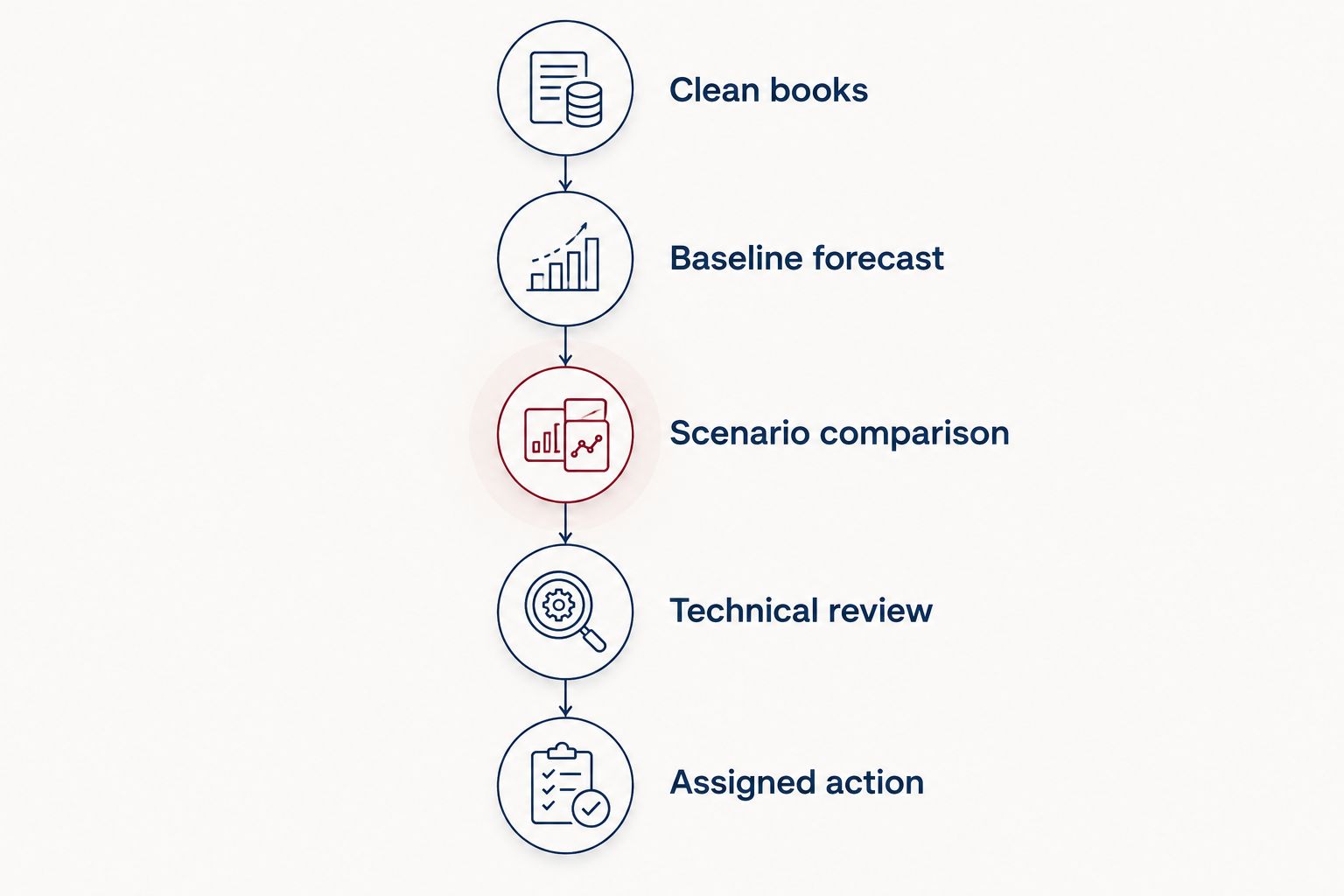
Reliable inputs come before scenario comparisons and implementation.
CEOHAVEN offers tax planning, tax preparation, and bookkeeping for entrepreneurs, real estate investors, content creators, and high-income professionals. That is a service relationship, not a software product. Evaluate it on the work you need covered and the advice you want explained.
Professional advice adds judgment; software supplies calculations. Do not confuse the two when selecting your money team.
Discuss your tax planning needs
Explore tax planning, tax preparation, and bookkeeping for your business.
Estimated payments: a useful software check
Ask whether your planning discussion distinguishes projected liability from the payments needed to avoid an underpayment penalty. These are related calculations, not interchangeable goals.
Under the federal rules described in IRS Publication 505 and the Form 1040-ES instructions, the general estimated-tax safe harbor uses 90% of current-year tax or 100% of prior-year tax, whichever is smaller. The prior-year percentage generally rises to 110% when prior-year adjusted gross income exceeds $150,000, or $75,000 for married filing separately.
Those rules have conditions, including a qualifying prior-year return, and payment timing matters. Special rules apply in certain situations. Have your advisor confirm the applicable calculation rather than treating those percentages as a complete payment instruction.
A safe harbor addresses an underpayment penalty; it does not erase the remaining tax bill. Your 2026 plan should distinguish the payment schedule from the cash you need to reserve for the projected liability.
How this shortlist is ranked
BNA Income Tax Planner takes the projection slot; Holistiplan takes return-based review; Intuit Tax Advisor takes ProConnect workflow fit; TaxCaster takes the basic estimate slot. The criteria are decision coverage, scenario clarity, input quality, operator fit, actionability, and scope boundaries.
This is a use-case ranking, not a benchmark of calculated tax savings. No software wins on savings before your facts, eligibility, and proposed decisions are established. Avoid choosing a tool because a demonstration produces an attractive hypothetical result.
Which tax planning option should you choose?
Choose BNA Income Tax Planner through your advisor when scenario projection is the central need. Choose Holistiplan when the engagement starts with return analysis, or Intuit Tax Advisor when your professional already works in ProConnect Tax. Use TaxCaster for a preliminary personal estimate.
If your real problem is inconsistent books, unexplained estimates, or decisions made before a tax discussion, start with the service relationship. CEOHAVEN provides tax planning, tax preparation, and bookkeeping; establish which work belongs in your engagement before shopping for software.
FAQ
What's the best tax planning software for entrepreneurs in 2026?
BNA Income Tax Planner is the default on this shortlist for advisor-led income tax projections. Holistiplan fits return-based reviews, Intuit Tax Advisor fits ProConnect practices, and TaxCaster fits a basic personal estimate.
Can I use tax planning software without an accountant?
You can use a consumer estimator without an accountant, but professional planning requires more than data entry. Entity decisions, eligibility questions, and state tax treatment need separate technical review.
Is Holistiplan better than BNA Income Tax Planner?
Holistiplan fits a return-based review, while BNA Income Tax Planner fits professional projection work. Choose according to the question your advisor needs to answer rather than treating them as identical workflows.
Is TurboTax TaxCaster enough for my business tax planning?
TurboTax TaxCaster is not a complete business tax planning tool. Use its personal federal estimate as a starting point, then address business structure, state obligations, and implementation separately.
Does CEOHAVEN sell tax planning software?
CEOHAVEN is a business tax consulting firm offering tax planning, tax preparation, and bookkeeping. Evaluate its services separately from the software tools in this guide.
What should I bring to a tax planning meeting?
Bring your filed returns, current financial statements, payroll information, and records of tax payments. Also identify the business or investment decisions you want to compare.
Will tax planning software guarantee a lower tax bill?
Tax planning software does not guarantee a lower tax bill. The result depends on your facts, applicable rules, available choices, and whether a valid recommendation is implemented.
One last thing
Ask what changes if you do nothing. Every proposed strategy needs that baseline. If the recommendation only shows a favorable outcome without the unchanged case, you cannot judge the actual benefit or its trade-offs.
For 2026, make the next move concrete: name the decision, assemble the records, and ask who owns implementation. The software selection follows that work, not the other way around.