

Best overall: Fidelity Self-Employed 401(k) for a business owner who wants a brokerage-based solo 401(k). Best for an existing Schwab investor: Schwab Individual 401(k). Best for an owner comparing pre-tax and Roth employee deferrals: E*TRADE Individual 401(k). Fidelity is the default choice for brokerage-based investing; the right plan is the one whose document supports your tax strategy.
TL;DR
- Fidelity is the best solo 401k provider for business owners seeking a brokerage-based investing account in 2026.
- Schwab fits existing Schwab investors; E*TRADE fits owners comparing pre-tax and Roth employee deferrals.
- Provider selection is separate from tax planning: confirm eligibility, contribution calculations and filing duties before funding.
Why this matters
A solo 401(k) is a retirement plan for a business owner with no eligible employees other than a spouse. You can contribute in two capacities: as the employee and as the employer. That flexibility makes the plan useful, but it also makes a provider list an incomplete answer. Your business structure, compensation and other retirement plans affect what you can contribute.
A brokerage account does not calculate your tax strategy. CEOHAVEN provides tax planning, tax preparation and bookkeeping services for entrepreneurs and high-income professionals. Bring the proposed plan document and your business numbers into that planning process before you elect contributions. CEOHAVEN is a tax consulting firm, not a solo 401(k) provider.
This 2026 comparison focuses on whom each provider serves and what to verify before you sign. It does not treat a familiar brokerage name as proof that every plan feature is available to you.
What makes the best solo 401(k) provider?
- A usable plan document. Confirm that the document permits the contribution types and other features you intend to use. An account-opening page is not a substitute for plan terms.
- An investment account you will manage. Decide whether you want to select investments yourself and whether the provider's account setup suits that approach.
- Clear contribution handling. Ask how employee deferrals and employer contributions are designated, recorded and corrected if entered incorrectly.
- Administrative responsibilities you understand. Establish who tracks eligibility, plan assets, distributions and required filings. Do not assume the brokerage handles the sponsor's duties.
- A fit with your existing accounts. Keeping accounts at one brokerage can simplify your own record review. It does not make that brokerage the right tax choice by itself.
The deciding question is not which logo you recognize. It is whether you can operate that provider's plan correctly alongside your business income, payroll and tax return.
Solo 401(k) providers at a glance
| Provider | Best for | Standout feature | Key limitation |
|---|---|---|---|
| Fidelity Self-Employed 401(k) | Brokerage-based investing | Individual account for an owner-only business | You remain responsible for coordinating plan activity with taxes and filings |
| Schwab Individual 401(k) | Existing Schwab investors | A solo plan within the Schwab brokerage environment | Account convenience does not resolve contribution calculations |
| E*TRADE Individual 401(k) | Comparing pre-tax and Roth employee deferrals | Roth deferral option to evaluate in the plan document | Roth elections add a recordkeeping decision, not an automatic tax advantage |
Each row identifies a use case, not a guarantee that a feature fits your business. Read the current adoption agreement before opening or transferring a plan; that document controls your plan's available options.
1. Fidelity Self-Employed 401(k): best for brokerage-based investing
Fidelity Self-Employed 401(k) is the strongest default here for an owner who wants to make investment decisions in a brokerage account. The account solves the investing-location question. It does not decide how much of your business income qualifies for each type of contribution.
Fidelity pros:
- Gives a self-directed owner a brokerage setting for plan investments.
- Provides a clear default when the priority is an owner-only retirement account, rather than an added tax-advice service.
- Keeps the choice focused on the investment account while your tax planning addresses contribution amounts.
Fidelity cons:
- You must coordinate contributions with your actual compensation and business structure.
- You must confirm the current plan document's features rather than assume every solo 401(k) works the same way.
Best for: A business owner who wants a brokerage-based solo 401(k) and has a separate process for tax planning and plan records.
Verdict: Buy if brokerage-based investing is your priority and the current document supports the elections you need. Hold if you have not established which contributions your business can make.
2. Schwab Individual 401(k): best for existing Schwab investors
Schwab Individual 401(k) gives an owner-only business a retirement plan in the Schwab brokerage environment. Its distinct appeal is straightforward: if you already manage investments there, another account at the same brokerage fits your existing review routine. That convenience is operational, not a tax deduction in itself.
Schwab pros:
- Fits an owner who already uses Schwab to review investments.
- Keeps the investing decision separate from the contribution calculation.
- Offers a defined alternative to changing brokerages solely to open a solo plan.
Schwab cons:
- An existing Schwab account is not evidence that its plan document covers every feature you want.
- You still need records that distinguish employee deferrals from employer contributions.
Best for: An existing Schwab investor whose required plan features appear in the current Schwab document.
Verdict: Buy when the document checks out and account familiarity matters to you. Skip if familiarity is the only reason you are choosing it; compare the plan terms first.
3. E*TRADE Individual 401(k): best for evaluating Roth deferrals
E*TRADE Individual 401(k) belongs on the shortlist when an owner wants to compare pre-tax and Roth employee deferrals. Those are different tax treatments, not different levels of retirement-plan quality. A Roth contribution decision needs to fit your current tax picture and the rules governing eventual distributions.
E*TRADE pros:
- Gives an owner a solo 401(k) option to assess alongside Roth deferral goals.
- Makes the pre-tax versus Roth election a concrete question to settle before funding.
- Fits owners prepared to keep contribution designations clear in their records.
E*TRADE cons:
- A Roth option alone does not establish that Roth contributions are the better tax choice.
- You still need to verify the current document and administer the plan correctly.
Best for: An owner who wants Roth employee deferrals considered as part of a documented tax plan.
Verdict: Buy if the current plan document supports your intended election and your tax plan calls for it. Hold until you know whether pre-tax or Roth deferrals serve your goals.
Choose the plan before you choose the brokerage
The comparison table identifies a sensible starting point. It cannot tell you whether your business qualifies for an owner-only plan, which compensation figure drives your calculation or how an existing plan affects your available deferral. Settle those questions in this order:
- Confirm who works in the business. An owner-only plan stops being a simple owner-and-spouse decision when another employee becomes eligible. Review your workforce before adopting the plan, then keep eligibility under review.
- Identify the business's tax structure. Sole proprietor earnings and S corporation wages do not enter every retirement-plan calculation in the same way. Base the calculation on your actual structure, not a generic online example.
- Check other plans. If you defer compensation into another employer's 401(k), include those deferrals when you calculate the applicable employee limit. Opening a solo plan does not create a separate personal deferral limit.
- Choose the tax treatment. Compare pre-tax and Roth employee deferrals against your current tax position. Confirm what the selected provider's plan document permits before making an election.
- Assign the recordkeeping. Record employee and employer amounts separately, retain the plan document and track total plan assets. Those records support the return and any plan filing.
In 2026, this order protects you from a common error: opening an account first, funding it from a convenient number and asking the tax preparer to reconstruct the decision later. The investment account is only one part of the plan.
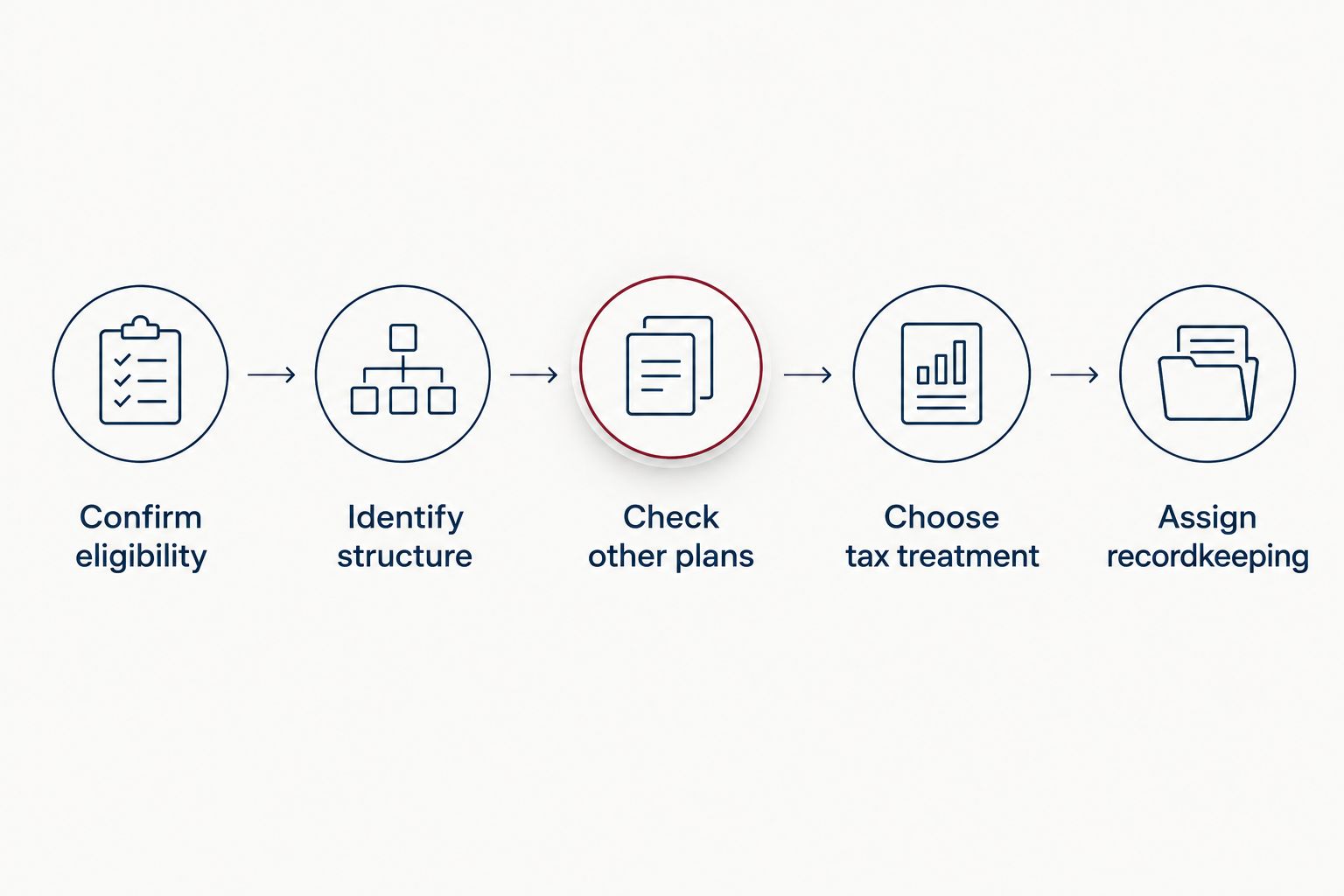
Settle eligibility and contribution treatment before funding the account.
The filing threshold is not the setup threshold
The IRS generally requires Form 5500-EZ for a one-participant plan once total plan assets reach $250,000 at year-end. A final plan year can also require a filing below that threshold. Treat that amount as a filing trigger to monitor, not as the point when recordkeeping begins. You need reliable records from the start.
Early distributions raise a separate question. A distribution before age 59½ years generally faces a 10% additional tax unless an exception applies. That is why access to the account and access to the money are different decisions. Confirm distribution rules in the plan document rather than building a cash-flow plan around the balance.
For 2026, keep the plan document, adoption agreement, contribution records and year-end asset information together. Those documents matter whether you choose Fidelity, Schwab or E*TRADE.
How the providers were ranked
The ranking prioritizes a clear owner use case, then asks whether the plan can be operated with accurate contribution and tax records. Fidelity takes the default brokerage-based slot. Schwab serves the owner already invested in its account environment. E*TRADE serves the owner who wants to evaluate a Roth deferral election.
This is not a ranking by promised tax savings. No provider creates a deduction simply by opening the account. Your eligibility, compensation, elections and contribution records determine the tax result. Confirm current plan terms directly before adopting a provider's document; features and administrative processes are subject to change.
Which solo 401(k) provider should you choose?
Choose Fidelity Self-Employed 401(k) as the 2026 default if you want a brokerage-based plan and have no stronger account or plan-feature requirement. Choose Schwab Individual 401(k) when you already invest through Schwab and its document covers your needs. Choose E*TRADE Individual 401(k) when evaluating Roth employee deferrals is central to your decision and the plan terms support your election.
Do not select a provider to repair unclear books. For a founder with multiple income streams, clean records determine whether you can tell employee deferrals, employer contributions and distributions apart. CEOHAVEN's tax planning and bookkeeping services address that business-side work; the brokerage holds the plan account. Keep those roles distinct.
FAQ
What is the best solo 401k provider for business owners in 2026?
Fidelity Self-Employed 401(k) is the default here for an owner seeking brokerage-based investing. Choose a different provider if its current plan document better matches your required features.
Is Fidelity better than Schwab for a solo 401(k)?
Fidelity is the default for an owner without an existing brokerage preference; Schwab is the better fit for an existing Schwab investor whose plan-feature needs are met. Neither brokerage determines your allowable contribution for you.
When should a business owner consider E*TRADE for a solo 401(k)?
Consider E*TRADE Individual 401(k) when comparing pre-tax and Roth employee deferrals is a priority. Confirm the available elections in the current plan document before funding.
Can a solo 401(k) cover a business with employees?
A solo 401(k) is designed for an owner-only business, including a spouse where applicable. If another worker becomes eligible, review the plan's eligibility and administration requirements instead of treating it as an owner-only arrangement.
Can I contribute to a solo 401(k) and a 401(k) at another job?
Yes, but your employee deferrals across applicable plans share a personal limit. Calculate contributions across both jobs before funding the solo plan.
When does a solo 401(k) need a Form 5500-EZ filing?
A one-participant plan generally needs Form 5500-EZ when total plan assets reach $250,000 at year-end. A final plan year can also require a filing below that threshold.
Does a solo 401(k) provider prepare my business tax return?
A brokerage account does not replace business tax preparation or contribution planning. Keep plan records aligned with your compensation, business structure and tax return.
One last thing
Your best solo 401(k) decision for 2026 can change before your investment preference does. Hiring an eligible employee changes the owner-only premise; taking a job with another 401(k) changes the deferral calculation. Review those events when they happen, not just when you open the account.