

Best overall for an owner-only business: a Solo 401(k). Best for a business with employees: a safe harbor 401(k). Best for consistent high profits and larger retirement funding: a cash balance plan paired with a 401(k). This guide compares the best retirement plans for high-income business owners in 2026, including when a SEP IRA or SIMPLE IRA is the more practical choice.
TL;DR
- The best retirement plans for high-income business owners depend on employee eligibility, compensation, and sustainable funding.
- A Solo 401(k) is the default for eligible owner-only businesses seeking employee deferrals and employer contributions.
- A safe harbor 401(k) suits staffed businesses; required employer contributions belong in the decision.
- A cash balance plan suits consistent high profits, not unpredictable cash flow.
- CEOHAVEN offers tax planning, tax preparation, and bookkeeping for entrepreneurs and high-income professionals.
Why this matters
A retirement deduction is not free money. You move business cash into a retirement account, accept distribution rules, and, with employees, take on obligations that extend beyond your own balance.
Choose the plan your business can fund, not the plan with the largest theoretical deduction. The right answer connects compensation, employee eligibility, tax treatment, and cash reserves before you sign adoption documents.
CEOHAVEN provides tax planning, tax preparation, and bookkeeping. For a high-income owner, those functions supply the financial foundation for a retirement-plan decision; plan design and administration require their own qualified specialists.
What makes the best retirement plan for business owners?
Compare these criteria before comparing contribution ceilings:
- Employee coverage: Determine who must participate, including eligible employees across related businesses.
- Contribution capacity: Separate employee salary deferrals from employer contributions and defined benefit funding.
- Funding flexibility: Distinguish discretionary contributions from required employer payments or actuarially determined funding.
- Compensation fit: Use eligible compensation, not revenue, distributions, or the amount sitting in your bank account.
- Administrative burden: Account for payroll coordination, annual filings, testing, and actuarial work where applicable.
- Tax coordination: Model current deductions, future taxable distributions, Roth features, and existing IRA balances together.
Retirement plans at a glance
The ranking below reflects distinct business situations, not a claim that every owner should adopt the first option. A staffed firm and an owner-only consultancy have different coverage obligations even when their profits match.
| Rank and plan | Best for | Standout feature | Key limitation |
|---|---|---|---|
| 1. Solo 401(k) | Owner-only businesses seeking flexible contributions | Employee deferrals plus employer contributions | Eligible non-spouse employees change the coverage picture |
| 2. Safe harbor 401(k) | Staffed businesses seeking more predictable owner deferrals | Satisfies specified nondiscrimination requirements through qualifying contributions and conditions | Required employer contributions and administration |
| 3. Cash balance plan with a 401(k) | Owners with sustained profits and substantial funding capacity | Defined benefit funding alongside defined contribution savings | Actuarial calculations and continuing funding obligations |
| 4. SEP IRA | Owners prioritizing employer-only contribution simplicity | Discretionary employer contributions | Required contributions for eligible employees follow the plan's allocation rules |
| 5. SIMPLE IRA | Smaller employers prioritizing straightforward administration | Employee deferrals with required employer contributions | Lower standard deferral ceiling than a 401(k) |
1. Solo 401(k): best for owner-only businesses
A Solo 401(k) covers a business owner with no eligible common-law employees other than a spouse. It lets you contribute as both employee and employer, subject to compensation and contribution rules.
For 2026, the standard employee elective-deferral limit is $24,500. Total annual additions generally cannot exceed $72,000, excluding permitted catch-up contributions and subject to the compensation limit. These are IRS limits, not automatic contribution entitlements.
Solo 401(k) pros:
- Employee deferrals can create contribution capacity without relying entirely on employer contributions.
- Employer contributions add a separate funding component.
- A working spouse can participate when eligibility and compensation support contributions.
- A plan offering designated Roth contributions provides another tax-treatment choice.
Solo 401(k) cons:
- Hiring eligible employees requires reassessing the owner-only arrangement.
- Payroll elections, deposits, and applicable annual filings still matter.
- Employee deferrals generally share one individual limit across your 401(k) arrangements.
For an S corporation, employer contributions depend on eligible W-2 compensation, not shareholder distributions. For a sole proprietor, the calculation uses adjusted net earnings from self-employment rather than gross receipts.
Best for: An eligible owner-only business that wants employee deferrals and employer contributions without funding a broader employee group.
Verdict: Buy into this structure first if your business is genuinely owner-only. Confirm eligibility and compensation before calculating a maximum.
2. Safe harbor 401(k): best for businesses with employees
A safe harbor 401(k) is a workplace retirement plan that satisfies specified nondiscrimination requirements when its contribution, vesting, notice, and other applicable conditions are met. It is not a blanket exemption from every retirement-plan rule.
The practical advantage is predictability: qualifying safe harbor design addresses testing that otherwise can restrict highly compensated employees' deferrals. The employer contribution is part of that design, not an incidental extra.
Safe harbor 401(k) pros:
- Supports employee salary deferrals across a staffed business.
- Qualifying design avoids the standard actual deferral percentage test.
- Offers an established structure for owner and employee retirement savings.
- Can include additional employer contributions when the document and applicable rules permit them.
Safe harbor 401(k) cons:
- Required employer contributions create a recurring business obligation.
- Payroll integration, disclosures, and annual administration remain necessary.
- Additional contributions can introduce further testing requirements.
In 2026, evaluate the employee census before choosing a contribution formula. Compensation, tenure, ownership, and related-business interests all affect the analysis; owner compensation alone does not tell you the employer's total commitment.
Best for: A business with eligible employees that wants predictable owner deferrals and accepts required employee funding.
Verdict: Buy the structure after reviewing the full employee contribution obligation. Do not approve a design based only on the owner's projected deduction.
3. Cash balance plan: best for sustained high profits
A cash balance plan is a defined benefit pension plan expressed through a hypothetical account balance. An actuary calculates funding requirements; it is not simply another account with a universal annual deposit limit.
Pairing a cash balance plan with a 401(k) can support retirement contributions beyond a defined contribution plan alone. The appropriate amount depends on age, compensation, plan design, existing benefits, and actuarial assumptions.
Cash balance plan pros:
- Adds defined benefit funding capacity to a retirement strategy.
- Can support substantial catch-up retirement accumulation for owners closer to retirement.
- Integrates with a 401(k) when both plans are designed and tested together.
- Creates a formal pension benefit structure.
Cash balance plan cons:
- Requires actuarial services and ongoing administration.
- Funding obligations persist beyond the owner's preferred tax deduction.
- Employee coverage and investment results affect funding needs.
Do not adopt a pension solely because this year's profit is unusually strong. Review recurring cash generation, employee obligations, and your ability to maintain the plan through a weaker business cycle.
For 2026 planning, request a written actuarial illustration showing owner funding, employee funding, assumptions, and downside scenarios. A headline deduction without those details is not a usable plan.
Best for: An established owner with consistent profits, substantial funding capacity, and a willingness to maintain pension obligations.
Verdict: Hold until the actuarial model and business cash-flow forecast agree. Then decide whether the commitment serves your retirement goals.
4. SEP IRA: best for employer-only simplicity
A SEP IRA accepts employer contributions to individual retirement accounts established for participants. Employer contributions are discretionary, but eligible employees must receive contributions under the plan's allocation rules when the employer contributes.
For 2026, the SEP contribution ceiling is $72,000, subject to compensation-based limits. A SEP does not provide the employee salary-deferral component available through a Solo 401(k).
SEP IRA pros:
- Uses an employer-funded structure without employee salary-deferral payroll elections.
- Allows discretion over whether to make an employer contribution.
- Generally avoids the annual Form 5500 filing required of many qualified plans.
SEP IRA cons:
- Contributions for eligible employees can make an owner-focused strategy expensive to fund.
- No standard employee elective-deferral component exists.
- Pretax SEP IRA balances enter the IRA pro-rata calculation for Roth conversions.
An owner-only business should compare a SEP against a Solo 401(k) using actual compensation. Simpler paperwork does not automatically produce the better contribution result.
Best for: An owner prioritizing discretionary employer contributions and a relatively straightforward administrative structure.
Verdict: Buy for simplicity after checking employee allocations and Roth-conversion consequences. Skip the assumption that a SEP always maximizes retirement savings.
5. SIMPLE IRA: best for straightforward employee participation
A SIMPLE IRA lets eligible employees make salary-reduction contributions and requires employer contributions. It generally serves employers with 100 or fewer employees who meet the applicable compensation test, subject to additional eligibility rules.
Its appeal is a relatively straightforward employee retirement arrangement. Its standard deferral ceiling is lower than a 401(k)'s, so high-income owners seeking maximum accumulation should compare capacity before selecting it.
SIMPLE IRA pros:
- Gives employees a payroll-based retirement savings arrangement.
- Generally requires less administration than a conventional 401(k).
- Avoids the standard 401(k) nondiscrimination testing structure.
SIMPLE IRA cons:
- Requires employer contributions under the applicable formula.
- Provides less standard employee deferral capacity than a 401(k).
- Has special early-distribution rules during the initial participation period.
Best for: A qualifying smaller employer that values straightforward employee participation more than maximizing the owner's deferral ceiling.
Verdict: Buy for administrative fit; skip when contribution capacity is your dominant objective. Keep employee benefits and owner accumulation as separate decision criteria.
How the retirement plans rank
This ranking prioritizes employee coverage first, then contribution capacity, funding flexibility, compensation fit, administration, and tax coordination. It compares plan structures rather than providers or investment performance.
The Solo 401(k) leads for eligible owner-only businesses because it combines employee and employer contributions. A staffed business moves toward a safe harbor 401(k); a consistently profitable owner considers adding a cash balance plan. SEP and SIMPLE IRAs earn their places through administrative fit, not universal contribution advantages.
Choose the structure before calculating the deduction
Use this sequence before opening accounts or changing payroll:
- Employee coverage: Identify eligible workers and related businesses.
- Eligible compensation: Reconcile wages or adjusted self-employment earnings.
- Funding capacity: Separate retirement funding from taxes and operating reserves.
- Plan design: Obtain the coverage, contribution, and administration requirements.
- Payroll execution: Document elections, deposit procedures, and deadlines.
The order matters. A retirement account cannot fix an unsupported compensation calculation or an employee census that leaves out eligible workers.
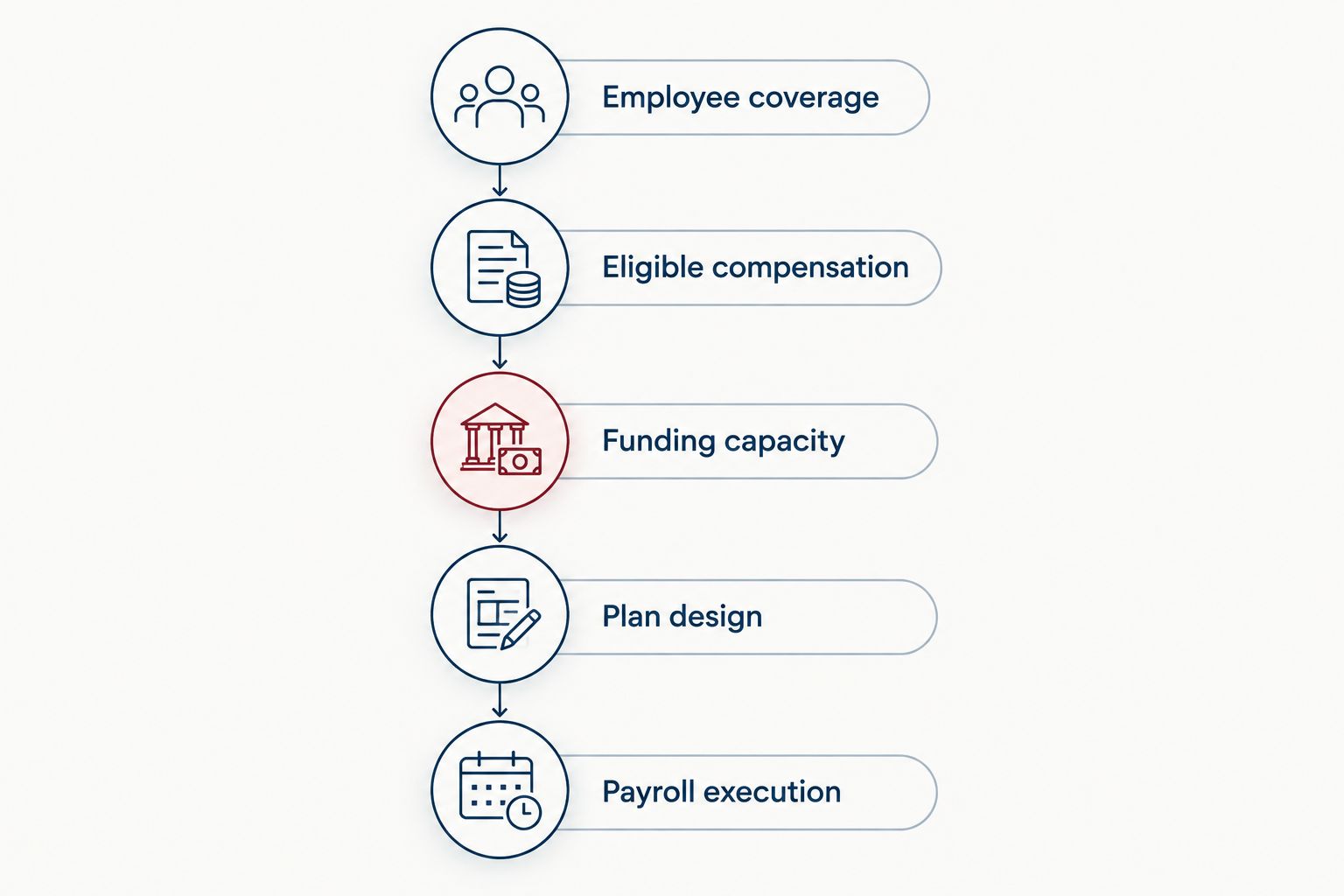
Confirm coverage and compensation before selecting a contribution target.
For 2026, keep the retirement calculation connected to your tax projection. Traditional employer contributions generally reduce current taxable income; designated Roth employee contributions do not provide the same current income-tax deduction. Neither treatment removes the need for cash reserves.
CEOHAVEN's retirement-plan tax planning context is the business itself: accurate books, supported compensation, and coordinated tax preparation. Use a plan administrator and, for a cash balance plan, an actuary to establish the plan-specific obligations.
Coordinate retirement with your tax plan
Discuss tax planning, tax preparation, and bookkeeping for your business.
Which retirement plan should you choose?
Choose a Solo 401(k) by default if you qualify as an owner-only business. Choose a safe harbor 401(k) when employee coverage changes the equation. Consider a cash balance plan only after demonstrating sustainable funding capacity.
Use a SEP IRA when discretionary employer-only contributions justify its trade-offs. Choose a SIMPLE IRA when straightforward employee participation matters more than the highest standard deferral ceiling.
CEOHAVEN pairs tax planning, tax preparation, and bookkeeping for business owners evaluating retirement decisions. Keep that tax work connected to plan administration rather than treating either function as a substitute for the other.
FAQ
What's the best retirement plan for a high-income business owner with no employees?
A Solo 401(k) is the default starting point for an eligible owner-only business because it combines employee deferrals and employer contributions. Compare the actual compensation-based calculation against a SEP IRA before adopting either plan.
How much can I contribute to a Solo 401(k) in 2026?
For 2026, the standard employee deferral limit is $24,500 and the general annual additions limit is $72,000, excluding permitted catch-up contributions. Eligible compensation, contributions to other plans, and plan terms can reduce your available amount.
Is a cash balance plan better than a Solo 401(k)?
A cash balance plan is better suited to sustained, substantial funding goals, while a Solo 401(k) offers a more flexible starting structure for eligible owner-only businesses. The plans can work together, but cash balance funding requires actuarial calculations and ongoing commitments.
Can I use S corporation distributions to calculate employer retirement contributions?
S corporation shareholder distributions are not eligible compensation for calculating employer retirement contributions. Use qualifying W-2 compensation and confirm that payroll and the plan's compensation definition agree.
Can rental income fund a Solo 401(k)?
Ordinary rental income generally is not earned income supporting a Solo 401(k) contribution. Qualifying compensation or self-employment earnings from a separate business can support contributions; owning rental property alone does not establish eligibility.
Does a SEP IRA affect a backdoor Roth IRA contribution?
Pretax SEP IRA balances enter the IRA pro-rata calculation that applies to Roth conversions. Review traditional, SEP, and SIMPLE IRA balances together before assuming a nondeductible IRA contribution converts without additional tax.
What happens to a Solo 401(k) when I hire employees?
Hiring employees requires reviewing eligibility and coverage rather than automatically continuing an owner-only arrangement. Employee service, plan terms, and related-business rules determine when participation is required.
One last thing
A larger retirement deduction can reduce qualified business income and change the associated deduction. Compare the complete tax projection, not just the retirement contribution multiplied by your marginal rate.
Before funding your 2026 plan, have the tax preparer and plan administrator reconcile the same compensation figures. A contribution calculated from one payroll total and deducted using another creates a preventable problem.