

Best overall for self-managing landlords: Stessa. Best for accountant-led books: QuickBooks Online. Best for banking-centered workflows: Baselane. Buildium suits property managers, while AppFolio suits portfolios with broader operating needs. This 2026 guide separates software selection from the tax planning, preparation, and bookkeeping services offered by CEOHAVEN.
TL;DR
- Stessa leads this best rental property accounting software for landlords shortlist for property-level income and expense tracking.
- QuickBooks Online fits accountant-led rental bookkeeping; Buildium fits property management accounting.
- Baselane fits banking-centered workflows; AppFolio fits portfolios needing connected accounting and operations.
- CEOHAVEN serves real estate investors who need tax planning, tax preparation, and bookkeeping—not another software dashboard.
Why this matters
Your rental portfolio needs two different answers: whether each property produces cash and whether the books support an accurate tax return. Those answers are related. They are not interchangeable.
A mortgage payment includes principal and interest, but principal repayment generally is not a deductible rental expense. A security deposit you must return generally is not rental income when received. A property dashboard that treats every deposit as revenue and every withdrawal as an expense gives you the wrong picture.
CEOHAVEN is best for real estate investors who need rental bookkeeping connected to tax planning and preparation. Software records activity; professional judgment determines how that activity belongs in your books and return.
What makes the best rental property accounting software?
Use these criteria before choosing a platform for 2026. A polished dashboard is not a substitute for a usable ledger.
- Property-level reporting: You need income and expenses separated by property, not just a portfolio-wide balance.
- Transaction control: Look for bank reconciliation, supporting documents, and a clear way to correct classifications.
- Accounting depth: Distinguish income-and-expense tracking from a full accounting system with balance-sheet reporting.
- Rental operations: Decide whether rent collection, leases, maintenance, and tenant communication belong in the same system.
- Accountant handoff: Confirm how your bookkeeper or tax preparer receives records, reports, and access.
- Implementation burden: Choose a system you can maintain consistently, including when properties change hands or accounts change.
The decisive question is not which platform has the longest feature list. It is which platform supports the work your portfolio actually requires without making the monthly close harder.
Rental accounting software at a glance
| Rank and option | Best for | Standout function | Key limitation |
|---|---|---|---|
| 1. Stessa | Self-managing landlords | Rental-focused income and expense tracking | Do not treat the dashboard as a substitute for tax classification |
| 2. QuickBooks Online | Accountant-led rental businesses | General ledger and financial reporting | Property organization requires deliberate setup; it is not a leasing system |
| 3. Baselane | Banking-centered landlords | Banking, rent collection, and bookkeeping workflows | Banking organization alone does not resolve tax treatment |
| 4. Buildium | Property managers handling owner reporting | Property management accounting connected to operations | A broader management system adds setup work beyond expense tracking |
| 5. AppFolio | Portfolios with wider operational needs | Accounting connected to property management workflows | Implementation is a larger decision than choosing a rental tracker |
This shortlist compares different operating models. Stessa and QuickBooks Online are not interchangeable, and choosing between them starts with deciding whether you need a landlord dashboard or accountant-led books.
1. Stessa: best rental accounting software for self-management
Stessa focuses on rental property financial tracking. It organizes rental income and expenses around properties, making it a direct fit for landlords whose immediate need is understanding portfolio performance.
Choose Stessa when you manage the properties yourself and want rental-focused organization rather than a general business accounting workspace. Keep tax review separate from the decision to use a rental dashboard.
Stessa pros:
- Rental-focused organization matches how landlords think about their assets.
- Property-level tracking supports comparisons between rentals.
- Income and expense records provide a starting point for tax preparation.
Stessa cons:
- Transaction categorization still needs review; importing activity does not establish deductibility.
- Landlords with complex entities should confirm that reporting and accountant access meet their requirements.
Best for: Self-managing landlords prioritizing property performance and organized rental records.
Before committing your 2026 books, review a representative mortgage payment, tenant deposit, and repair invoice. Check whether you can record each correctly and retrieve its supporting document. Those transactions reveal more about fit than an attractive summary chart.
Verdict: Buy Stessa for rental-focused tracking; hold if your accountant requires a different ledger structure.
2. QuickBooks Online: best for accountant-led rental bookkeeping
QuickBooks Online is general business accounting software, not a dedicated landlord platform. Its accounting reports and ledger structure make it a candidate when your rental business needs formal books maintained with an accountant or bookkeeper.
The setup matters. Your accountant needs a consistent method for separating properties, entities, loans, deposits, and owner activity rather than letting everything collect in a single expense list.
QuickBooks Online pros:
- Supports core accounting reports, including profit and loss and balance sheets.
- Provides a ledger for assets, liabilities, income, and expenses.
- Fits workflows where accounting discipline comes before tenant operations.
QuickBooks Online cons:
- It does not replace dedicated leasing or maintenance software.
- Property-level reporting depends on the structure and features you configure; confirm the required subscription capabilities.
Best for: Rental businesses with accountant-led books and a defined reporting structure.
Ask your accountant to approve the chart of accounts before importing transactions. A platform cannot repair a structure that mixes acquisition costs, capital improvements, loan principal, and operating expenses into the same bucket.
Verdict: Buy QuickBooks Online for accountant-led books; skip it as a stand-alone property management system.
3. Baselane: best for banking-centered rental workflows
Baselane combines landlord banking, rent collection, and bookkeeping tools. Its central appeal is bringing rental money movement and financial organization into a connected workflow.
That makes Baselane a distinct choice for landlords whose biggest problem is scattered accounts and rent records. The banking workflow still needs an accounting policy behind it.
Baselane pros:
- Connects landlord banking and bookkeeping tasks.
- Includes rent collection within the broader rental workflow.
- Encourages financial organization around rental activity rather than personal spending.
Baselane cons:
- Separating cash does not determine whether an expenditure is deductible or capitalized.
- Confirm reporting and export requirements with your preparer before making it the primary record system.
Best for: Landlords who want banking and rental bookkeeping organized together.
The 2026 decision is whether a banking-centered workflow matches how you operate. Review how you will handle transfers, loan payments, security deposits, and records from accounts outside the platform. Every movement of money needs a consistent treatment, even when it is not income or expense.
Verdict: Buy Baselane when banking organization is the priority; hold until your accountant approves the reporting handoff.
4. Buildium: best for property managers reporting to owners
Buildium combines property management operations with accounting. It belongs on this shortlist when your work includes tenant activity, maintenance coordination, and reporting to property owners—not just tracking expenses on your own rentals.
The distinction is operational. A property manager needs records that connect the property, tenant, owner, and accounting activity without losing responsibility for each balance.
Buildium pros:
- Combines accounting with property management workflows.
- Supports owner-facing financial reporting.
- Fits businesses coordinating rental operations as well as bookkeeping.
Buildium cons:
- Setup requires attention to operational records as well as financial records.
- A landlord needing only income and expense tracking takes on a broader system than necessary.
Best for: Property managers who need accounting connected to tenant and owner workflows.
Evaluate Buildium using an actual management scenario: rent received, a maintenance expense recorded, and an owner report prepared. Follow the transaction through the system. Your decision should turn on whether the records remain clear at each stage.
Verdict: Buy Buildium for owner-reporting and management workflows; skip it if a rental tracker solves the entire problem.
5. AppFolio: best for portfolios needing connected operations
AppFolio connects property management accounting with broader operational workflows. It is a candidate when software selection affects the way your team handles leasing, maintenance, reporting, and financial records across the portfolio.
Do not evaluate AppFolio as an expense tracker with extra features. Evaluate it as an operating-system decision for your property business.
AppFolio pros:
- Connects accounting with property management activity.
- Supports coordinated work across operational functions.
- Fits a selection process that considers team workflows alongside financial reporting.
AppFolio cons:
- Moving operational and accounting records requires a defined implementation plan.
- A simpler landlord workflow does not justify adopting a broader platform by itself.
Best for: Rental portfolios whose accounting decisions must support wider team operations.
For a 2026 implementation, map responsibility before choosing software. Identify who enters transactions, who approves corrections, who handles tenant records, and who closes the books. Then confirm that the proposed workflow gives each person the right access and accountability.
Verdict: Buy AppFolio when connected operations justify the implementation; hold if your reporting process is still undefined.
How this ranking works
The ranking prioritizes the landlord's operating model, then accounting requirements, then implementation burden. Stessa takes the default position because its rental-focused tracking directly matches the query. QuickBooks Online leads when formal bookkeeping is the controlling requirement.
Baselane, Buildium, and AppFolio occupy different decision branches: banking organization, owner-reporting workflows, and broader property operations. There is no useful universal winner across those jobs.
Choose the smallest system that handles your required records correctly. Confirm current features and account requirements directly with each provider before committing your books.
Before you move your rental books
A clean transition matters more than a fast import. Use this sequence to prevent your new platform from inheriting unresolved balances.
Define reports
Decide which reports you need by property and legal entity. Include income and expenses, loan balances, security deposits, and owner activity where applicable. Your accountant should approve the structure before data moves.
Reconcile balances
Match bank accounts and loans to statements. Review transfers separately from income and expenses, and resolve unexplained balances rather than carrying them into the new system.
Move records
Preserve transaction history and supporting documents. Keep acquisition statements, improvement invoices, and depreciation records accessible; bank transactions alone do not contain the full tax history of a rental.
Verify reports
Compare the old and new records for the same period. If you migrate a complete year, check all 12 months rather than relying on the annual total. Offsetting errors can leave the total looking correct.
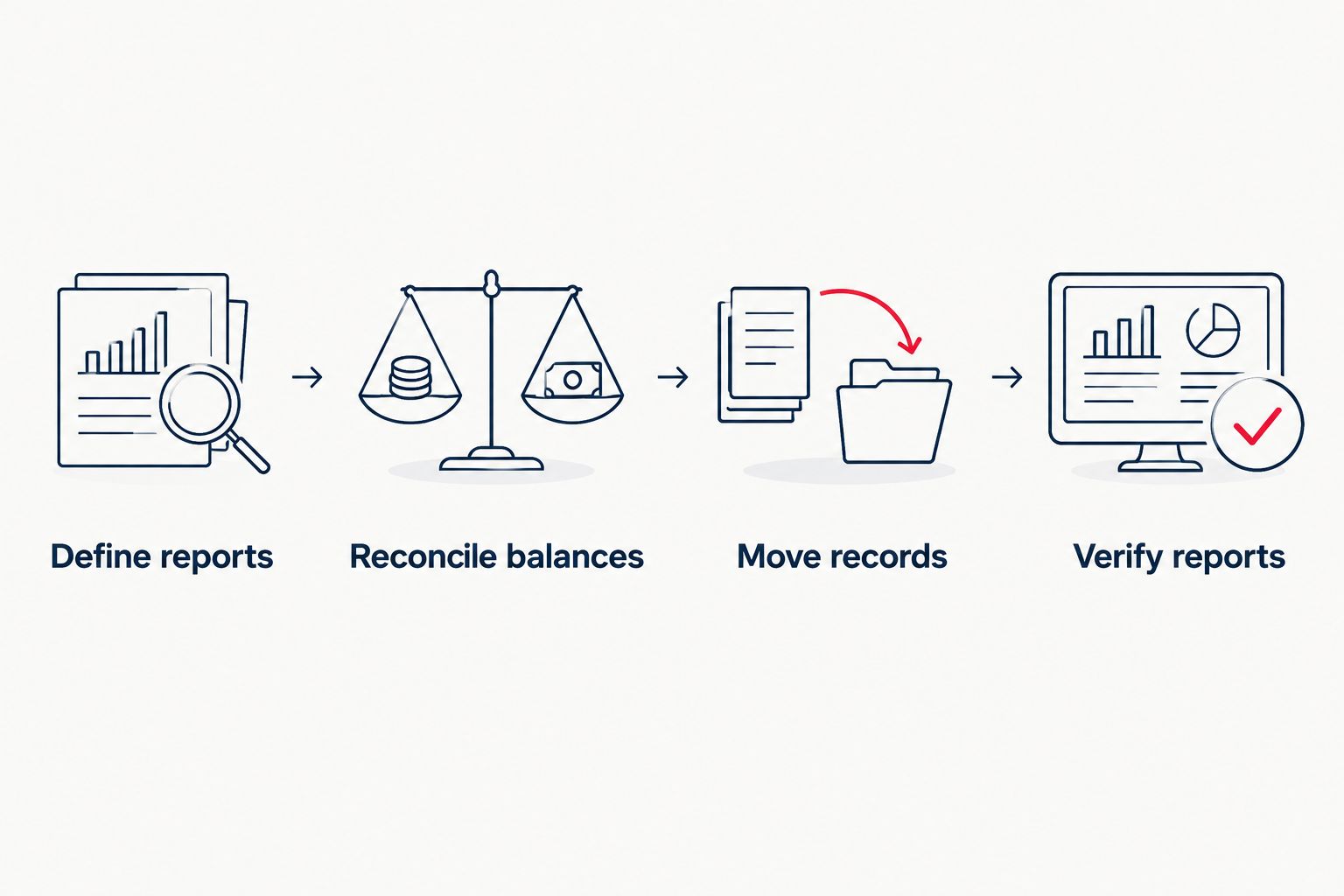
Resolve the accounting structure before importing transactions.
Software selection and tax planning are separate decisions. CEOHAVEN offers rental bookkeeping, tax planning, and preparation services for real estate investors; your software choice should support that work rather than dictate tax treatment.
Connect your books to tax planning
Review tax planning, tax preparation, and bookkeeping services for your rental business.
Which rental accounting software should you choose?
Choose Stessa if you are undecided and your main job is tracking your own rentals. Choose QuickBooks Online instead when your accountant needs a structured general ledger and formal financial reporting.
Baselane is the banking-centered choice. Buildium is the owner-reporting choice. AppFolio is the broader operations choice. Do not select the last two merely because you expect to buy more properties; select them when the operating requirements exist.
For 2026, settle the reporting structure first. The right software follows from that decision.
FAQ
What's the best rental property accounting software for landlords in 2026?
Stessa is the default pick for self-managing landlords who need rental-focused income and expense tracking. QuickBooks Online is the better fit when an accountant-led general ledger is the priority.
Is QuickBooks Online better than Stessa for rental properties?
QuickBooks Online is better for accountant-led general bookkeeping; Stessa is better suited to rental-focused financial tracking. Choose based on the reports and record structure your rental business needs.
Do I need property management software or accounting software?
Choose property management software when you need tenant, lease, maintenance, and owner workflows alongside financial records. Choose accounting-focused software when those operations already have a workable home and the main requirement is maintaining the books.
Does rental accounting software replace a tax professional?
No, rental accounting software does not replace tax advice or return preparation. CEOHAVEN provides tax planning, tax preparation, and bookkeeping services for real estate investors who need those services alongside their records.
Can I deduct the whole mortgage payment on a rental property?
No, mortgage principal repayment generally is not a deductible rental expense. Separate principal from interest, and review other payment components such as escrow amounts according to their actual tax treatment.
Does software automatically calculate rental depreciation correctly?
Do not assume a software-generated depreciation figure is correct. Under the general depreciation system, residential rental buildings generally use a 27.5-year recovery period and nonresidential real property generally uses 39 years; land is not depreciable.
What should I check before changing rental accounting software?
Approve the reporting structure and reconcile balances before migrating records. Preserve supporting documents, then compare the migrated reports with the original records for the same period.
One last thing
Your bank feed cannot tell the whole acquisition story. A closing statement includes items that require different accounting treatment, and the purchase amount must be allocated appropriately between land and building.
Keep the closing statement with the property's permanent records—not just the payment transaction. A clean ledger is useful; a clean ledger with its supporting evidence is defensible.