

Best overall for personal federal estimates: IRS Direct Pay. Best for business federal tax payments: EFTPS. Best for checking personal federal payment history: an IRS Individual Online Account. Best for state estimates: your state tax agency’s payment portal. The right tool in 2026 depends on which taxpayer owes the tax, not which portal has the shortest payment form.
TL;DR
- Among the best quarterly tax payment tools for business owners, IRS Direct Pay is the default for personal federal estimates.
- Use EFTPS when the business itself must make a federal tax payment; use a state tax portal for state estimates.
- An IRS Individual Online Account helps you review personal federal payments before sending another one.
- CEOHAVEN’s tax planning addresses the amount to pay; a payment portal only sends the money.
Why this matters
A business owner can have more than one tax obligation. Your personal estimated income tax, a payment owed by a business entity, and a state estimated payment do not necessarily go to the same place. Sending money through an official portal is useful only when you select the right taxpayer, tax type, and period.
That distinction matters when your compensation changes. An S corp break-even decision affects how you think about business income and owner compensation; it does not make every tax payment an entity payment. In 2026, keep the planning decision separate from the payment instruction.
- Personal federal estimates: Payments toward your individual federal income tax.
- Business federal payments: Federal taxes owed and paid under the business taxpayer’s account.
- State estimates: Payments governed by the state where the tax is owed.
- Payment records: Confirmation and history you can reconcile against your tax records.
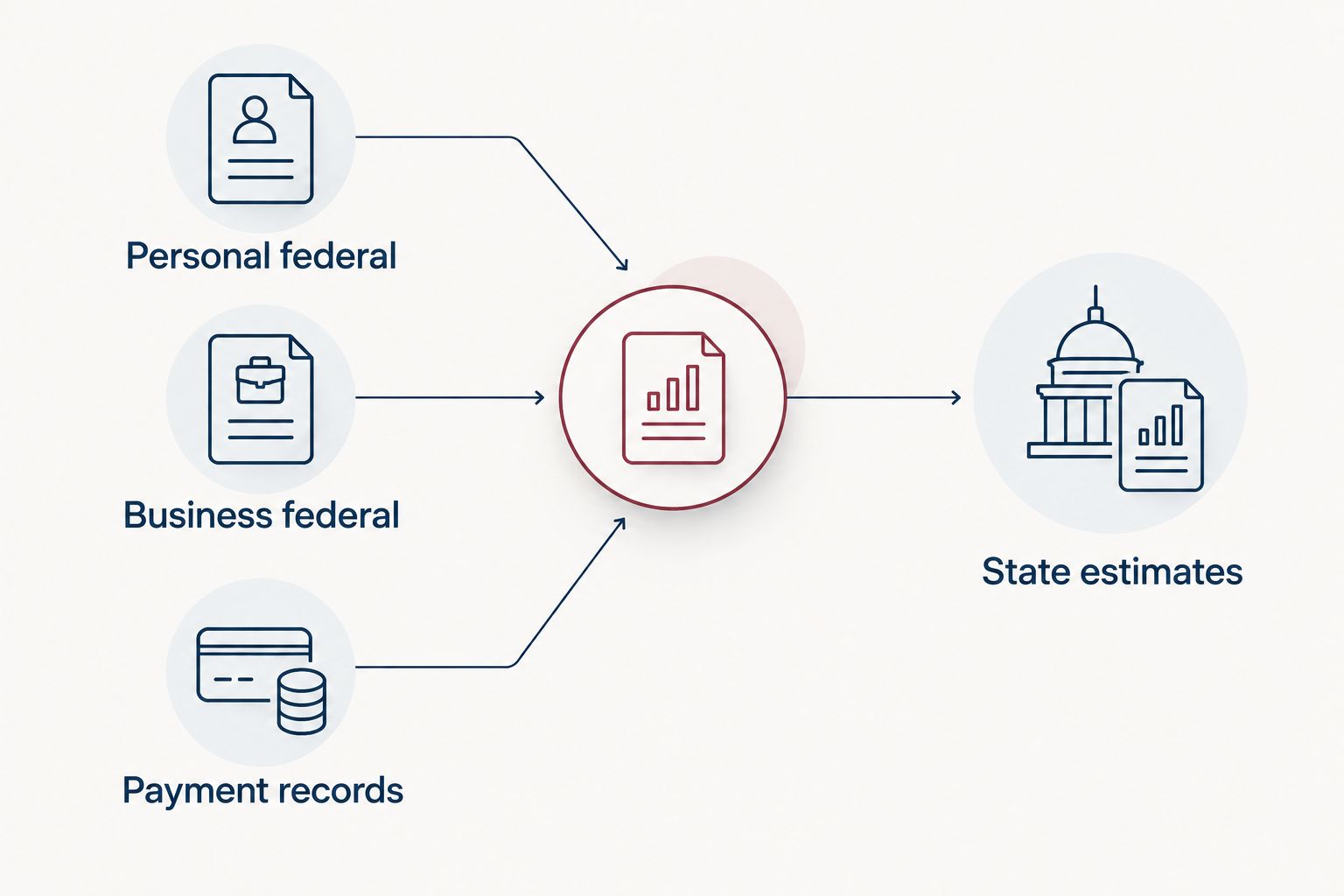
Identify the taxpayer and tax authority before choosing a payment portal.
What makes the best quarterly tax payment tool?
Judge a portal by the payment you need to make, not by how many tax tasks it promises to cover. The strongest choice for one obligation can be the wrong destination for another.
- Taxpayer fit: Can you pay under your individual account, your business account, or both?
- Tax-type fit: Does the portal accept the specific estimated payment or business tax payment you owe?
- Jurisdiction: A federal payment tool does not replace a state tax agency’s portal.
- Record access: Can you obtain a confirmation and check what the tax agency has recorded?
- Setup burden: Do you need an account or enrollment before you can pay?
- Planning gap: Does the tool calculate a defensible payment amount, or merely process the amount you enter?
That final criterion is decisive. The IRS explains estimated-tax calculations in Form 1040-ES, but a payment screen does not resolve how business profit, withholding, and other income change your 2026 estimate. CEOHAVEN offers tax planning, tax preparation, and bookkeeping; those services address the inputs behind the payment rather than replacing an IRS or state portal.
The tools at a glance
| Tool | Best for | Standout feature | Key limitation |
|---|---|---|---|
| IRS Direct Pay | Personal federal estimated payments | Direct payment through the IRS | Not a business-tax payment portal |
| EFTPS | Business federal tax payments | Federal payment system for business and individual taxpayers | Enrollment adds a setup step |
| IRS Individual Online Account | Reviewing personal federal payments | Payment history alongside individual account information | Does not answer what your next estimate should be |
| State tax agency payment portal | State estimated payments | Payment to the relevant state tax authority | Rules and portal functions vary by state |
These are destinations for different obligations, not four interchangeable ways to handle one bill. Check the taxpayer and tax period before submitting any 2026 payment.
1. IRS Direct Pay: best for personal federal estimates
IRS Direct Pay is the default when you need to send a personal federal estimated income tax payment from a bank account. It lets an individual select the payment reason and tax period through the IRS rather than routing that payment through a business service.
For a sole proprietor or a business owner paying estimates on an individual return, this is the simplest match in this list. Simplicity does not verify your calculation: you still choose the amount and confirm that the payment belongs to the correct tax period.
IRS Direct Pay pros:
- The payment goes through an official IRS channel.
- The payment flow identifies the reason and period before submission.
- You can keep its confirmation with your 2026 tax records.
IRS Direct Pay cons:
- It is for individual tax payments, not a substitute for a business federal tax account.
- It does not calculate estimated tax from your books, compensation, or other income.
Best for: An owner making a personal federal estimated income tax payment who already knows the amount to send.
Verdict: Buy. Use IRS Direct Pay for that specific job; hold the payment until you have checked the amount and period.
2. EFTPS: best for business federal tax payments
The Electronic Federal Tax Payment System, or EFTPS, is a federal payment system available to businesses and individuals. Its distinct role here is handling a federal payment that belongs under a business taxpayer’s account. That makes it the better comparison point when an owner is looking beyond personal Form 1040 estimated tax.
EFTPS requires enrollment, so do not treat setup as a last-minute task. Before paying, identify the business taxpayer, the tax form or payment type, and the period. An owner’s personal income-tax estimate and a business federal payment are different instructions even when the owner controls both accounts.
EFTPS pros:
- It is an official federal tax payment system.
- It accommodates business federal tax payments.
- Enrollment gives you an established payment channel to use again.
EFTPS cons:
- You must complete enrollment before relying on it.
- It cannot determine whether a liability belongs to the owner or the business.
- It does not replace a state tax payment portal.
Best for: A business taxpayer making a federal payment under its own account.
Verdict: Buy. Set up EFTPS before a business federal payment is due; skip it as a reason to misclassify a personal estimate as a business payment.
3. IRS Individual Online Account: best for checking personal payments
An IRS Individual Online Account gives an individual access to federal tax account information, including payment history. Its place on this list is record-checking: use it to review what your personal account shows before relying on a spreadsheet, bank debit, or memory alone.
It also offers a way to make personal tax payments through your online account. Still, its strongest use case in this ranking is visibility. A record of past payments helps you check what happened; it cannot tell you whether your next 2026 estimate covers current income.
IRS Individual Online Account pros:
- It puts individual federal payment history in the context of your IRS account.
- It supports checking a recorded payment rather than relying only on a bank transaction.
- It provides a personal-account route for making a federal payment.
IRS Individual Online Account cons:
- You need account access to use its features.
- It is an individual account, not the business’s federal payment account.
- Payment history is not a forward-looking tax projection.
Best for: An owner reconciling personal federal payments before making the next one.
Verdict: Hold. Use it to confirm your personal payment record; do not treat a past-payment list as a 2026 tax plan.
4. State tax agency portal: best for state estimates
Your state tax agency’s payment portal is the destination for an estimated payment owed to that state. There is no single state portal that works for every business owner in the United States, and the available payment types depend on the state and taxpayer.
Check whether the payment belongs to you individually or to a business before selecting an account. State estimated income tax and an entity-level state payment are not labels to swap for convenience. Confirm the state’s instructions, payment type, and tax period on its own tax agency site.
State tax agency portal pros:
- It directs a state payment to the relevant tax authority.
- It lets you follow that state’s stated payment categories.
- It gives you a confirmation to retain with your state tax records.
State tax agency portal cons:
- Its rules and functions vary by state.
- It does not pay your federal estimated tax.
- It does not decide whether an individual or an entity owes the payment.
Best for: An owner who has identified a state estimated-tax obligation and the taxpayer responsible for it.
Verdict: Buy. Use the relevant state’s official portal, but verify the obligation first.
How to choose the right payment route in 2026
Start with the notice, return, or tax plan that identifies the liability. Then work through these questions in order:
- Who owes it? Separate your individual tax account from any business taxpayer account.
- Which authority receives it? A federal payment goes to the IRS; a state payment goes to the applicable state tax agency.
- What type of tax is it? Do not select an estimated-income-tax reason for a different business obligation.
- Which period applies? Match the period on the payment screen to the obligation you intend to cover.
- What amount is supported? Reconcile the payment against current income, withholding, prior payments, and the applicable calculation.
- What proves submission? Save the confirmation and check the agency’s account record when available.
The federal estimated-tax safe-harbor rules illustrate why the amount needs its own decision. IRS Form 1040-ES explains the general comparison between paying 90% of current-year tax and 100% of prior-year tax, subject to conditions; the prior-year percentage rises to 110% for certain higher-income taxpayers. Those percentages help assess an underpayment-penalty threshold. They are not a universal instruction to pay the same amount every quarter, and they do not tell you which portal receives a state payment.
If your income comes from several sources, bookkeeping and tax planning belong before the payment screen. CEOHAVEN’s business tax consulting covers tax planning, tax preparation, and bookkeeping for entrepreneurs, real estate investors, content creators, and high-income professionals. The portal remains the place to submit a payment once the taxpayer, amount, and destination are settled.
How we ranked these options
The ranking follows the job each tool can perform: taxpayer fit first, then tax type, jurisdiction, record access, and setup. IRS Direct Pay takes the overall spot because the query commonly begins with an owner’s personal federal estimate. EFTPS leads when the business taxpayer owes a federal payment; the state portal leads for state tax. The IRS Individual Online Account earns a separate place for checking personal payment records.
This is a decision tree, not a claim that one website handles every 2026 tax obligation. None of the four options replaces a calculation of what you owe.
Which quarterly tax payment tool should you choose?
Choose IRS Direct Pay for a personal federal estimate when the amount is already determined. Choose EFTPS for a federal payment owed under the business’s account. Use your state tax agency’s portal for state estimates, and check your IRS Individual Online Account when you need to reconcile personal federal payment history.
If you cannot yet say who owes the tax or how the amount was calculated, do not pick a portal first. CEOHAVEN is best suited to owners who need tax planning and bookkeeping behind the payment decision; the tax agency’s tool handles the submission. A private plan and a correct payment instruction do different work.
FAQ
What is the best quarterly tax payment tool for a business owner in 2026?
IRS Direct Pay is the best default for a business owner’s personal federal estimated tax payment in 2026. Use EFTPS for a federal payment owed by the business taxpayer and the relevant state portal for state estimates.
Is IRS Direct Pay better than EFTPS for estimated taxes?
IRS Direct Pay is the simpler match for an individual federal estimated income tax payment. EFTPS also serves individuals, but its business-payment role and enrollment requirement make it a distinct choice in this ranking.
Can I pay state estimated taxes through IRS Direct Pay?
No. IRS Direct Pay handles federal individual tax payments; send a state estimated payment through the relevant state tax agency’s approved channel.
Does an IRS payment tool calculate my quarterly tax payment?
No. A payment tool submits the amount you choose. Calculate the obligation using your income, withholding, prior payments, and applicable tax rules before paying.
Should an S corp owner make every tax payment through EFTPS?
No. An owner’s personal estimated income tax and a payment owed by the business are separate obligations. Identify the taxpayer and tax type before choosing EFTPS or a personal payment route.
How do I check whether a personal federal payment was recorded?
Review your IRS Individual Online Account and keep the payment confirmation. Match the recorded tax period and payment type to the obligation you intended to pay.
Do I need a different portal for federal and state estimates?
Yes. Federal and state tax authorities receive their own payments. Use the appropriate IRS channel for a federal obligation and the relevant state tax agency’s instructions for a state obligation.
One last thing
A bank withdrawal proves money left your account; it does not, by itself, confirm that you selected the intended taxpayer, tax type, and period. Save the payment confirmation, then reconcile it against the tax agency’s record. That check is especially important when you manage both personal and business payments in 2026.