

Best overall for complex high-earner calculations: IRS Form 8995-A and its supporting worksheets. Best for straightforward eligibility: IRS Form 8995. Best for comparing decisions: a rules-based spreadsheet. These are the best QBI 199A deduction calculators for high earners by task—not interchangeable shortcuts. CEOHAVEN provides tax planning, tax preparation, and bookkeeping for entrepreneurs, real estate investors, content creators, and high-income professionals.
TL;DR
- The best QBI 199A deduction calculators for high earners handle taxable income, business classification, wages, and qualified property.
- IRS Form 8995-A is the default framework for complex Section 199A calculations.
- IRS Form 8995 suits eligible taxpayers with simpler qualified business income calculations.
- Use a spreadsheet for scenario planning, then reconcile the result with the applicable IRS form.
- CEOHAVEN tax planning suits high earners who need advice alongside a QBI calculation.
Why this matters
The qualified business income deduction is not simply 20% of whatever your business earns. Taxable income, business classification, losses, wages, and qualified property can change the result. A calculator that asks only for profit leaves the important questions unanswered.
For 2026, the IRS Section 199A taxable-income threshold is $403,500 for married filing jointly and $201,750 for other filing statuses. These thresholds use taxable income before the QBI deduction—not revenue, gross income, or the balance in your operating account.
Above the applicable threshold, additional restrictions begin to matter. Choose the calculation method around your actual tax situation, not around the cleanest interface.
What makes the best QBI deduction calculator
Use these criteria before trusting a result:
- Tax-year accuracy: The calculation uses 2026 thresholds and applicable rules, rather than carrying forward an old template.
- Correct income base: It separates taxable income before the deduction from qualified business income and net capital gain.
- Business classification: It distinguishes specified service trades or businesses, known as SSTBs, from other qualified businesses.
- Limitation handling: It addresses W-2 wages, qualified property, phase-ins, losses, and aggregation where applicable.
- Traceable calculations: You can follow the result back to inputs and the relevant IRS worksheets.
- Decision usefulness: It shows what changes between scenarios without treating a projection as a completed tax return.
For a high earner, an explainable calculation beats an impressive-looking estimate. A result without its assumptions is not enough to support a tax decision.
QBI calculation options at a glance
| Option | Best for | Standout feature | Key limitation |
|---|---|---|---|
| IRS Form 8995-A and supporting worksheets | Complex high-earner calculations | Official framework for applicable limitations | Requires accurate inputs and careful instructions |
| IRS Form 8995 | Straightforward eligible taxpayers | Simplified official calculation | Not appropriate for every high-income situation |
| Rules-based spreadsheet | Comparing planning scenarios | Makes assumptions and changes visible | Formulas and tax-year rules need maintenance |
| Return-integrated QBI calculation | Reconciling the deduction with the full return | Connects the deduction to other return inputs | Incorrect classifications still produce incorrect results |
These are calculation approaches, not a claim that every tax application implements them equally. The official IRS forms provide the reference point; spreadsheets and return-integrated calculations serve different stages of the decision.
1. IRS Form 8995-A: best for complex high-earner calculations
IRS Form 8995-A calculates the qualified business income deduction when the simplified form is not appropriate. Its supporting schedules address matters including SSTBs, aggregation, and loss netting. For owners subject to income-based restrictions, this is the framework to understand before relying on an estimate.
The form does not decide whether your activity qualifies as a business or whether your inputs are correct. You must resolve those questions separately. Its advantage is that the calculation follows an official structure rather than concealing limitations behind a single output.
IRS Form 8995-A pros:
- Provides an official reference for a complex Section 199A calculation.
- Supports the applicable wage and qualified-property limitations.
- Includes supporting schedules for business-level issues.
- Makes the calculation reviewable alongside the return.
IRS Form 8995-A cons:
- Requires careful reading of the applicable instructions.
- Does not automatically produce alternative planning scenarios.
- Cannot correct an incorrect SSTB classification or unsupported aggregation election.
Best for: High earners with applicable limitations, multiple businesses, or issues requiring supporting schedules.
For your 2026 planning, use the applicable published instructions and reconcile the calculation with the final tax-year forms before filing. Do not assume that changing the year at the top of a worksheet updates the law inside it.
Verdict: Use IRS Form 8995-A as the reference calculation for complex cases.
2. IRS Form 8995: best for straightforward eligible taxpayers
IRS Form 8995 is the simplified qualified business income deduction computation. Its eligibility rules include a taxable-income test and restrictions involving specified agricultural or horticultural cooperatives. Check the instructions before choosing it.
A high salary does not automatically disqualify you from using the simplified form. Conversely, modest business profit does not establish eligibility. The relevant taxable-income calculation includes the broader return, including a spouse's income when filing jointly.
IRS Form 8995 pros:
- Offers a shorter official calculation for eligible taxpayers.
- Separates QBI from qualified REIT dividends and qualified publicly traded partnership income.
- Includes the overall taxable-income limitation.
- Provides a clear reference for reconciling a straightforward result.
IRS Form 8995 cons:
- Does not replace Form 8995-A when the more detailed computation is required.
- Still depends on correct QBI and loss information.
- Does not establish whether rental activity qualifies for Section 199A.
Best for: Taxpayers who satisfy the simplified form's requirements and do not need the more detailed calculation.
Your choice of form follows eligibility, not convenience. If a projection puts you close to the 2026 threshold, calculate taxable income carefully before deciding which approach fits. A simplified result is useful only when the simplified rules actually apply.
Verdict: Use IRS Form 8995 when eligible; skip it when the detailed computation is required.
3. A rules-based spreadsheet: best for comparing planning scenarios
A rules-based spreadsheet lets you compare the same business under different assumptions. Separate the baseline from each proposed change: retirement contributions, owner compensation, business profit, or a different filing assumption. This makes the source of a changed deduction visible.
The spreadsheet is a planning model, not an authority. Its formulas must reflect the relevant rules, and the final result must reconcile with the applicable IRS computation. An attractive dashboard does not validate a formula.
Rules-based spreadsheet pros:
- Shows assumptions beside the calculation.
- Lets you compare alternatives without overwriting the baseline.
- Makes individual income and business inputs easy to inspect.
- Supports discussion of both the deduction and the broader tax result.
Rules-based spreadsheet cons:
- Requires maintenance when tax rules or thresholds change.
- Can omit loss carryforwards, capital-gain adjustments, or phase-in mechanics.
- Does not prepare or file the return.
Best for: Owners evaluating decisions before committing to them.
For 2026, label the assumptions clearly and keep separate inputs for household taxable income, business QBI, eligible W-2 wages, and qualified-property basis. Do not use revenue as a substitute for QBI. Do not assume that increasing the deduction necessarily reduces total tax.
Verdict: Use a rules-based spreadsheet for scenario planning, then verify the result against the IRS framework.
4. A return-integrated calculation: best for final reconciliation
A return-integrated QBI calculation uses information entered across the tax return rather than treating business profit as an isolated number. This approach is useful when you need the deduction to reflect the household's income, adjustments, losses, and business schedules together.
Evaluate the calculation by its output and supporting worksheets. You should be able to identify which businesses contribute QBI, which limitations apply, and how the deduction reaches the return. An unexplained total is not a sufficient review trail.
Return-integrated calculation pros:
- Connects the deduction with the full taxable-income calculation.
- Supports reconciliation between business schedules and the return.
- Reduces the need to maintain a separate final calculation when inputs are integrated correctly.
- Provides a place to review the deduction alongside other tax consequences.
Return-integrated calculation cons:
- Depends on correct business classifications and input mapping.
- Does not replace the legal judgment behind an election or qualification decision.
- Can conceal mistakes if you review only the final deduction.
Best for: Taxpayers validating the completed return rather than comparing isolated planning assumptions.
Ask for the supporting computation, not just confirmation that the software calculated QBI. For an S corporation, verify the separation between shareholder wages and pass-through income. For multiple businesses, inspect how losses and any aggregation affect the result.
Verdict: Use a return-integrated calculation for final reconciliation; skip outputs you cannot explain.
The high-earner rules your calculation must capture
The following rules determine whether a calculator is answering your actual question. Sources are Internal Revenue Code Section 199A, the IRS Form 8995 and Form 8995-A instructions, and the IRS inflation-adjusted amounts applicable to 2026.
Taxable income
The basic QBI deduction rate is 20%, but the overall deduction is subject to a limitation based on taxable income before the deduction, reduced by net capital gain. Qualified dividends are included in the relevant net-capital-gain adjustment.
This is why a business-only estimate can mislead a household with investment income. Keep the business calculation and the overall return limitation separate, then reconcile them.
Business type
For 2026, the phase-in range is $150,000 for married filing jointly and $75,000 for other filing statuses. An SSTB's eligibility phases out across that range; above it, SSTB income does not qualify for the deduction.
Do not classify a business from its marketing description alone. The actual services and applicable definitions control. A creator, consultant, or investor needs the activity classified before trusting the calculation.
Wage limitation
For businesses subject to the full wage-and-property limitation, the relevant limit is generally the greater of 50% of eligible W-2 wages, or 25% of eligible W-2 wages plus 2.5% of qualifying property's unadjusted basis immediately after acquisition.
These percentages do not mean that adding payroll automatically improves your overall tax position. Payroll costs and employment taxes belong in the comparison too.
Qualified property
Qualified-property basis is not simply the current market value of your real estate. Section 199A has its own requirements for eligible property and the period during which it counts.
Real estate investors should also separate rental-business qualification from property-basis calculations. Owning a rental does not, by itself, answer every QBI question.
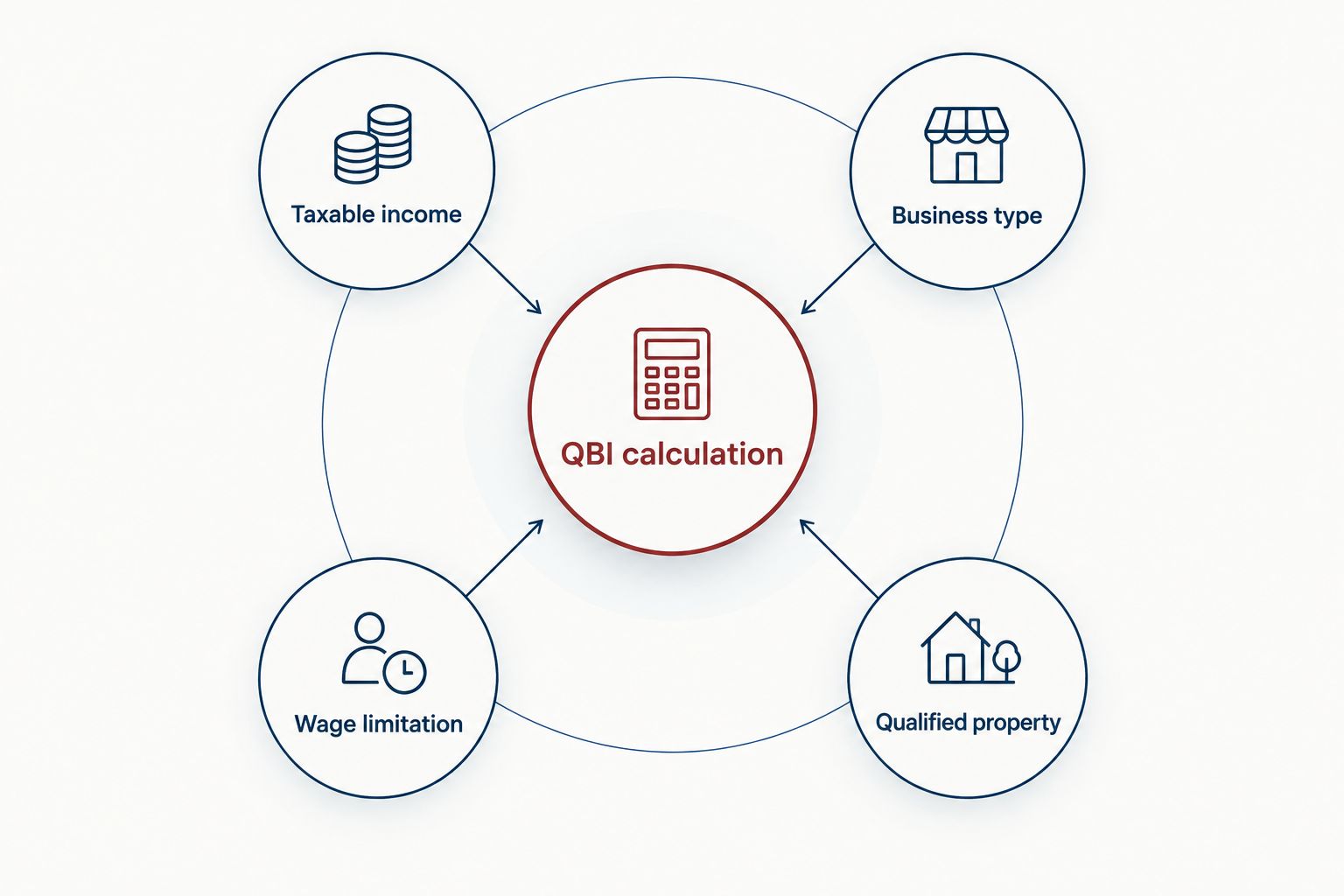
A profit-only estimate leaves the high-earner limitations unresolved.
Where tax planning fits
CEOHAVEN tax planning is best for high earners who need advice alongside a QBI calculation. The firm offers tax planning, tax preparation, and bookkeeping; it is not presented here as a standalone calculator.
CEOHAVEN tax planning pros: Those stated services address planning, filing, and the underlying business records. That service scope fits owners whose question extends beyond entering profit into a form.
CEOHAVEN tax planning limitation: Advisory services do not replace the required deduction computation. Keep the supporting calculation with the return and evaluate decisions on their full tax consequences.
Arrive with current financial statements, prior returns, payroll information, and relevant property records. A clear question is more useful than a desired deduction: which decision improves your after-tax position without creating a larger cost elsewhere?
How these options are ranked
The ranking prioritizes official calculation authority, handling of high-income restrictions, and a traceable result. IRS Form 8995-A comes first because complex cases require the detailed framework. IRS Form 8995 serves eligible simpler cases; spreadsheets serve decisions; return-integrated calculations serve reconciliation.
The ranking does not treat every method as a competing software product. Each wins a different job. Choose the method that answers the question in front of you, then verify it against the applicable rules.
Which QBI calculation method should you choose?
Start with IRS Form 8995-A if your high-earner situation requires the detailed calculation. Use IRS Form 8995 only after confirming eligibility. Add a spreadsheet when you need to compare decisions, and reconcile the final deduction within the return.
For 2026 planning, keep the baseline and proposed changes separate. The objective is not the largest QBI figure on a screen. It is a defensible deduction and a better after-tax outcome.
FAQ
What's the best QBI deduction calculator for high earners?
IRS Form 8995-A and its supporting worksheets provide the reference framework for complex high-earner QBI calculations. Use a scenario model for planning, then reconcile the result with the applicable IRS computation.
Is the QBI deduction always 20% of business profit?
No. Section 199A uses qualified business income and applies additional limitations, including an overall taxable-income limitation. Business classification, losses, wages, and qualified property can also affect the result.
What is the QBI income threshold for 2026?
For 2026, the threshold is $403,500 for married filing jointly and $201,750 for other filing statuses. The test uses taxable income before the QBI deduction, not business revenue.
Can high-income consultants claim the QBI deduction?
Consultants operating an SSTB face income-based restrictions on the QBI deduction. Eligibility phases out across the applicable range above the taxable-income threshold and is eliminated above that range.
Does S corporation salary count as QBI?
Reasonable compensation paid to an S corporation shareholder is excluded from QBI. Eligible W-2 wages can nevertheless matter for the separate wage limitation, so salary and pass-through income need separate treatment.
Do rental properties automatically qualify for QBI?
No. A rental activity must satisfy the applicable qualification rules, including qualifying as a trade or business or meeting the relevant rental real estate safe harbor. Property ownership alone does not establish eligibility.
Is a spreadsheet better than a tax-return calculation?
A spreadsheet is better suited to comparing assumptions; a return-integrated calculation is better suited to final reconciliation. Neither approach fixes incorrect classifications or unsupported inputs.
Does CEOHAVEN offer a standalone QBI calculator?
CEOHAVEN is presented here as a tax consulting firm offering tax planning, tax preparation, and bookkeeping, not as a standalone QBI calculator. Use the appropriate calculation framework alongside advice when your decisions affect more than the deduction.
One last thing
A smaller QBI deduction is not automatically a worse tax outcome. A deductible retirement contribution, for example, can reduce income while also changing the QBI calculation. Judge the combined result rather than protecting one deduction in isolation.
Keep a decision log with each scenario's assumptions and total tax result. When the return differs from the projection, that record shows whether the business changed, the inputs changed, or the calculation needs correction.