

Best overall: Gusto. Best for owners already keeping their books in QuickBooks: QuickBooks Payroll. Best for a payroll-focused shortlist: OnPay. For solo S corporation owners in 2026, the right provider handles payroll execution; your tax adviser determines the compensation and reporting instructions behind it.
TL;DR
- Gusto leads this best payroll providers for solo s corp owners shortlist for straightforward owner payroll.
- QuickBooks Payroll fits owners who want payroll connected to their QuickBooks accounting workflow.
- OnPay belongs on a payroll-focused shortlist; ADP RUN belongs on a hiring-focused shortlist.
- CEOHAVEN provides tax planning, tax preparation, and bookkeeping—not a substitute payroll platform.
- Resolve reasonable compensation, shareholder health insurance, and retirement deductions before approving payroll.
Why this matters
A solo S corporation owner wears two hats: shareholder and employee. Payroll handles employee compensation. Distributions are a separate transaction, and moving money from the business account does not automatically make it wages.
A payroll provider processes your salary; it does not establish that your salary is reasonable. That distinction matters more than an attractive dashboard. Start with the compensation decision, then use the Gusto payroll and S corporation salary compliance workflow to understand the handoff between advice and execution.
CEOHAVEN is best for entrepreneurs who need tax planning, tax preparation, and bookkeeping alongside a separate payroll provider. It belongs on the advisory side of this decision, not in a software ranking disguised as a service pitch.
What makes the best payroll provider for a solo S corp owner?
Judge your 2026 shortlist against these criteria before watching a sales demonstration:
- Tax execution: Identify which payroll returns, deposits, and jurisdictions the proposed service handles, and which remain your responsibility.
- Owner-specific reporting: Require a clear process for shareholder health insurance, retirement deductions, and year-end adjustments.
- Accounting fit: Follow a payroll transaction into the ledger. Wages, employer taxes, liabilities, and distributions must remain distinguishable.
- Correction workflow: Ask who fixes an incorrect payroll, who submits amendments, and what information that process requires.
- Adviser access: Confirm how your bookkeeper or tax adviser reviews payroll records without relying on screenshots.
- Operating fit: Choose for your actual business: one owner, existing accounting software, or a planned employee team.
Do not mistake a long feature list for an answer to these questions. Ask the provider to demonstrate the specific owner-payroll workflow you intend to use.
Best solo S corp payroll providers at a glance
| Rank and provider | Best for | Standout fit | Key limitation |
|---|---|---|---|
| 1. Gusto | A straightforward owner-payroll starting point | Payroll administration in a dedicated platform | Reasonable compensation still needs a separate decision |
| 2. QuickBooks Payroll | Owners already using QuickBooks | Payroll and bookkeeping within the QuickBooks environment | Accounting integration does not establish correct owner-tax treatment |
| 3. OnPay | Owners comparing payroll-focused services | Payroll administration without making an accounting-platform switch the central decision | Owner-specific adjustments still require explicit instructions |
| 4. ADP RUN | Owners preparing to employ a team | Small-business payroll within ADP's broader employment-services offering | A solo owner must separate necessary services from future hiring needs |
These are use-case rankings, not claims that one provider produces better tax outcomes. The right choice depends on the work you need the provider to perform and the responsibilities your adviser retains.
1. Gusto: best payroll provider for straightforward owner payroll
Gusto is a payroll platform for running wages, withholding payroll taxes, and administering payroll filings. It is the default starting point here for a solo owner choosing a dedicated payroll system rather than selecting around an existing accounting platform.
Best for: A solo S corporation owner who wants a focused payroll workflow. Keep the brief narrow: owner wages, required tax reporting, clear records, and a documented process for adjustments.
Gusto pros:
- Provides a dedicated system for payroll administration.
- Keeps employee wage records separate from shareholder distributions recorded in your books.
- Gives you a concrete payroll workflow to review with your tax adviser.
Gusto cons:
- Running a salary through Gusto does not establish reasonable compensation.
- Owner health insurance and retirement treatment still require correct setup and review.
- Payroll records must still reconcile to your accounting records.
Before choosing Gusto in 2026, ask the provider to walk through an owner-only payroll and an owner-specific adjustment. Ask how an adviser receives the payroll register and tax reports. A successful demonstration should answer operational questions, not promise a particular tax result.
Gusto is the first provider to evaluate when you have no accounting-platform preference driving the purchase. Verdict: Buy for straightforward owner payroll after confirming the required reporting workflow.
2. QuickBooks Payroll: best for owners already using QuickBooks
QuickBooks Payroll is Intuit's payroll offering within the QuickBooks product family. Its strongest reason for making this shortlist is the connection between payroll and an existing QuickBooks accounting workflow.
Best for: An owner whose books already run in QuickBooks. Start by asking your bookkeeper how payroll entries will appear, how liabilities will be cleared, and how corrections will reach the ledger.
QuickBooks Payroll pros:
- Fits an existing QuickBooks-centered bookkeeping process.
- Lets your selection focus on payroll-to-ledger handling rather than a new accounting environment.
- Makes it practical to evaluate payroll and bookkeeping together during a demonstration.
QuickBooks Payroll cons:
- Staying within one product family does not eliminate reconciliation work.
- Incorrect account mapping still produces incorrect books.
- Owner-tax decisions remain separate from software setup.
Do not choose QuickBooks Payroll merely because you recognize the name. Have your bookkeeper inspect a sample payroll entry, including employer taxes and deductions. A bank withdrawal alone is not sufficient detail for accurate payroll accounting.
For an owner changing both accounting and payroll systems, evaluate the two decisions separately. Convenience matters, but it should not force an accounting change you otherwise do not need. Verdict: Buy when QuickBooks is already your accounting home and the payroll entries meet your bookkeeper's requirements.
3. OnPay: best for a payroll-focused comparison
OnPay provides payroll services for employers. It belongs on this shortlist for owners who want to compare a dedicated payroll provider without making an accounting-platform decision the center of the purchase.
Best for: A solo owner evaluating payroll as a separate operating function. Give OnPay the same owner-payroll scenario you give Gusto so the comparison remains useful.
OnPay pros:
- Provides a dedicated payroll option outside the QuickBooks product family.
- Keeps the buying discussion centered on payroll administration.
- Gives you another provider against which to assess setup, reporting, and correction responsibilities.
OnPay cons:
- Provider selection does not resolve your reasonable-compensation analysis.
- Shareholder-specific reporting needs instructions, not assumptions.
- You still need to establish how payroll information reaches your books.
For your 2026 comparison, ask OnPay to explain how the proposed service handles your state registrations, owner deductions, and year-end adjustments. Request the boundaries of the service in writing. A verbal assurance that a provider handles S corporations is not a substitute for a defined process.
Keep OnPay on the shortlist when its demonstrated workflow fits your adviser and bookkeeping arrangements. Verdict: Buy when OnPay's confirmed payroll process fits your owner-specific requirements.
4. ADP RUN: best for owners preparing to hire
RUN Powered by ADP is ADP's small-business payroll offering. Its place here is for the solo owner whose next operating challenge includes employing a team, not just paying the founder.
Best for: An owner planning a transition from owner-only payroll to employee payroll. Evaluate current needs first, then identify which hiring-related services you actually expect to use.
ADP RUN pros:
- Provides a small-business payroll offering from an established payroll company.
- Belongs in a comparison that includes future employment-service needs.
- Allows the discussion to extend beyond the owner's paycheck to employee administration.
ADP RUN cons:
- A broader service discussion requires careful attention to what the proposed agreement includes.
- Future hiring needs should not distract from current owner-payroll requirements.
- ADP RUN does not replace tax advice about owner compensation or distributions.
Ask for a written breakdown of payroll responsibilities, support routes, and any separately selected services. Assess the proposal you receive, not the full list of services associated with the ADP name.
If hiring remains only an idea, keep the comparison focused on owner payroll. Verdict: Hold unless your hiring plan gives you a clear reason to evaluate the broader employment-services offering.
The owner-payroll setup that matters more than the ranking
The best payroll providers for solo S corp owners still need correct instructions. Before the first 2026 payroll, settle these responsibilities with your tax adviser and bookkeeper.
Compensation decision
Document what you do for the business, the services you perform, and the basis for the salary decision. IRS guidance requires reasonable compensation for services before non-wage distributions to shareholder-employees; there is no universal salary-to-distribution ratio that substitutes for the facts.
A profitable company and an owner with substantial outside income still need a business-specific compensation decision. Do not select a wage figure solely to produce a preferred payroll-tax result.
Owner benefits
Flag shareholder status during setup. Under IRS guidance, health insurance for a shareholder owning more than 2% of an S corporation has special reporting rules. Properly qualifying premiums generally enter Form W-2 Box 1 without entering Social Security and Medicare wages.
Retirement deductions also need deliberate handling. Employee deferrals and employer contributions are different items, and payroll configuration should match the retirement plan's instructions.
Tax responsibilities
For 2026, the standard employee Social Security tax rate is 6.2%, subject to the annual wage base. The standard employee Medicare rate is 1.45%, with separate Additional Medicare Tax rules; employers also owe their applicable payroll taxes.
Those withholding amounts do not answer the owner's entire tax question. Federal income-tax withholding, state obligations, and income outside payroll require a separate review. Identify who monitors those items.
Bookkeeping handoff
Reconcile gross wages, employee withholding, employer taxes, deductions, and cash withdrawals to the books. Record shareholder distributions separately. Otherwise, a correct payroll run can still feed an incorrect financial statement.
Year-end review
Review owner benefits, retirement amounts, payroll liabilities, and wage reporting before finalizing year-end forms. Confirm who approves changes and who submits any required correction. Assign a name to each responsibility.
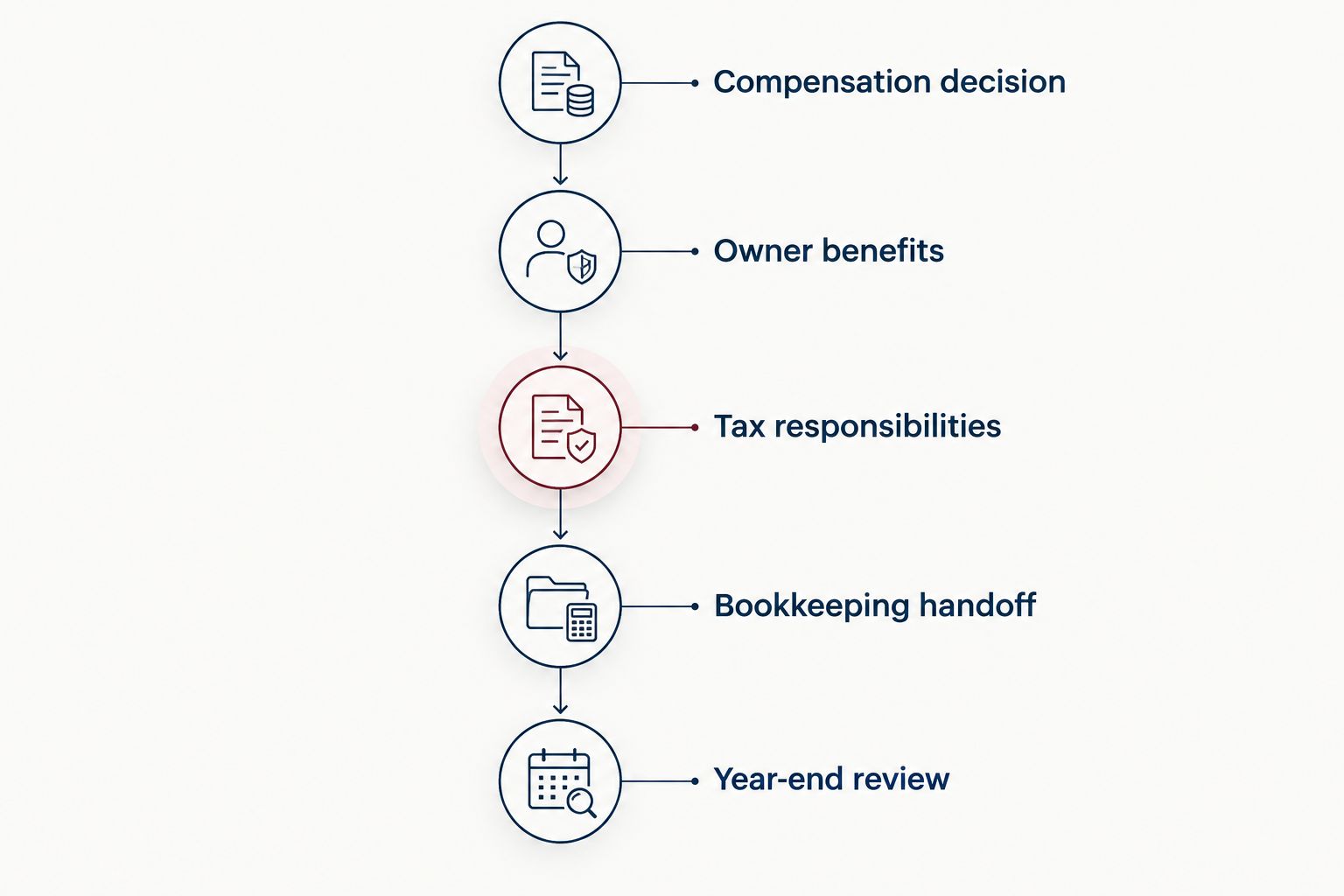
Choose the provider after defining the decisions and records it must support.
What to ask before moving an existing payroll
A midyear switch requires more than entering your next salary payment. The new system needs accurate year-to-date records so it can continue payroll reporting correctly.
Use this checklist before authorizing the move:
- Payroll history: Supply year-to-date wages, withholding, employer taxes, deductions, and prior payroll reports.
- Agency records: Confirm employer identification details, state accounts, and filing authorizations.
- Owner adjustments: Identify shareholder health insurance and retirement items already processed.
- Filing ownership: Establish which provider files each return covering the transition period.
- Final reconciliation: Compare the old provider's closing records with the new provider's opening balances.
Do not assume canceling a subscription transfers filing responsibility. Obtain written confirmation of what each provider will finish. Keep copies of payroll records outside the departing provider's account.
How the providers are ranked
This ranking prioritizes owner-payroll fit, accounting context, owner-specific reporting questions, and the division of responsibility between provider and adviser. Gusto is the default starting point; QuickBooks Payroll takes priority when existing QuickBooks bookkeeping drives the decision.
OnPay supplies a payroll-focused alternative. ADP RUN fits a hiring-led evaluation. No position here implies hands-on performance testing, a provider guarantee, or a tax-saving result.
Which payroll provider should you choose?
Start with Gusto unless your accounting workflow or hiring plan gives you a specific reason to start elsewhere. Choose QuickBooks Payroll first when your bookkeeper wants payroll within the existing QuickBooks environment. Evaluate OnPay against the same requirements; bring ADP RUN into the discussion when hiring is part of the operating plan.
For 2026, keep the service boundaries clear. CEOHAVEN offers tax planning, tax preparation, and bookkeeping; the selected payroll provider performs the payroll work covered by its agreement. Neither side should assume the other has made the compensation decision.
Define your owner-payroll tax plan
Discuss tax planning, tax preparation, and bookkeeping for your S corporation.
FAQ
What's the best payroll provider for a solo S corp owner?
Gusto is the default starting point in this shortlist for straightforward owner payroll. QuickBooks Payroll takes priority when an existing QuickBooks bookkeeping workflow drives the decision.
Does CEOHAVEN provide payroll software?
CEOHAVEN is a business tax consulting firm offering tax planning, tax preparation, and bookkeeping. Choose a separate payroll provider and define the responsibilities of each service.
Can I pay myself only distributions from my S corporation?
Distributions do not replace reasonable compensation for services you perform as a shareholder-employee. IRS guidance requires reasonable compensation before non-wage distributions for those services.
Will Gusto or QuickBooks Payroll determine my reasonable salary?
Processing payroll does not establish that your salary is reasonable. Make and document the compensation decision separately, then give the provider the approved payroll instructions.
Can I switch payroll providers during the year?
Yes, but the transition requires accurate year-to-date payroll information and a clear assignment of filing responsibilities. Reconcile wages, withholding, deductions, and payroll taxes before the new provider processes payroll.
Does an S corp owner need special health-insurance reporting?
A shareholder owning more than 2% of an S corporation is subject to special health-insurance reporting rules. Have your tax adviser confirm the treatment and give the payroll provider explicit instructions.
Does payroll withholding cover all my personal taxes?
No, payroll withholding does not automatically cover tax on all your income. Review your total tax position, including pass-through income and other income sources, separately from payroll processing.
One last thing
A payroll system can process an incorrect instruction exactly as entered. Successful submission is not evidence that your salary, owner benefits, or retirement treatment is correct.
Before approving the next payroll, ask one question: Who reviewed the owner-specific tax instructions? If nobody owns that decision, fix the responsibility gap before changing software.