

Best overall for a small team: Lively. Best for a solo owner who wants to manage investments: Fidelity HSA. Best for an established benefits program: HealthEquity. These are the best HSA providers for small business owners in 2026 by use case, but the right account still depends on who makes contributions, how employees enroll, and how the owner’s tax treatment works.
TL;DR
- Lively is the best HSA provider for small business owners managing contributions for a small team.
- Fidelity HSA is the better fit for a solo owner focused on self-directed investing.
- HealthEquity fits employers coordinating an HSA with a broader employee benefits program.
- An eligible health plan and correct owner tax treatment matter more than a provider’s feature list.
Why this matters
An HSA is a personal account, but choosing one for a business is not just a personal banking decision. If you contribute for employees, you need an enrollment process, a contribution workflow, and records that agree with payroll. If you are choosing an account only for yourself, those employer features add little value.
The owner’s business structure also changes how contributions are reported. An S corporation owner should settle that question before treating an employer contribution like an ordinary employee benefit; the S corporation break-even guide explains the broader choice of entity structure. CEOHAVEN’s tax planning services are not an HSA provider: the firm helps business owners address tax decisions around the account, while the provider holds and administers it.
What makes the best HSA provider for a small business?
- Owner or employer fit. A solo owner needs a usable personal HSA. A business contributing for employees needs a repeatable employer process.
- Contribution administration. Check how the provider handles employee enrollment, employer deposits, contribution changes, and records you can reconcile against payroll.
- Investment access. If you intend to invest unused HSA funds, examine the available choices and any conditions for using them. An investment menu matters less if you expect to spend the balance on current care.
- Account-holder control. Employees own their HSAs. Confirm what happens to account access and contributions when someone leaves the business or changes health coverage.
- Clear disclosures. Read current account, investment, and employer documents before opening accounts. A feature that exists for an individual HSA does not automatically belong to an employer arrangement.
These criteria put the contribution workflow ahead of the provider name. They also keep the ranking honest: Fidelity HSA is a strong personal-account pick, not the default answer for a company administering contributions for employees.
Best HSA providers at a glance
| Provider | Best for | Standout feature | Key limitation |
|---|---|---|---|
| Lively | Small teams making employer contributions | Employer-focused HSA administration | Investment-first solo owners should compare the individual account separately |
| Fidelity HSA | Solo owners managing their own investments | Self-directed investment access | A personal-account choice does not settle employee contribution administration |
| HealthEquity | Employers coordinating an HSA with other benefits | Employer benefits administration | More administration to evaluate than a solo owner needs |
The table separates three different decisions, not three versions of the same account. In 2026, choose the row that describes how the HSA will be used before comparing account details.
1. Lively: best HSA provider for small-team contributions
Lively is the default pick when a small business wants to offer HSAs and make employer contributions. It serves both individuals and employers, so the relevant question is whether its employer process fits your payroll and enrollment routine. Ask to see the steps for adding an employee, changing a contribution, and correcting a deposit before you commit.
For a founder, the appeal is operational. One person can choose an individual HSA based on investment preferences; a business has to account for every participating employee. An employer-facing process gives you a clearer starting point for that second job, but it does not remove your responsibility to verify eligibility and reconcile records.
Lively pros:
- Serves employers as well as individual account holders.
- Gives a small team an employer-focused starting point for HSA contributions.
- Lets you evaluate the employee account and the business workflow together.
Lively cons:
- Its employer fit does not establish that every owner can receive contributions on the same tax basis as employees.
- A solo owner focused mainly on investing should compare the personal account with Fidelity HSA rather than buy employer administration by default.
Best for: A small business that will administer HSA contributions for employees. Verdict: Buy if its current employer documents match your enrollment, payroll, and recordkeeping process.
2. Fidelity HSA: best for a solo owner who wants to invest
Fidelity HSA is the pick for a self-employed person or solo business owner choosing an account primarily for personal use. Its self-directed investment access is the distinguishing feature. That is useful when you intend to leave eligible funds in the account, rather than spend every contribution as it arrives.
An HSA is not an investment account by default: you must first be eligible to contribute, then decide how much to keep available for medical expenses. Investment choices also do not answer business-tax questions. If your company has employees, evaluate the employer contribution process as a separate requirement instead of assuming your personal account choice solves it.
Fidelity HSA pros:
- Clear fit for an individual who wants to direct HSA investments.
- Keeps the solo-owner decision focused on account use rather than an employer benefits rollout.
- Gives an owner a way to assess spending and investing within one HSA decision.
Fidelity HSA cons:
- Its individual-account strengths do not, by themselves, solve enrollment and contribution administration for a team.
- An owner who plans to spend HSA funds soon has less reason to prioritize investment access.
Best for: A solo owner selecting a personal HSA with investment access in mind. Verdict: Buy for the individual account; hold on using it as the answer to a team-wide benefits decision until you verify the employer workflow.
3. HealthEquity: best for an established benefits program
HealthEquity is an HSA administrator with employer-facing benefits services. Put it on the shortlist when an HSA must fit into a broader employee benefits process rather than stand alone as an account a founder opens personally. The decision turns on enrollment, contribution handling, and the records your benefits and payroll teams need.
That scope is also the trade-off. A business with an established benefits program has more moving parts to coordinate; a solo owner does not need to evaluate those moving parts to open a personal HSA. Request the current employer and account-holder materials, then trace a contribution from payroll through to the employee account.
HealthEquity pros:
- Employer-facing administration suits a business reviewing HSAs alongside other benefits.
- Provides a basis for evaluating employee enrollment and contribution processes together.
- Fits a decision led by benefits operations rather than personal investment preference.
HealthEquity cons:
- A solo owner must assess an employer-oriented offering that goes beyond the immediate personal-account decision.
- Its fit depends on how well the current employer process works with your existing benefits and payroll arrangements.
Best for: An employer coordinating an HSA within an established benefits program. Verdict: Buy when its documented workflow fits that program; hold if you have not mapped enrollment and deposits.
Settle eligibility and tax treatment before opening accounts
The best HSA provider cannot make an ineligible contribution deductible. In 2026, HSA contributions require qualifying high-deductible health plan coverage and no disqualifying coverage, among other eligibility rules. Medicare enrollment also affects contribution eligibility. Confirm each account holder’s status for the months in which contributions are made; do not treat a company-wide health plan selection as proof that every person qualifies.
For 2026, the annual HSA contribution limit is $4,400 for self-only coverage and $8,750 for family coverage, before any applicable catch-up contribution. Eligible account holders age 55 or older can contribute an additional $1,000. Employer and employee contributions share the applicable limit; they are not separate allowances. Limits can require adjustment when someone is eligible for only part of the year, subject to the last-month rule and its testing period.
Withdrawals used for qualified medical expenses receive different tax treatment from withdrawals for other purposes. A nonqualified distribution generally faces income tax and an additional 20% tax before age 65; the additional tax does not apply after that age, although income tax can still apply. Keep expense records even when a provider offers an easy way to use the account.
Business owners need one more check. A sole proprietor making a personal contribution and a more-than-2% S corporation shareholder receiving a company contribution do not use identical reporting treatment. Neither should copy an ordinary employee’s payroll entry without reviewing the facts. CEOHAVEN’s tax preparation and bookkeeping services address the reporting and records side; the HSA provider administers the account.
Choose the provider without creating a payroll problem
Work through these decisions in order. The sequence matters because correcting eligibility or contribution reporting after deposits have been made is harder than choosing the right account process at the start.
- Confirm eligibility. Check the health plan and any other coverage for each prospective contributor. Record the months of HSA eligibility, not just the date coverage began.
- Choose provider. Pick Fidelity HSA for a solo investing decision, Lively for a small-team contribution workflow, or HealthEquity for an established benefits process. Review each provider’s current documents for the account type you will actually use.
- Set contributions. Decide who contributes, how deposits reach the account, and who monitors the combined 2026 limit. Employer contributions still count toward that limit.
- Reconcile records. Match employer deposits to payroll and provider records. Preserve the records needed for tax preparation and for employees to check their own accounts.
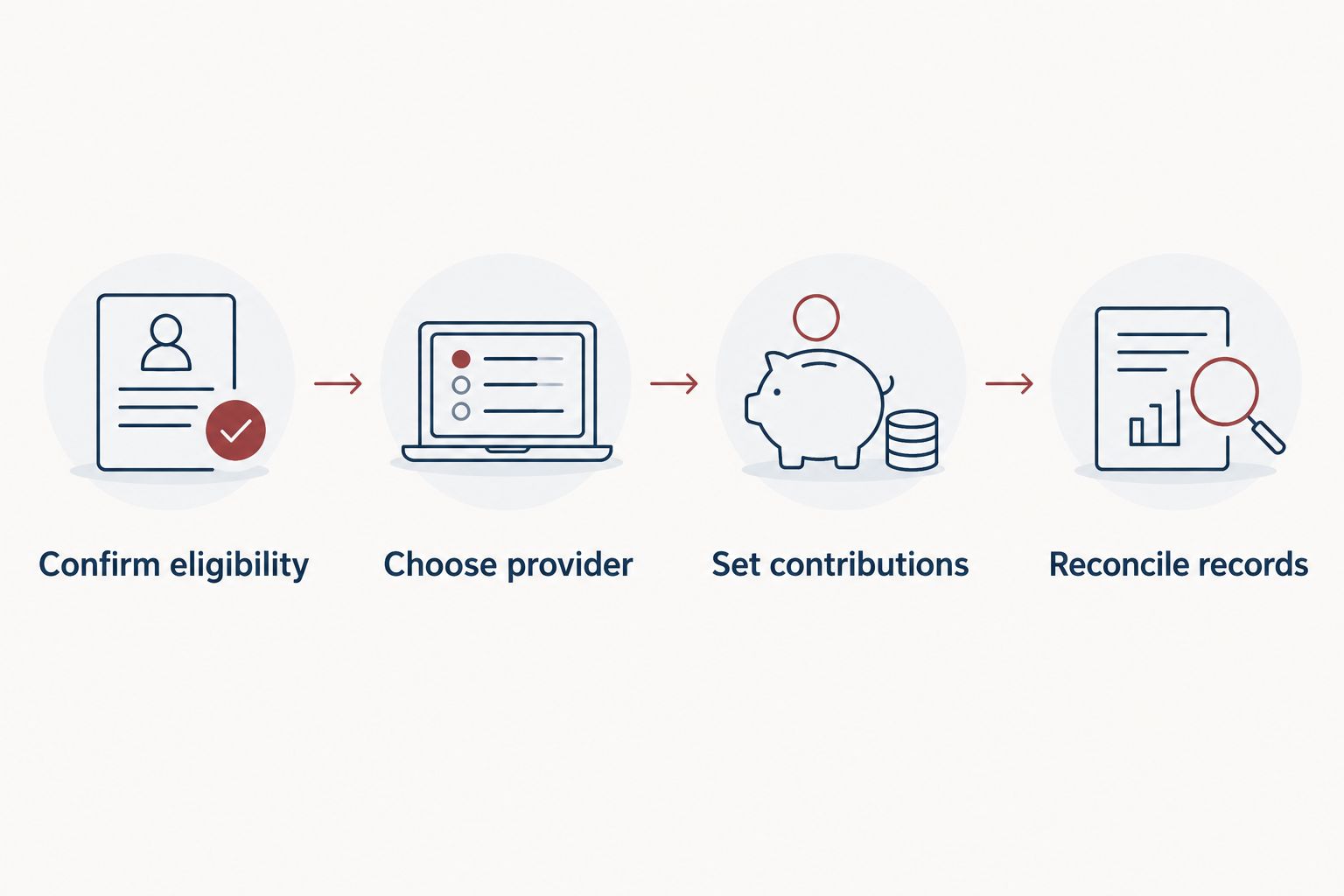
Choose the account after confirming eligibility, then match contributions to payroll records.
The handoff between the third and fourth steps is where an employer choice becomes an accounting task. CEOHAVEN’s bookkeeping services can support the recordkeeping decision; they do not replace the employee’s need to verify personal eligibility or retain medical-expense records.
Review your HSA tax treatment
Connect HSA contribution decisions with tax planning and bookkeeping.
How these HSA providers were ranked
The ranking follows the stated use cases: employee contribution administration, solo-owner investing, and coordination with an established benefits program. It does not rank providers by an unverified claim about current account terms, investment returns, or customer support. Those details require the provider’s current disclosures and a comparison against your actual arrangement.
Lively takes the overall spot because the query asks what works for small business owners, not just what works for one account holder. Fidelity HSA moves ahead when the owner is choosing for themselves and values investment control. HealthEquity becomes relevant when benefits administration, rather than a standalone HSA, drives the decision.
Which HSA provider should you choose?
Choose Lively if you need an employer HSA process for a small team. Choose Fidelity HSA if you are a solo owner making an individual investment-led decision. Choose HealthEquity if the HSA must fit an existing benefits operation. Do not choose any of them until you confirm 2026 eligibility and who will make contributions.
An HSA provider handles the account; it does not decide how your business structure affects tax reporting. CEOHAVEN helps business owners address that separate tax-planning question, including where contribution records meet payroll and bookkeeping. Keep the provider decision and the tax decision connected, but do not confuse one for the other.
FAQ
What is the best HSA provider for a small business owner in 2026?
Lively is the best overall pick for a small business owner administering employee HSA contributions in 2026. Fidelity HSA fits a solo owner focused on investing; HealthEquity fits an established benefits process.
Is Fidelity HSA better than Lively for a sole proprietor?
Fidelity HSA is the stronger pick when a sole proprietor primarily wants self-directed investment access. Lively deserves consideration if the business also needs an employer contribution process.
Can a small business owner contribute to an HSA in 2026?
Yes, a small business owner can contribute when they meet HSA eligibility requirements, including qualifying health coverage. Business structure affects how contributions are reported, so confirm the treatment before setting up deposits.
What is the HSA contribution limit for 2026?
The 2026 limit is $4,400 for self-only coverage or $8,750 for family coverage, before an applicable $1,000 catch-up contribution for eligible people age 55 or older. Employer and employee deposits count toward the same limit.
Can an S corporation pay its owner’s HSA contribution?
An S corporation can make an HSA contribution for an eligible shareholder, but a more-than-2% shareholder does not receive the same treatment as an ordinary employee. Review payroll and individual tax reporting before the contribution is made.
Do employees keep their HSAs when they leave a company?
Yes, an HSA belongs to the account holder, not the employer. Leaving the company does not transfer ownership of the account, although future contribution eligibility depends on the person’s coverage and circumstances.
One last thing
The investment menu is easy to compare; a missed payroll contribution is harder to untangle. Before you select the best HSA provider for small business owners in 2026, ask someone on your team to show exactly how one employee deposit moves from payroll to the HSA and into your books. If that path is unclear, fix it before enrollment.