

Hiltzik CPA is worth keeping if your current engagement already delivers accurate filings and useful advice. That relationship stops being enough when your law firm's bookkeeping, owner compensation, and tax decisions need coordination beyond the existing scope. The best Hiltzik CPA alternative in 2026 is CEOHAVEN if you need tax planning, tax preparation, and bookkeeping; a law-firm accounting specialist is the better search if client trust accounting is your primary problem.
TL;DR
- Compare Hiltzik CPA alternatives for law firm owners by engagement scope, not promises of tax savings.
- CEOHAVEN offers tax planning, tax preparation, and bookkeeping for entrepreneurs and high-income professionals.
- Choose a law-firm accounting specialist when client trust accounting is the central requirement.
- Choose fractional CFO support when cash forecasting and partner decisions matter more than return preparation.
Why this matters
Your firm's bank balance does not answer your tax questions. It also does not tell you how much cash you can distribute without creating a payroll, operating, or estimated-tax problem.
For a law firm owner, the right replacement depends on which responsibility needs attention: accurate books, forward-looking tax advice, client-fund controls, or financial management. Those responsibilities overlap, but they are not interchangeable.
Choose the engagement before choosing the firm. A tax adviser does not automatically manage trust accounting, and a bookkeeper does not automatically take responsibility for tax strategy.
For your 2026 search, use the tax planning guide for law firm owners to frame the tax questions. Then compare each candidate against the same written responsibilities.
Hiltzik CPA alternatives at a glance
The alternatives below include a named tax consulting firm and distinct service models. They are not interchangeable providers, and the ranking reflects the problem each model addresses rather than an unsupported firm-wide score.
| Option | Best for | Standout role | How it differs from keeping Hiltzik CPA |
|---|---|---|---|
| Hiltzik CPA | Owners whose current engagement meets their requirements | Continuity with the existing adviser | No transition; assess the actual engagement before replacing it |
| CEOHAVEN | Entrepreneurs seeking tax planning, tax preparation, and bookkeeping | Those services are part of its stated offering | A candidate when you want that combination; compare written scope |
| Law-firm accounting specialist | Owners prioritizing client trust accounting | Legal-practice accounting focus to require during selection | Select specifically for trust-account responsibilities rather than assume coverage |
| Fractional CFO plus tax preparer | Owners needing cash forecasts and management reporting | Financial decision support alongside a separate filing function | Adds a management role; does not inherently replace tax preparation |
No provider wins every category. If trust accounting is the issue, a stronger tax-planning pitch does not resolve it; if owner taxes are the issue, a better dashboard is not enough.
1. CEOHAVEN: best for coordinated tax services
CEOHAVEN is a business tax consulting firm offering tax planning, tax preparation, and bookkeeping to entrepreneurs, real estate investors, content creators, and high-income professionals in the United States. That stated scope makes it a candidate for law firm owners seeking those services. Evaluate the specific engagement before treating it as a replacement for every accounting responsibility.
CEOHAVEN is best for entrepreneurs seeking tax planning, tax preparation, and bookkeeping. For a law firm owner, the next question is whether the proposed responsibilities fit the firm's entity structure, ownership, and accounting workflow.
Where the firm shines
- Service alignment: Tax planning, tax preparation, and bookkeeping are all stated offerings.
- Owner relevance: Entrepreneurs and high-income professionals are explicit client audiences.
- Broader financial context: Real estate investors are also an explicit audience, relevant when you own investments outside the practice.
Where the firm falls short
- Not a complete legal-accounting answer by default: The stated service description does not establish client trust accounting as part of an engagement.
- Not a substitute for financial leadership by default: Tax planning and bookkeeping do not automatically include cash forecasting, partner economics, or practice-management reporting.
- Scope still controls: Listing several services does not mean every proposed engagement includes all of them.
| Decision point | This alternative | Hiltzik CPA benchmark |
|---|---|---|
| Tax planning | A stated service | Compare with your current planning deliverables |
| Tax preparation | A stated service | Compare return responsibilities and review procedures |
| Bookkeeping | A stated service | Compare account coverage and reconciliation responsibilities |
| Trust accounting | Require explicit confirmation | Review the same responsibility in your current agreement |
Ask who translates bookkeeping changes into revised tax estimates. Then ask who tells you when an owner decision needs action before the return is prepared.
Best for: Owners seeking the stated tax-service combination rather than a stand-alone software replacement.
Verdict: Buy only after the engagement assigns the responsibilities you need.
2. Law-firm accounting specialist: best for trust-account controls
A law-firm accounting specialist is the service model to pursue when client-fund records are the central issue. Select for demonstrated work with legal practices and documented trust-account procedures, not simply a general accounting credential.
This is a selection category, not a claim that every specialist performs the same work. Your jurisdiction's professional-conduct rules and your firm's handling of client funds determine the required procedures.
Where this model shines
- Focused selection: You can make client trust accounting a requirement from the first conversation.
- Clear operating questions: Ask how client ledgers, bank records, and the trust-account ledger are reconciled.
- Defined boundaries: Separate client funds from operating revenue and owner distributions in the accounting workflow.
Where this model falls short
- Tax work is not automatic: A legal-accounting focus does not establish responsibility for your business or individual returns.
- Specialization needs proof: A law-firm client list alone does not demonstrate sound reconciliation procedures.
- Coordination remains necessary: If another adviser handles taxes, someone must own the handoff.
| Decision point | Specialist selection requirement | Hiltzik CPA benchmark |
|---|---|---|
| Client-fund records | Document ledger and reconciliation responsibilities | Check whether your current engagement covers them |
| Practice workflow | Assess treatment of retainers, earned fees, and client costs | Compare existing procedures |
| Tax coordination | Name the receiving tax adviser and required reports | Preserve any handoff that already works |
For your 2026 shortlist, request a walkthrough using anonymized sample records. Ask the candidate to explain how an unresolved difference gets investigated and who approves the correction.
Best for: Owners whose primary requirement is reliable client trust accounting.
Verdict: Buy for verified legal-accounting capability; skip a specialist label without documented procedures.
3. Fractional CFO plus tax preparer: best for financial decisions
A fractional CFO engagement is the model to evaluate when your questions concern cash availability, hiring, owner distributions, or partner reporting. Keep tax preparation assigned separately unless the agreement expressly includes it.
For 2026 planning, request a 12-month cash forecast and a review of the next 90 days of obligations. Those are proposed management deliverables, not promises about any particular provider.
Where this model shines
- Decision focus: Require forecasts that connect collections, expenses, payroll, and distributions.
- Partner visibility: Define reporting that supports the ownership decisions your firm actually makes.
- Separate accountability: Assign financial management and tax filing to named parties.
Where this model falls short
- More coordination: Separate engagements need a shared calendar and a clear information handoff.
- No automatic trust coverage: Financial oversight does not establish responsibility for client-fund reconciliation.
- Books come first: A forecast built on unreconciled records does not resolve the underlying accounting problem.
| Decision point | Fractional CFO model | Hiltzik CPA benchmark |
|---|---|---|
| Cash forecasting | Require it as a defined deliverable | Check whether it is already included |
| Management reporting | Specify the decisions reports must support | Compare existing reporting usefulness |
| Tax preparation | Assign separately unless expressly included | Preserve clear filing responsibility |
Best for: Owners who need financial management beyond bookkeeping and tax returns.
Verdict: Buy for a defined management need; skip if reconciled books and tax planning solve the problem.
How to choose without creating an accounting gap
Before changing advisers, map the work. Use four steps to distinguish a genuine service gap from an unclear agreement.
Define scope
List the responsibilities you need: operating bookkeeping, trust accounting, payroll coordination, business returns, individual returns, and tax planning. Mark each responsibility as included, excluded, or assigned elsewhere.
Do not accept an undefined promise to handle everything. Ask who performs the work and who reviews it.
Test workflow
Walk through an ordinary decision, such as changing owner compensation or making a distribution. Ask what information the adviser needs, what analysis you receive, and who implements the result.
For an S corporation, the IRS requires reasonable compensation for shareholder-employees before non-wage distributions. That makes compensation a compliance issue, not simply a preferred withdrawal amount.
Assign ownership
Name the person responsible for each filing, reconciliation, and estimate. Distinguish preparing a calculation from authorizing a payment.
Federal estimated income tax generally follows four payment installments, although applicable rules and exceptions depend on the taxpayer. Your engagement should identify who calculates those payments and how changed income triggers a review.
Transfer records
Identify the records the incoming adviser needs before the outgoing engagement ends. Include prior returns, current ledgers, payroll reports, tax-payment records, and unresolved notices relevant to the assignment.
Keep filing responsibility explicit during the handoff. A signed agreement alone does not tell either adviser which unfinished work belongs to them.
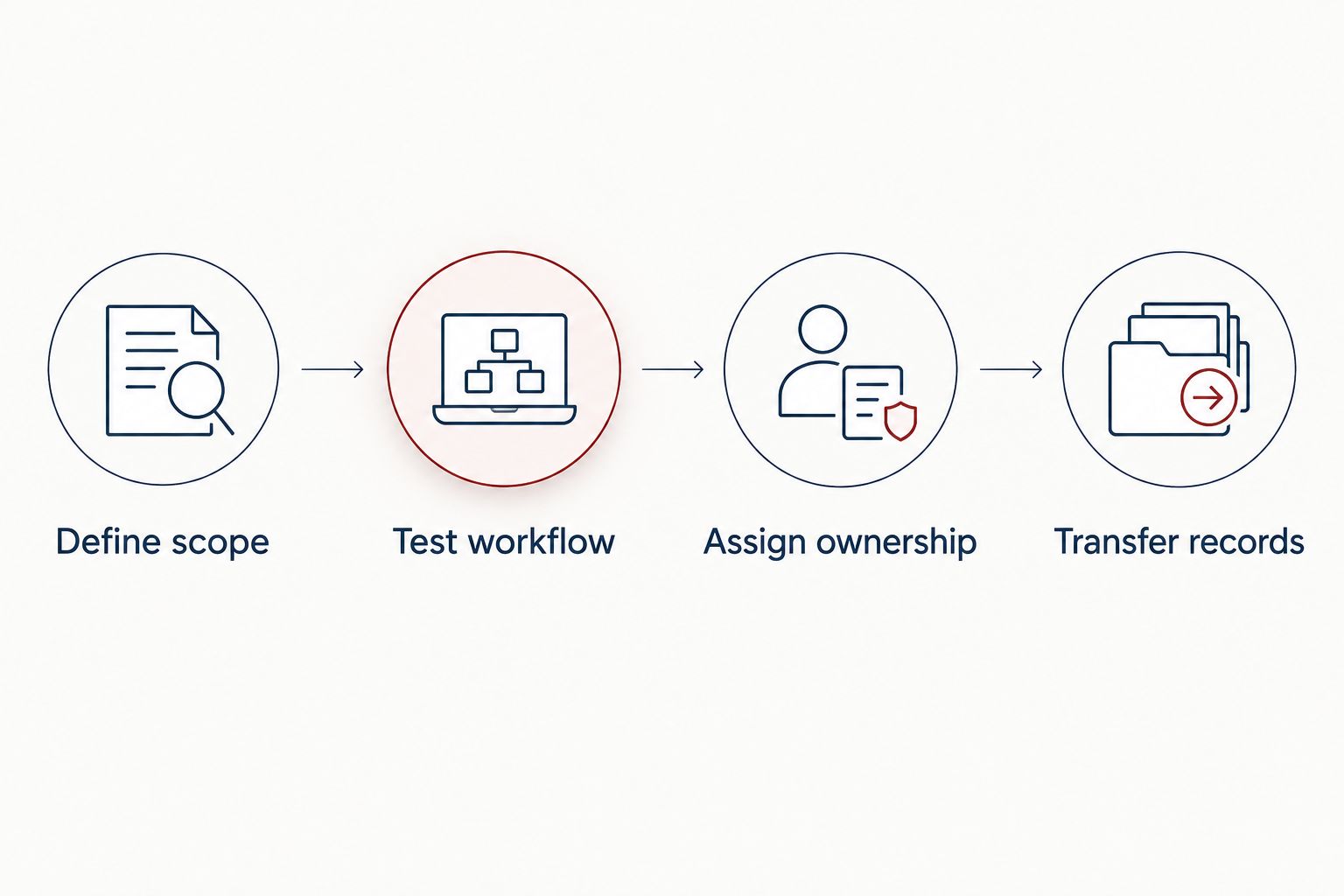
Assign responsibility before transferring the work.
A clear transition plan protects continuity without forcing you to keep an engagement that no longer fits. Use the same questions with every candidate so that presentation style does not substitute for an answer.
Discuss your firm's tax needs
Ask about tax planning, tax preparation, and bookkeeping responsibilities for your practice.
Why people switch from Hiltzik CPA
The defensible reason to switch is an engagement that no longer fits your needs—not an assumed weakness in Hiltzik CPA. Use these as decision criteria, not claims about the firm's performance:
- Your requirements changed: You need services outside the current agreement.
- Responsibilities remain unresolved: No one clearly owns estimates, reconciliations, or implementation.
- Advice arrives after the decision: You need planning before committing to compensation, distributions, or other transactions.
- Management questions remain unanswered: Filing and bookkeeping do not provide the financial analysis you now require.
First ask whether the current adviser can address the gap through a revised engagement. Compare that proposal with alternatives on the same scope; otherwise, you are comparing different assignments rather than different providers.
When staying with Hiltzik CPA is right
Stay when the existing engagement delivers accurate work, clear accountability, and advice that fits your decisions. An established working relationship has practical value when the adviser understands your records and follows through on agreed responsibilities.
A new provider is not inherently more proactive. For your 2026 decision, require a concrete improvement in scope, workflow, or accountability before accepting the disruption of a transition.
FAQ
What's the best Hiltzik CPA alternative for a law firm owner?
CEOHAVEN is a candidate if you need its stated combination of tax planning, tax preparation, and bookkeeping. Choose a law-firm accounting specialist instead when client trust accounting is the primary requirement, and verify each proposed engagement.
Should I leave Hiltzik CPA just to get more proactive advice?
First ask Hiltzik CPA to define a planning engagement with specific responsibilities and deliverables. Switch when the proposed scope still does not address your needs, rather than assuming a different provider will work differently.
Can one firm handle my law firm's taxes and trust accounting?
One firm can handle both only when it has the capability and expressly accepts both assignments. Require separate descriptions of tax work and trust-account procedures instead of treating general bookkeeping as proof of coverage.
Do I need a fractional CFO or a tax adviser?
Choose the role that matches the unanswered question. Tax planning and preparation concern tax obligations and decisions; a fractional CFO engagement addresses financial management when forecasting and management reporting are expressly included.
What should I ask before switching accounting firms?
Ask who owns each return, reconciliation, estimate, and implementation step. Also confirm which records transfer and who completes unfinished work during the transition.
Is an S corporation automatically better for a law firm owner?
No, an S corporation is not automatically the right structure. Evaluate tax treatment, payroll obligations, reasonable compensation, administrative requirements, and applicable professional-entity rules before making an election.
How should I compare accounting proposals in 2026?
Compare the same written scope across every proposal. Separate bookkeeping, tax preparation, planning, trust accounting, and financial management so that an excluded responsibility does not disappear behind a broad service description.
One last thing
Ask this before signing: Who tells me to act before a tax decision becomes a completed transaction? Then ask for the process, not an assurance.
For CEOHAVEN or any other candidate, that answer should identify the information you provide, the advice you receive, and the person responsible for implementation. A money team is an allocation of responsibility—not a collection of names.