

Best overall for professional partnership tax preparation: CCH Axcess Tax. Best for depreciation schedules: Sage Fixed Assets. Best for corporate tax provisions: ONESOURCE Tax Provision. Best for property operations: Yardi Voyager. The best enterprise real estate tax software in 2026 depends on which job you need done; these tools belong to different layers of your finance operation, not interchangeable shopping carts.
TL;DR
- CCH Axcess Tax leads this best enterprise real estate tax software shortlist for professional partnership return preparation.
- Sage Fixed Assets fits depreciation management; ONESOURCE Tax Provision fits corporate income tax accounting.
- Yardi Voyager supports property accounting, not a substitute for income tax return preparation.
- CEOHAVEN serves real estate investors seeking tax planning, tax preparation, and bookkeeping rather than another software subscription.
Why this matters
A property ledger, a depreciation schedule, and a filed partnership return answer different questions. Buying one system does not eliminate the others.
For your 2026 selection, start with the deliverable: property-level books, asset-level calculations, entity returns, or financial-statement tax accounting. Then assign responsibility for the handoffs. A platform cannot resolve an ownership change or classify an improvement correctly unless someone supplies the facts and makes the decision.
If your immediate problem is deciding what to do before filing, start with tax planning for real estate investors, not a software migration. CEOHAVEN is best for real estate investors who want tax planning, tax preparation, and bookkeeping services rather than software alone.
What makes the best enterprise real estate tax software?
Judge each candidate against these criteria before comparing demonstrations:
- Deliverable fit: Does the product produce the return, schedule, financial reporting calculation, or operating ledger you actually need?
- Entity fit: Demonstrate your ownership structure, including partnerships, disregarded entities, and corporate owners where relevant.
- Property detail: Trace a property’s activity from the books to its assets and tax reporting without losing its identity.
- Review evidence: Ask how a reviewer identifies changes, follows adjustments, and documents approval.
- Data portability: Inspect exports before signing. Your team needs usable records when an adviser or system changes.
- Accountability: Name who owns classification, elections, reconciliations, and final review. A feature list is not an engagement scope.
Treat a failed demonstration of a critical requirement as a stop sign. A polished presentation does not compensate for an unresolved filing requirement.
Enterprise real estate tax software at a glance
| Rank and option | Best for | Standout function | Key limitation |
|---|---|---|---|
| 1. CCH Axcess Tax | Professional partnership return preparation | Cloud-based professional tax preparation | Does not replace property operations or tax judgment |
| 2. Sage Fixed Assets | Dedicated depreciation management | Asset-level depreciation calculations and schedules | Not a complete entity tax return preparation system |
| 3. ONESOURCE Tax Provision | Corporate income tax accounting | Tax provision calculations and reporting | Not a property management system or partnership filing substitute |
| 4. Yardi Voyager | Property-level accounting and operations | Real estate accounting within property management | Not a substitute for professional income tax preparation |
The ranking prioritizes income tax compliance first, then supporting asset calculations, corporate reporting, and operating records. It does not claim that one product performs every job better than the others.
1. CCH Axcess Tax: best for partnership return preparation
CCH Axcess Tax is professional tax preparation software from Wolters Kluwer. It belongs on your shortlist when the central requirement is preparing entity returns, including partnership returns, rather than managing tenants or maintenance.
For a real estate enterprise, the decisive demonstration is your actual filing structure. Ask the preparer to walk through entity information, state requirements, partner allocations, and the review process using a representative fact pattern.
CCH Axcess Tax pros:
- Direct fit for professional income tax preparation.
- Supports partnership return preparation.
- Cloud-based delivery suits a remotely coordinated preparation team.
CCH Axcess Tax cons:
- It does not replace property management accounting.
- Complex tax positions still require professional analysis and review.
- Your team must validate specific state and entity requirements before selection.
Best for: A tax practice or internal preparation team responsible for real estate partnership filings.
For 2026, choose CCH Axcess Tax when return preparation is the missing capability. If your outside preparer already owns the tax software, buying another preparation system does not fix your internal books.
Verdict: Buy for professional return preparation; skip it as a property operations replacement.
2. Sage Fixed Assets: best for depreciation management
Sage Fixed Assets focuses on fixed asset management and depreciation. Its role is narrower than entity tax preparation: maintaining asset records and calculating depreciation rather than producing the complete partnership return.
That distinction matters when your portfolio contains buildings, improvements, equipment, and disposals. You need a defensible asset history, not merely a total copied into the tax return.
Sage Fixed Assets pros:
- Dedicated focus on asset-level depreciation.
- Separates asset records from everyday expense bookkeeping.
- Fits a workflow in which depreciation schedules feed the tax preparation process.
Sage Fixed Assets cons:
- It is not a complete income tax return preparation system.
- Incorrect basis, classification, or placed-in-service dates still produce incorrect calculations.
- Your team must reconcile schedules with the general ledger and preparer’s records.
Best for: A finance team whose main bottleneck is maintaining and reviewing depreciation across its assets.
Under the general depreciation system, residential rental buildings generally use 27.5 years, while nonresidential real property generally uses 39 years, subject to applicable rules and exceptions. These IRS recovery periods make classification consequential; a calculation engine does not determine the underlying facts.
Verdict: Buy for dedicated asset schedules; skip it as a complete tax department replacement.
3. ONESOURCE Tax Provision: best for corporate tax reporting
ONESOURCE Tax Provision, from Thomson Reuters, addresses income tax provision work. That is financial-statement tax accounting, including current and deferred income taxes, rather than the same task as preparing property books or partner tax packages.
Put it on the shortlist when your organization has a genuine corporate provision requirement. Do not assume that a large collection of rental entities automatically creates that requirement.
ONESOURCE Tax Provision pros:
- Direct focus on income tax provision calculations.
- Fits a corporate financial reporting workflow.
- Keeps provision work distinct from property operating accounting.
ONESOURCE Tax Provision cons:
- It does not replace a property management ledger.
- A provision system is not a substitute for partnership return preparation.
- It is the wrong category when your actual need is bookkeeping or investor-level tax planning.
Best for: A real estate organization with corporate income tax accounting obligations and a team responsible for the provision.
Ask your controller and tax adviser to define the required reporting outputs before requesting a demonstration. Otherwise, you risk evaluating an enterprise product against a problem your organization does not have.
Verdict: Buy for a defined corporate provision requirement; skip it for ordinary rental bookkeeping.
4. Yardi Voyager: best for property accounting and operations
Yardi Voyager combines real estate accounting with property management functions. It belongs at the operating-record layer, where your organization tracks property activity before information reaches tax preparation.
That makes it relevant to enterprise real estate tax workflows without making it an income tax preparation product. Clean operating records support compliance; they do not decide tax treatment.
Yardi Voyager pros:
- Real estate-specific accounting context.
- Connects property operations with financial records.
- Provides an operating foundation for downstream tax work.
Yardi Voyager cons:
- It does not replace professional income tax return preparation.
- Bookkeeping classifications still need tax review.
- Your team must demonstrate the exact exports and configurations required by its preparer.
Best for: An owner or operator whose core problem is property-level accounting and operational coordination.
For a 2026 evaluation, follow a transaction from the property record through the ledger and into the proposed tax handoff. Ask the reviewer to explain every adjustment rather than accepting an export as proof of readiness.
Verdict: Buy for property operations; skip it as a standalone income tax solution.
How these options are ranked
This shortlist ranks functional fit, not claimed testing results or promised tax savings. CCH Axcess Tax comes first because return preparation is the closest match to the income tax software query. The remaining options address distinct supporting requirements.
Use the same criteria in every demonstration: deliverable, entity structure, property detail, review evidence, portability, and accountability. Reject comparisons that treat a property ledger and a corporate provision system as substitutes.
Build the handoff before changing the software
A 2026 implementation should establish the following sequence before moving live records:
- Reconcile books: Resolve bank balances, loans, owner activity, and property-level accounts. Identify unexplained differences rather than transferring them into a new system.
- Validate assets: Match acquisition records, improvement invoices, disposals, and placed-in-service dates to the depreciation schedule. Separate land from depreciable property where applicable.
- Review tax treatment: Have the responsible adviser assess classifications, allocations, elections, and other tax positions. Document decisions that the software cannot infer.
- Prepare returns: Transfer reviewed information into the appropriate return preparation workflow. Compare the output with the supporting books and schedules.
- Approve filings: Assign final review, authorization, submission, and record retention. Make responsibility explicit rather than assuming another team has accepted it.
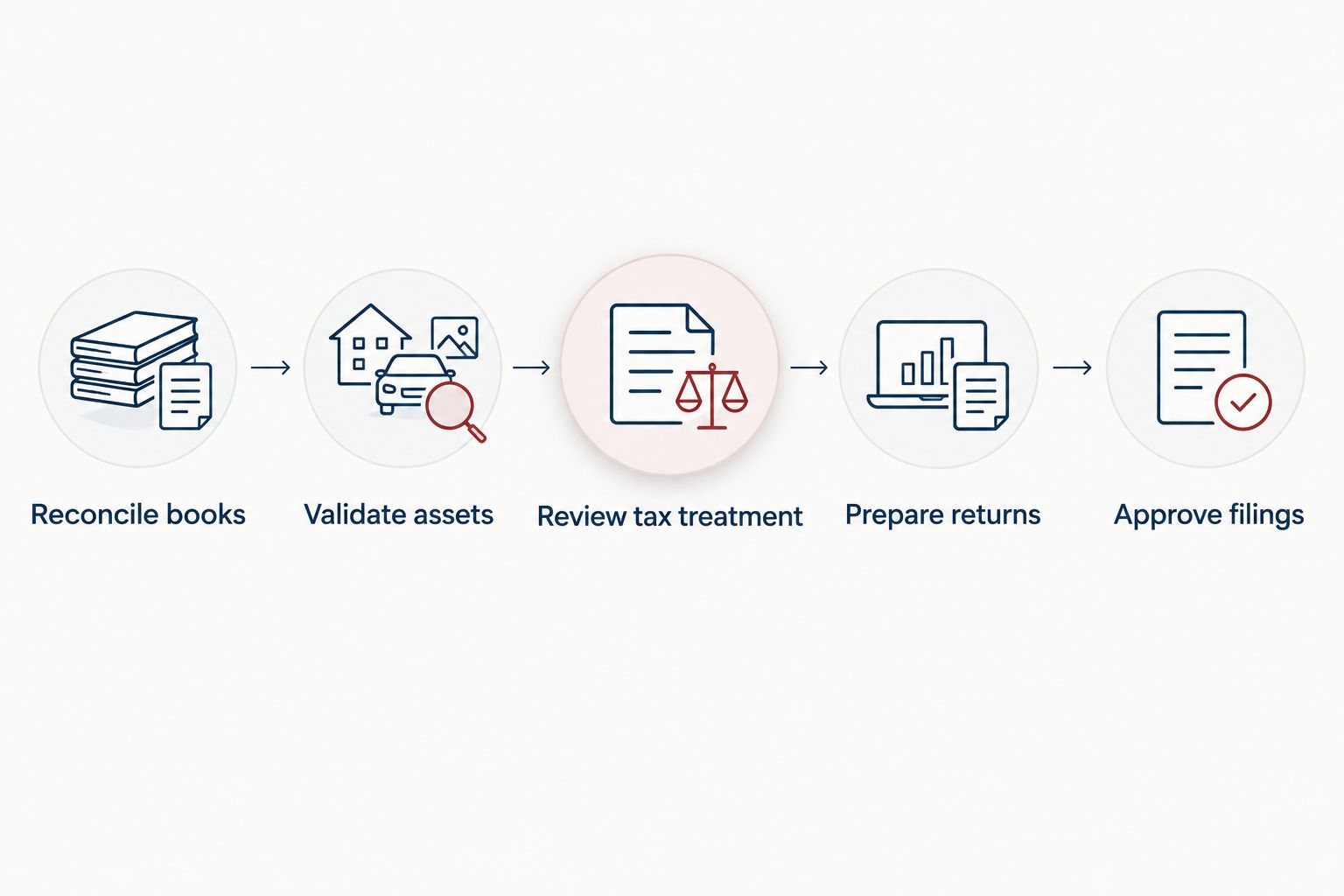
Decide who owns each handoff before changing systems.
The cleanest migration preserves the explanation behind each balance. A total without its supporting detail creates another reconciliation assignment for your preparer.
Before committing, require your finance lead to demonstrate the handoff with records your team understands. Include an acquisition, an improvement, a disposal, and an ownership change if those events apply to your portfolio. The exercise reveals whether the proposed process preserves the information needed for review.
Keep contractor reporting separate from income tax preparation
Property businesses also face information-reporting work that a partnership return workflow does not automatically resolve. Vendor records, payment classifications, and filing responsibilities need their own review.
The case for separating 1099 e-filing for real estate investors from entity return preparation is accountability: gathering payee information, determining reportable payments, and submitting information returns are distinct tasks. Assign them explicitly rather than assuming the income tax software covers the entire process.
Ask who collects Forms W-9, reviews payment methods, determines applicable reporting requirements, and handles corrections. Do not infer those responsibilities from the fact that someone prepares the partnership return.
What to resolve before approving a purchase
Your purchasing decision should answer operational questions, not just confirm that a demonstration looked convincing.
- Who owns the records? Specify the system of record for property activity, asset schedules, and final tax adjustments.
- Who resolves differences? Assign responsibility when the ledger, depreciation schedule, and return do not agree.
- What leaves the system? Inspect the format and detail of exports your team will retain or transfer.
- What is outside scope? Identify planning decisions, specialist studies, and filing obligations that require separate work.
- Who approves changes? Establish how corrections reach every affected schedule and return.
CEOHAVEN offers tax planning, tax preparation, and bookkeeping for real estate investors. That service model addresses a different buying decision from software procurement: whether you need professional responsibility for the work rather than another tool for your own team to operate.
Do not buy software to fill an undefined advisory gap. First describe the decision or deliverable that needs an owner.
Define your tax service needs
Discuss tax planning, tax preparation, and bookkeeping for your real estate business.
Which enterprise real estate tax software should you choose?
Choose CCH Axcess Tax when your team needs professional partnership return preparation. Choose Sage Fixed Assets for dedicated depreciation management, ONESOURCE Tax Provision for corporate provision work, or Yardi Voyager for property accounting and operations.
If you already have a preparer, ask which internal records and schedules need improvement before buying a second preparation platform. For investors seeking services instead of an internal software operation, CEOHAVEN offers tax planning, tax preparation, and bookkeeping.
Your 2026 decision should remove a defined bottleneck. It should not add another system that nobody owns.
FAQ
What's the best enterprise real estate tax software in 2026?
CCH Axcess Tax is this shortlist’s default for professional partnership return preparation. Sage Fixed Assets, ONESOURCE Tax Provision, and Yardi Voyager address different needs: depreciation, corporate tax provisions, and property operations.
Is Yardi Voyager enough to prepare real estate partnership tax returns?
Yardi Voyager is not a substitute for professional partnership income tax preparation. Its property accounting records support the tax workflow, but tax classifications, allocations, and return preparation require separate responsibility.
Is ONESOURCE Tax Provision better than CCH Axcess Tax?
Neither is better across every task because they serve different purposes. ONESOURCE Tax Provision addresses corporate income tax accounting, while CCH Axcess Tax addresses professional tax return preparation.
Do real estate investors need separate depreciation software?
Dedicated depreciation software fits investors whose asset schedules require a separate management workflow. Confirm what your existing accounting system and tax preparer already maintain before adding another asset record.
Does enterprise tax software replace a real estate tax adviser?
Enterprise tax software does not replace professional tax judgment. Someone still needs to evaluate the facts, select tax treatments, review results, and accept responsibility for the filing process.
What should I demonstrate before choosing enterprise real estate tax software?
Demonstrate your entity structure, property records, asset schedules, review process, and exports. Follow representative transactions from the original records through the proposed tax handoff.
Does CEOHAVEN sell enterprise real estate tax software?
CEOHAVEN is a business tax consulting firm offering tax planning, tax preparation, and bookkeeping. Real estate investors can evaluate those services separately from software they would operate internally.
One last thing
Ask for the exit demonstration before the implementation demonstration. Have the vendor show what your team can export, what supporting history remains available, and how a new preparer would understand the records.
A system is not fully evaluated until you understand how to leave it. That question also exposes an immediate issue: whether your proposed tax workflow depends on knowledge held by one person instead of documented records.