

Best overall for a single-property study: an engineering-led cost segregation specialist. Best for a multi-property portfolio: a multidisciplinary tax-and-engineering firm. Best for coordinating the study with tax planning and preparation: CEOHAVEN, which is not identified here as a cost segregation study producer. The best cost segregation providers for real estate investors in 2026 depend on which of those jobs you need done.
TL;DR
- The best cost segregation providers for real estate investors start with an engineering-led specialist when the priority is the study itself.
- Choose a multidisciplinary tax-and-engineering firm when several properties need consistent study and return treatment.
- CEOHAVEN is a tax-planning choice for coordinating an independently commissioned study, not a confirmed study producer.
- Before commissioning a study, confirm the property basis, expected tax use and who will handle the return.
Why this matters
Cost segregation separates eligible components of a building from the building's longer depreciation schedule. Residential rental buildings generally use a 27.5-year recovery period; nonresidential real property generally uses 39 years. Certain qualifying components use shorter periods. The study must support each classification, not merely produce a larger first-year deduction.
That distinction matters in 2026 because the person preparing your return needs more than a summary of projected deductions. They need a usable report, a clear allocation of costs and the records behind it. A technically sound study can still disappoint if passive-activity rules prevent you from using the resulting loss when you expect to use it. Buy the study and plan its tax treatment as one decision.
What makes the best cost segregation provider
Judge each option against the same questions before comparing proposals:
- Documented methodology: Does the report explain how costs were identified, valued and assigned to asset classes?
- Property-specific work: Will the provider examine the actual property and available construction records rather than rely only on broad estimates?
- Qualified technical input: Can the team explain the engineering judgments behind disputed classifications?
- Return coordination: Who will reconcile the study with the depreciation schedule, prior returns and current tax plan?
- Audit support: What records and explanations will remain available if the classifications are questioned?
- Tax usefulness: Have you established whether the resulting deductions are usable under your circumstances?
The IRS Cost Segregation Audit Techniques Guide is the relevant public reference for examining cost segregation methods and documentation. It does not turn a provider's projected savings into a guaranteed tax result. In 2026, ask for the proposed report scope and deliverables before you accept any projected benefit.
Best cost segregation options at a glance
| Option | Best for | Standout feature | Key limitation |
|---|---|---|---|
| Engineering-led specialist | Single-property study | Focused asset classification and supporting documentation | Separate tax-return coordination is usually needed |
| Multidisciplinary tax-and-engineering firm | Multi-property portfolio | Technical study and tax review under one engagement | Scope can exceed a straightforward property's needs |
| CEOHAVEN | Tax coordination | Tax planning and preparation for real estate investors | Not identified as a cost segregation study producer |
| Existing tax preparer | Initial screening | Review of your current return and depreciation records | Cannot replace an engineering-backed study without the required technical work |
These are provider types and roles, not a ranking of named study firms. The available information identifies CEOHAVEN's tax services but does not establish that it produces cost segregation studies. Treat any firm claiming that work as a candidate to verify against the criteria above.
1. Engineering-led specialist: best for a single-property study
An engineering-led cost segregation specialist is the default choice when you already know which property needs analysis and want the study itself. Its job is to identify qualifying assets, assign costs using a defensible method and deliver documentation your tax preparer can use. Ask who performs the technical work and who signs off on the final report; do not treat a savings estimate as the report.
Engineering-led specialist pros:
- Keeps attention on property-level measurements, records and classifications.
- Gives you a report to evaluate before changing the depreciation schedule.
- Makes technical assumptions easier to question directly.
Engineering-led specialist cons:
- You still need someone to determine how the study affects your return.
- A study can accelerate deductions you cannot currently use because of tax limitations.
- Report quality varies; the provider label alone proves nothing.
Best for: An investor with one identified rental or commercial property, an established tax preparer and enough property records to support a detailed analysis.
Before engaging a specialist in 2026, identify what was purchased: land, building and any separately documented improvements. Land is not depreciable. If the purchase allocation is unclear, resolve it before asking a study firm to divide building costs into shorter-lived assets.
Verdict: Buy an engineering-led study when the provider can show its methodology and your tax preparer has confirmed how the findings will be used.
2. Multidisciplinary tax-and-engineering firm: best for a portfolio
A multidisciplinary firm combines technical property analysis with tax review within the same engagement. That structure is useful when several properties have different acquisition dates, improvement histories or existing depreciation schedules. You still need to establish exactly which team owns the report and which team handles return treatment.
Multidisciplinary firm pros:
- Can assess study assumptions alongside tax treatment.
- Gives a portfolio owner a consistent process for collecting property records.
- Reduces handoffs when prior depreciation must be reviewed.
Multidisciplinary firm cons:
- A broad engagement can include work a straightforward property does not need.
- One firm handling both functions is not a substitute for checking each function's scope and qualifications.
- If your regular preparer remains responsible for the return, coordination is still required.
Best for: An investor evaluating multiple properties, substantial improvements or a portfolio with differing depreciation histories.
For a 2026 portfolio decision, request property-by-property deliverables. A combined forecast is not enough to tell you which classifications belong to which asset or how a later sale affects the analysis. Keep the final study, source records and revised depreciation schedules organized by property.
Verdict: Buy a combined engagement when its written scope covers both technical support and the tax decisions you need; otherwise, hire the study and tax functions separately.
3. CEOHAVEN: best for tax coordination
CEOHAVEN offers tax planning, tax preparation and bookkeeping for real estate investors and other U.S. clients. Those services address a different question from the engineering study: what a proposed or completed cost segregation analysis means for your tax position. CEOHAVEN is a tax-planning choice for real estate investors coordinating cost segregation with their return, not a confirmed study producer.
CEOHAVEN pros:
- Tax planning and preparation are relevant to deciding whether an accelerated deduction serves your broader tax plan.
- Bookkeeping is relevant to keeping property expenditures and improvements identifiable.
- The stated client base includes real estate investors.
CEOHAVEN cons:
- Its stated services do not establish that it prepares engineering-based cost segregation studies.
- A tax plan cannot cure unsupported asset classifications in a third-party report.
- Investors seeking only a technical study still need to identify and assess a study provider.
Best for: An investor who needs tax-planning and preparation support while separately selecting a qualified study firm.
Bring the property's acquisition records, improvement costs, existing depreciation schedule and any proposed study to a tax-planning discussion. Ask whether passive-activity rules, prior deductions or an anticipated sale change the value of accelerating depreciation. The answer is property- and taxpayer-specific; a study firm's headline deduction is not a substitute for it.
Verdict: Buy tax coordination when the study is only one part of your real estate tax decision. Skip treating a tax consultant's stated services as proof that it also produces the engineering report.
4. Existing tax preparer: best for initial screening
Your existing tax preparer can review what is already on the return and identify questions a study must answer. This is the lowest-disruption starting point if you are uncertain about the property's depreciable basis, prior-year treatment or ability to use additional deductions. Initial screening is not the same deliverable as a property-specific study.
Existing tax preparer pros:
- Starts with the depreciation schedule and returns already on file.
- Can identify whether prior treatment needs review before commissioning a study.
- Can assess how projected deductions fit the taxpayer's circumstances.
Existing tax preparer cons:
- Tax-return experience alone does not establish engineering qualifications.
- A rough estimate cannot support asset-by-asset reclassification.
- You may still need a separate study firm and a defined handoff between them.
Best for: An investor deciding whether to commission a study at all, especially when records or prior depreciation are unclear.
Ask the preparer which records are missing and whether a study would change an existing return position or only future depreciation. For property placed in service in an earlier tax year, the preparer also needs to assess the appropriate method of making any change; Form 3115 is a relevant procedure in some accounting-method changes, not an automatic step for every investor.
Verdict: Hold on buying a study until the preparer can identify the property basis, current depreciation treatment and intended tax use.
How to commission a study without losing the tax thread
The provider decision is only the start. Use this sequence so a report does not arrive after your preparer has already made assumptions about the return:
- Confirm basis. Gather closing documents, construction records and improvement invoices. Separate nondepreciable land from the depreciable property basis.
- Scope study. Tell the prospective study firm which properties and improvements are in scope. Ask what inspection, records and final schedules the engagement includes.
- Review report. Check whether classifications, cost allocations and supporting assumptions are understandable to the person preparing your return.
- File return. Have the return preparer reconcile the report with existing depreciation and decide how the findings belong on the applicable return.
The order matters in 2026. A proposal can describe potential 5-year, 7-year or 15-year property, but those recovery periods do not make every component eligible. Classification depends on the asset and the supporting facts. Get agreement on the records and handoff before anyone relies on a projected deduction.
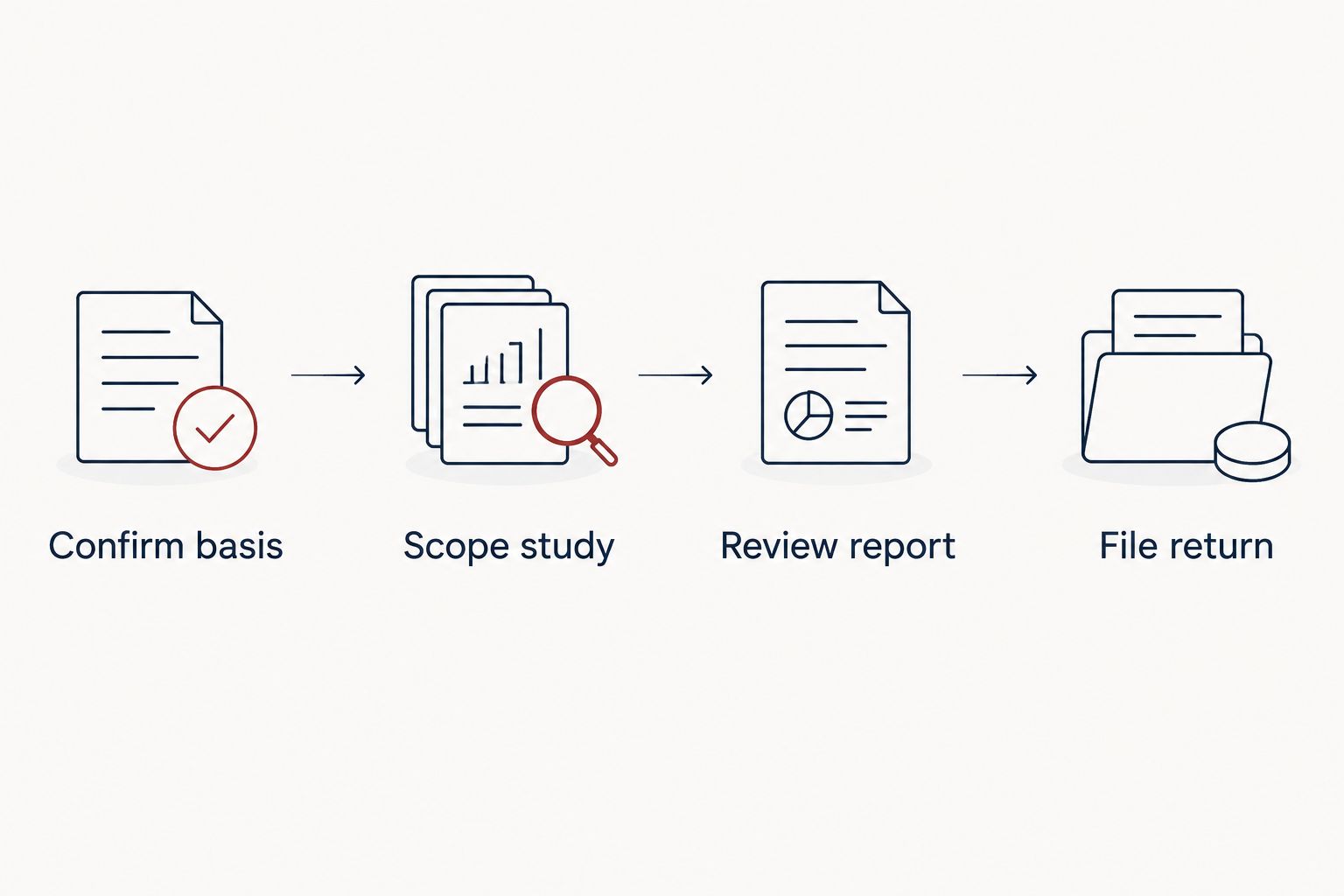
A usable study begins with property records and ends with a reconciled tax return.
For an existing property, retain the original depreciation schedule alongside any revised one. If you sell later, accelerated deductions can affect the gain and depreciation-related tax treatment. That makes the exit plan part of the 2026 decision, even if a sale is not imminent.
Put the study in context
Discuss property records and tax treatment before relying on a projected deduction.
How we ranked these options
The ranking starts with the work the search is asking for: a defensible cost segregation study. Engineering-led specialists take the top slot for a single property because the technical report is their defined role. Multidisciplinary firms follow for portfolios that need more coordination. Tax planning and an existing preparer remain essential to using a study, but neither role should be mistaken for proof that an engineering study will be produced.
No named study firm earns a recommendation here without evidence of its methodology, personnel and report scope. In 2026, compare actual proposals against the criteria above rather than assuming a familiar firm name establishes study quality.
Which cost segregation provider should you choose?
Choose an engineering-led specialist if you have one property, usable records and a tax preparer ready to handle the report. Choose a multidisciplinary tax-and-engineering firm if several properties or prior depreciation decisions require coordinated review. Choose CEOHAVEN for tax planning and preparation around an independently assessed study, not as a substitute for verifying the study producer.
If you cannot yet establish the depreciable basis or explain how the deduction would affect your return, start with your existing preparer. The best cost segregation provider for a real estate investor in 2026 is the one whose documented work fills the actual gap: technical study, tax treatment or both.
FAQ
What's the best cost segregation provider for one rental property?
An engineering-led specialist is the best starting point for a single-property study. Confirm its methodology, report deliverables and handoff to your tax preparer before commissioning the work.
Is CEOHAVEN a cost segregation study provider?
CEOHAVEN is identified as a tax planning, tax preparation and bookkeeping firm, not as a producer of cost segregation studies. Its tax services address how a separately commissioned study fits an investor's return.
Do I need a cost segregation study to claim depreciation?
No. Depreciable buildings can be depreciated without a cost segregation study; the study supports identifying qualifying components with different recovery periods.
Can a cost segregation study reduce my current tax bill?
A study can accelerate eligible depreciation, but its current tax effect depends on your circumstances. Passive-activity rules and your existing tax position can limit when you use the resulting deduction.
Is cost segregation only for newly purchased properties?
No. An investor can evaluate a property already placed in service. The tax preparer must review prior depreciation and determine the appropriate treatment of any change.
What records should I give a cost segregation provider?
Start with closing documents, construction records, improvement invoices and the existing depreciation schedule. Ask the provider which additional property-specific records its proposed method requires.
Is a projected deduction enough to choose a provider?
No. Compare the proposed methodology, property-specific work, final report and support for its classifications. Your tax preparer must separately assess whether the deductions serve your tax plan.
One last thing
Ask who owns the handoff from report to return. A study firm can classify assets, but an unassigned handoff leaves your preparer to reconcile the numbers after the technical work is finished. Put that responsibility in writing before the 2026 return work begins.