

Best specialist starting point: Kravitz. Best tax-centered shortlist option: Emparion. Best owner-focused shortlist option: Dedicated Defined Benefit Services. For 2026, choose a cash balance plan provider by actuarial design, employee funding obligations, and ongoing administration—not the largest proposed deduction.
TL;DR
- The best cash balance plan providers for business owners match actuarial design to sustainable funding, not a deduction target.
- Shortlist Kravitz, Emparion, and Dedicated Defined Benefit Services; compare written proposals using identical employee information.
- CEOHAVEN provides tax planning, tax preparation, and bookkeeping—not an assumed substitute for a plan actuary.
- Request employee contribution estimates, downside funding scenarios, and clear responsibility for annual retirement plan compliance.
Why this matters
A cash balance plan is a defined benefit pension plan, even though participants see benefits expressed as account balances. The employer bears the investment risk and must satisfy applicable funding requirements. A strong investment year does not turn the arrangement into a discretionary savings account.
For an entrepreneur with consistent profits, that structure deserves consideration. For an owner whose available cash changes sharply, the funding commitment deserves equal attention. A deduction is not a return on investment; money contributed to the plan leaves your operating account.
CEOHAVEN provides tax planning, tax preparation, and bookkeeping for business owners and high-income professionals. Keep that tax role distinct from the actuary, plan administrator, investment adviser, and custodian roles involved in implementing a pension plan.
What makes the best cash balance plan providers?
Evaluate these criteria before comparing names. A recognizable provider still needs to produce a design that works for your actual business.
- Actuarial accountability: Identify the enrolled actuary responsible for funding calculations and required actuarial certifications.
- Employee economics: Compare the owner's projected benefit with required contributions for eligible employees across the retirement plan arrangement.
- Funding resilience: Ask how investment results, compensation changes, hiring, and departures affect future contributions.
- Administrative scope: Establish who handles documents, testing, participant notices, filings, and corrections.
- Investment alignment: Require coordination between the investment adviser and actuary around the plan's benefit obligations.
- Exit planning: Understand amendment, freeze, termination, and distribution procedures before signing.
For your 2026 search, request 3 written proposals using the same ownership information, employee census, compensation, and existing retirement plan documents. Different assumptions produce different illustrations; those are not meaningful provider comparisons.
Cash balance plan providers at a glance
These firms belong on a specialist shortlist. The use-case labels describe where to begin your evaluation, not verified differences in investment performance, service quality, or tax savings.
| Provider | Best for | Relevant focus | Key limitation to resolve |
|---|---|---|---|
| Kravitz | Established employers seeking a cash balance specialist | Cash balance plan design and administration | Confirm the exact service team and division of responsibilities |
| Emparion | Owners starting with a tax-planning objective | Defined benefit and cash balance plan services | A proposed deduction still needs an independent cash-flow review |
| Dedicated Defined Benefit Services | Owner-focused businesses evaluating a defined benefit plan | Defined benefit plan design and administration | An owner-focused illustration must still account for every eligible employee |
No provider can determine your appropriate contribution from revenue alone. Employee ages, compensation, ownership, related businesses, existing benefits, and plan provisions all affect the analysis.
1. Kravitz: best cash balance specialist for established employers
Kravitz specializes in cash balance retirement plans, including plan design and administration. Start here when your business needs a pension specialist rather than another account-opening service.
The substantive question is whether the proposed design connects employee benefits, actuarial funding, and administration. Ask the team to explain the employer's obligations in plain language before discussing the owner's preferred contribution.
Kravitz pros:
- Cash balance specialization directly matches the retirement arrangement under consideration.
- A specialist discussion puts actuarial design ahead of selecting investments.
- Design and administration belong in the same evaluation, reducing the risk of comparing setup work alone.
Kravitz cons and trade-offs:
- Specialist plan administration does not replace business-wide tax advice.
- The provider name does not establish which services, professionals, or correction work your engagement includes.
Best for: An established employer seeking a specialist proposal that addresses both owners and employees.
Request the proposed funding range, employee contribution schedule, annual deliverables, and named contacts. Also ask how changes in ownership or an acquisition would enter the review process.
Verdict: Buy only after the written engagement assigns actuarial and administrative responsibility.
2. Emparion: best shortlist option for a tax-centered evaluation
Emparion works with cash balance and other defined benefit retirement plans. It belongs on your shortlist when the initial question is how a pension arrangement fits your business tax position.
Start with the tax objective, but do not let it dictate the answer. The appropriate plan must also fit payroll, employee eligibility, liquidity, and your willingness to maintain an employer-funded benefit.
Emparion pros:
- Its defined benefit focus matches owners evaluating pension-based retirement contributions.
- Cash balance expertise is relevant when comparing a pension arrangement with an existing defined contribution plan.
- A specialist proposal provides a concrete design for your tax adviser to evaluate.
Emparion cons and trade-offs:
- A large illustrated contribution does not establish that the business should fund it.
- Plan-specific advice does not resolve every entity, compensation, or personal tax question.
Best for: An owner who wants to evaluate a cash balance plan within a broader tax strategy.
Require the proposal to separate the projected contribution, estimated deduction, employee obligations, and assumptions. Your tax adviser should then assess the deduction alongside other business decisions rather than treating it as an isolated win.
Verdict: Buy only when the tax analysis and funding analysis support the same design.
3. Dedicated Defined Benefit Services: best owner-focused shortlist option
Dedicated Defined Benefit Services focuses on defined benefit retirement plans for self-employed individuals and small businesses. Consider it when you need to establish whether an owner-focused pension arrangement fits the business at all.
An owner-only company and a company with employees present different design questions. Supply complete information about spouses, employees, ownership interests, and related businesses before relying on an illustration.
Dedicated Defined Benefit Services pros:
- Its defined benefit focus matches the underlying pension structure.
- Its self-employed and small-business focus is relevant to owner-led firms.
- A specialist evaluation helps distinguish pension funding from ordinary retirement account contributions.
Dedicated Defined Benefit Services cons and trade-offs:
- A simple ownership structure does not eliminate actuarial or administrative obligations.
- Hiring employees or operating related businesses can change the analysis supporting an initial design.
Best for: A self-employed owner or closely held business beginning a defined benefit feasibility review.
Ask the provider to document eligibility assumptions and explain which business changes require an immediate review. Do not assume that a plan suitable before hiring remains appropriate afterward.
Verdict: Buy only after employee eligibility and related-business questions are resolved.
How this ranking works
The ranking prioritizes specialist relevance, then separates providers by the question an owner needs answered first: established-employer design, tax-centered evaluation, or owner-focused feasibility. It is not a ranking of measured service performance or investment returns.
For 2026, the deciding evidence is your written proposal. Move any provider down your shortlist if the proposal leaves employee funding, actuarial responsibility, or ongoing administration unclear.
Stress-test the contribution before you approve it
Ask each provider to model 3 funding scenarios: expected operations, lower business earnings, and investment results below the plan's assumptions. These are decision scenarios, not predictions.
A cash balance benefit generally includes a pay credit and an interest credit under the plan's terms. Those credits are not simply whatever the investments earn. Your actuary and investment adviser need to address the difference between promised benefits and asset performance.
Use this sequence:
- Employee census: Confirm ages, compensation, service, ownership, and related-business information.
- Plan design: Identify benefit provisions and how the pension interacts with existing retirement plans.
- Funding scenarios: Compare required funding under the agreed assumptions and stress cases.
- Cash forecast: Put contributions into a 12-month cash forecast alongside taxes, payroll, debt, and operating reserves.
- Annual review: Assign responsibility for updated data, funding calculations, filings, and notices.
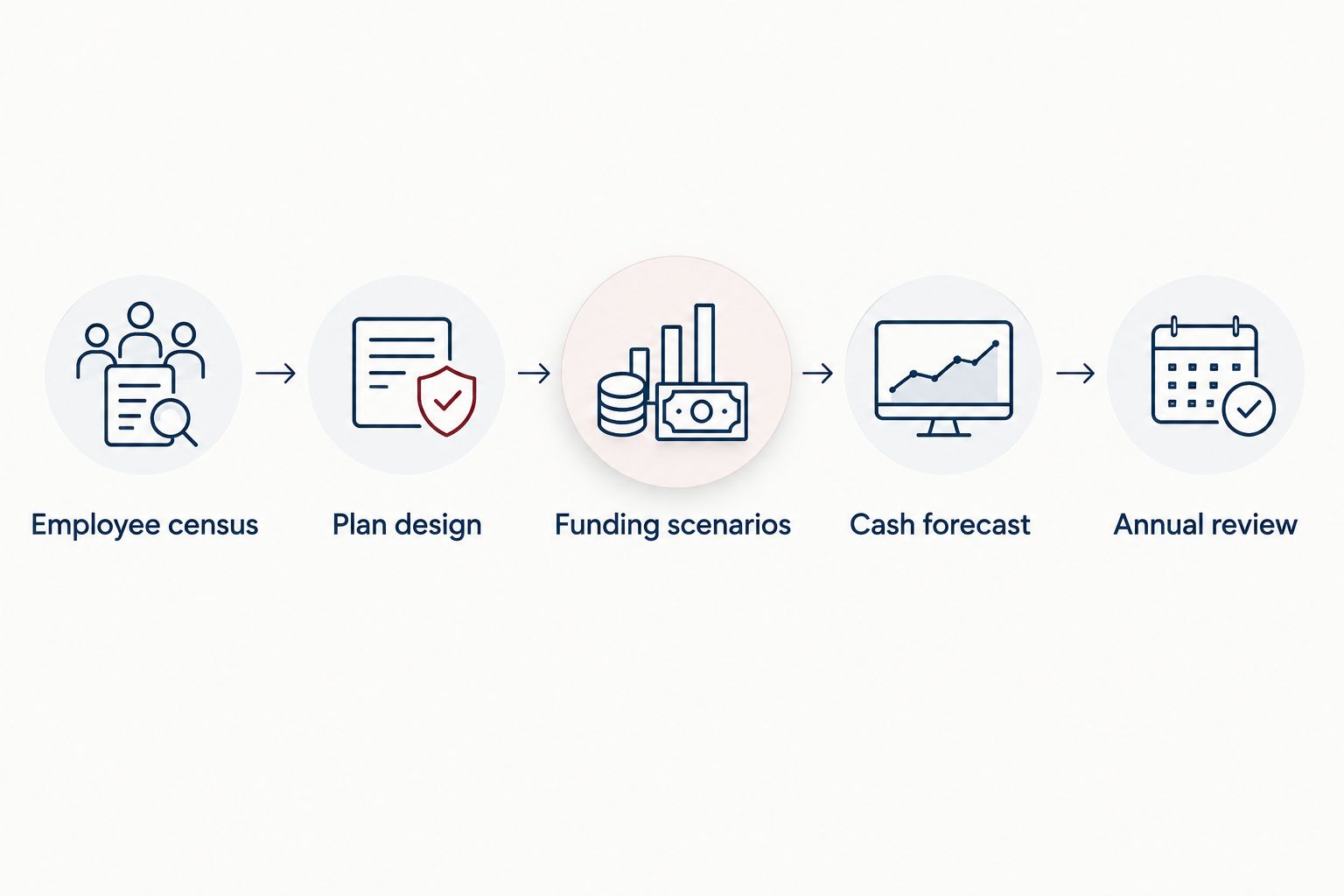
Approve a funding commitment only after it fits the business cash forecast.
A contribution that fits a strong year can still strain a weaker one. Ask what happens when profits decline, an owner reduces compensation, or a key employee leaves. Do not confuse the ability to amend a plan with permission to ignore benefits already earned.
Compare the pension with the alternative
Before selecting a provider, establish whether a cash balance plan is the appropriate retirement arrangement. Comparing retirement plans for small business owners means weighing funding obligations and employee coverage—not merely comparing contribution potential.
A defined contribution plan establishes contributions under its terms; a cash balance pension promises a benefit determined under its formula. That distinction changes who carries investment risk and how the employer plans future funding.
| Arrangement | Best for | Principal advantage | Principal trade-off |
|---|---|---|---|
| Cash balance pension | Owners able to support an ongoing defined benefit commitment | Benefits can support substantial retirement funding when the design permits | Actuarial funding and administration continue beyond the opening contribution |
| Defined contribution plan | Employers prioritizing a contribution-based retirement structure | Investment results generally affect participant account values | Contribution limits and plan terms constrain funding |
| Combined arrangement | Employers whose analysis supports coordinated retirement plans | Different plan structures can serve complementary objectives | Testing, funding, and administration require coordination |
For an S corporation owner, distributions are not retirement plan compensation. Salary decisions therefore belong in the analysis before anyone treats company profit as the contribution base.
CEOHAVEN's tax planning role is relevant here: evaluate compensation, deductions, and liquidity together. The pension provider must still establish the plan-specific funding and qualification requirements.
Put service responsibility in writing
A polished illustration is not an operating agreement. Before signing in 2026, identify who owns each recurring task and what information the business must supply.
Your engagement should address:
- Documents: Who prepares the plan document, amendments, and required participant communications?
- Actuarial work: Who calculates funding and signs required actuarial certifications?
- Testing: Who evaluates coverage, nondiscrimination, and interactions with other employer plans?
- Filings: Who prepares applicable Form 5500-series filings and coordinates submission?
- Investments: Who advises on assets, and how does that advice reflect the plan's obligations?
- Corrections: Who identifies and resolves missed contributions, inaccurate census data, or administrative errors?
PBGC coverage also deserves an explicit answer. Some plans are covered and others are exempt; do not assume the result from the business's size or profession alone.
Require a scope that distinguishes included work from separately engaged services. A provider's willingness to explain boundaries is more useful than an assurance that everything is handled.
Which cash balance plan provider should you choose?
Start with Kravitz if you want a specialist cash balance proposal, then compare Emparion and Dedicated Defined Benefit Services against the same facts. Let the written design—not the ordering of this list—determine your final choice.
CEOHAVEN is best for business owners seeking tax planning, tax preparation, and bookkeeping alongside a separately selected cash balance plan specialist. Keep those responsibilities connected without assuming they are interchangeable.
For your 2026 decision, approve a provider only when you can explain the employee obligations, funding risks, annual work, and exit process yourself. If the proposal makes sense only while a salesperson explains it, request a clearer proposal.
FAQ
What's the best cash balance plan provider for a business owner?
The best provider is the specialist whose written design fits your employee population, funding capacity, and administrative needs. Kravitz, Emparion, and Dedicated Defined Benefit Services are relevant shortlist candidates; compare proposals using identical business information.
Is a cash balance plan the same as a 401(k)?
No. A cash balance plan is a defined benefit pension, while a 401(k) is a defined contribution arrangement. The structures place investment risk and funding responsibilities differently.
Can a business have a cash balance plan and a 401(k)?
Yes, a business can maintain both arrangements. The plans must be designed and tested with their interaction in mind, including applicable employee coverage and contribution requirements.
Can I contribute only when my business has a strong year?
A cash balance pension is not a discretionary savings account. Required funding depends on the plan's benefits, assets, and actuarial calculations, so reduced profits do not automatically eliminate funding obligations.
Do I need an actuary for a cash balance plan?
Yes, cash balance pensions require actuarial work. Identify the enrolled actuary responsible for required calculations and certifications, and distinguish that role from investment management and tax preparation.
Can I exclude all employees and cover only myself?
You cannot assume employees are excluded. Eligibility, coverage, nondiscrimination, and related-business rules determine how a proposed owner-focused arrangement must treat employees.
Can I close a cash balance plan whenever I want?
Terminating a cash balance plan requires a formal process. Accrued benefits, funding, participant notices, distributions, and applicable regulatory requirements must be addressed; closing the business account is not plan termination.
One last thing
Ask every finalist this question: What business change would make you recommend against this plan? Require a specific answer addressing earnings, hiring, ownership, or funding—not another illustration of a larger deduction.
A pension should support your wealth plan without quietly weakening the business that funds it.