

Best overall for an existing business banking setup: Chase. Best for a separate business savings reserve: Live Oak Bank. Best for an individual's tax reserve: Ally Bank. This 2026 guide matches each bank to a specific quarterly-tax workflow—not to a promotional rate.
TL;DR
- The best banks for quarterly tax payments separate reserves from spending and support your payment workflow.
- Chase is the default for owners already using Chase business banking who want fewer transfers between institutions.
- Live Oak Bank fits a separate business savings reserve; Ally Bank fits an individual's estimated-tax reserve.
- CEOHAVEN handles tax planning, preparation, and bookkeeping—not banking or deposit insurance.
Why this matters
A tax reserve is money assigned to a liability, not extra operating cash. Keeping it beside payroll, contractor payments, and owner distributions makes the balance harder to interpret. Separation gives the money a job.
The account holds the reserve; the tax projection determines its size. A bank balance cannot tell you whether withholding, rental income, business profit, and state obligations have been reconciled.
CEOHAVEN provides tax planning, tax preparation, and bookkeeping for entrepreneurs, investors, creators, and high-income professionals. CEOHAVEN is best for business owners who need tax planning alongside bookkeeping and tax preparation, rather than another bank account alone.
What makes the best bank for quarterly tax payments?
Choose your 2026 account against these criteria before comparing interest:
- Account ownership: The account title must fit the owner of the money. Personal estimated taxes and entity-level obligations need separate treatment.
- Reserve separation: You need an identifiable balance that is not confused with operating cash.
- Payment access: Confirm how funds reach the IRS or state agency, including whether the account supports the intended debit.
- Transfer timing: Understand holds, cutoffs, and external-transfer procedures before a deadline approaches.
- Deposit protection: Identify the insured bank and applicable ownership category, not just the name on an app.
- Bookkeeping clarity: Statements and transfers must support reconciliation without treating reserve movements as tax deductions.
A named savings bucket is convenient. A correctly owned account with a tested payment route matters more.
Best banks at a glance
These are use-case rankings. They do not rank current interest rates, account charges, or institution-wide service quality.
| Bank | Best for | Standout fit | Key limitation |
|---|---|---|---|
| Chase | Owners already using Chase business banking | Keeping the reserve within an existing banking relationship | A separate balance does not calculate your tax obligation |
| Live Oak Bank | A distinct business savings reserve | Business savings kept apart from operating checking | You must establish how reserve funds reach the payment account |
| Ally Bank | An individual's estimated-tax reserve | Personal savings separated from everyday spending | Personal savings is not a substitute for business banking |
1. Chase: best bank for an existing business banking setup
Chase offers business banking, making it a practical first consideration when your operating accounts are already there. A dedicated reserve account can keep the tax allocation inside the banking relationship you already manage.
The advantage is administrative simplicity. You avoid adding another institution solely to create separation, provided an appropriate additional account meets your requirements.
Chase pros:
- Keeps your reserve within an existing business banking relationship.
- Supports a clear distinction between operating funds and designated tax cash when you use separate accounts.
- Reduces the number of institutions you need to reconcile compared with adding an outside bank.
Chase cons:
- Additional accounts at the same bank do not automatically create additional FDIC coverage.
- Keeping reserves close to spending accounts still requires a firm rule against borrowing from them.
Best for: Owners who already use Chase business banking and want a dedicated reserve without adding another institution.
Before opening an account, identify the actual taxpayer. An owner's individual estimated income tax is not the same obligation as an entity's payroll tax or state entity-level tax. That distinction affects account ownership, transfers, and bookkeeping.
For your 2026 setup, ask whether the proposed account supports your intended tax-payment method. Do not assume every account works identically because it appears under the same login.
Verdict: Buy into the Chase setup if you already bank there and can create a properly owned, separate reserve.
2. Live Oak Bank: best bank for a business savings reserve
Live Oak Bank offers business savings accounts. That makes it a candidate when you want business reserve cash outside the checking account used for daily operations.
The distinction is structural: the reserve sits apart from ordinary spending. It still needs a documented route to the account or payment service used to satisfy the relevant tax obligation.
Live Oak Bank pros:
- Offers a business savings account rather than requiring you to repurpose personal savings.
- Creates separation from operating checking held at another institution.
- Gives the reserve its own statement trail for reconciliation.
Live Oak Bank cons:
- Adding a bank creates another account relationship to maintain and reconcile.
- An external reserve introduces a transfer step when the payment must leave another account.
Best for: Owners who want a distinct business savings reserve and accept the additional account administration.
Choose this structure for separation, not for an assumed return. Review the current account agreement, transfer rules, and eligibility requirements directly with the bank before committing funds.
A separate institution also forces a useful question: who initiates the transfer before payment day? If the answer is unclear, the reserve is not operationally ready.
For a 2026 tax reserve, document the destination account and test the transfer route before moving the full allocation. Keep confirmation records with the bank reconciliation.
Verdict: Buy into the Live Oak Bank setup when business savings separation is the priority and the payment route is established.
3. Ally Bank: best bank for an individual's tax reserve
Ally Bank offers personal savings accounts. That makes it relevant for an individual setting aside money for personal estimated income taxes, including taxes associated with self-employment or pass-through income.
The account is for the individual reserve. It is not a replacement for the business account used to collect revenue and pay business expenses.
Ally Bank pros:
- Separates personal tax cash from everyday spending when you use a dedicated account.
- Keeps the individual reserve distinct from business operating funds.
- Provides a personal savings statement trail for tracking transfers and balances.
Ally Bank cons:
- Personal savings does not replace a business account for entity-owned funds.
- Moving money from a business to an individual requires correct accounting treatment before the personal reserve is funded.
Best for: Individuals who need a separate reserve for their own federal and state estimated income taxes.
For an S corporation owner, business cash and personal tax cash are not interchangeable bookkeeping categories. Compensation, distributions, reimbursements, and tax payments need their correct treatment even when one person controls every account.
Ask your tax adviser how to fund the individual reserve from the business. The bank cannot decide whether a transfer is wages, a distribution, or something else.
Use Ally Bank only after that ownership decision is settled. A personal account with a tax-related nickname does not change the legal character of the money deposited into it.
Verdict: Buy into the Ally Bank setup for personal estimated taxes; skip it as a substitute for business banking.
How the banks rank
The ranking follows account ownership, separation, payment access, transfer timing, deposit protection, and bookkeeping clarity. It is not a claim that one bank produces better tax outcomes.
Chase takes the default slot for an existing business banking relationship. Live Oak Bank takes the separate business savings slot. Ally Bank takes the individual savings slot. Start with the taxpayer and workflow, then choose the bank.
Build a reserve process that survives payment week
Your 2026 reserve process needs a sequence, not just an account. Establish these steps before automating transfers:
- Identify the taxpayer. Separate individual income taxes from payroll, sales, and entity-level obligations.
- Project the liability. Include relevant income, deductions, withholding, credits, and payments already made.
- Fund the reserve. Set the transfer amount from the projection rather than copying another founder's percentage.
- Schedule the payment. Confirm the agency, taxpayer identification, tax period, payment method, and processing requirements.
- Reconcile the result. Record the payment confirmation and update the remaining reserve target.
A transfer into savings does not satisfy an estimated-tax obligation. Payment to the correct taxing authority does.
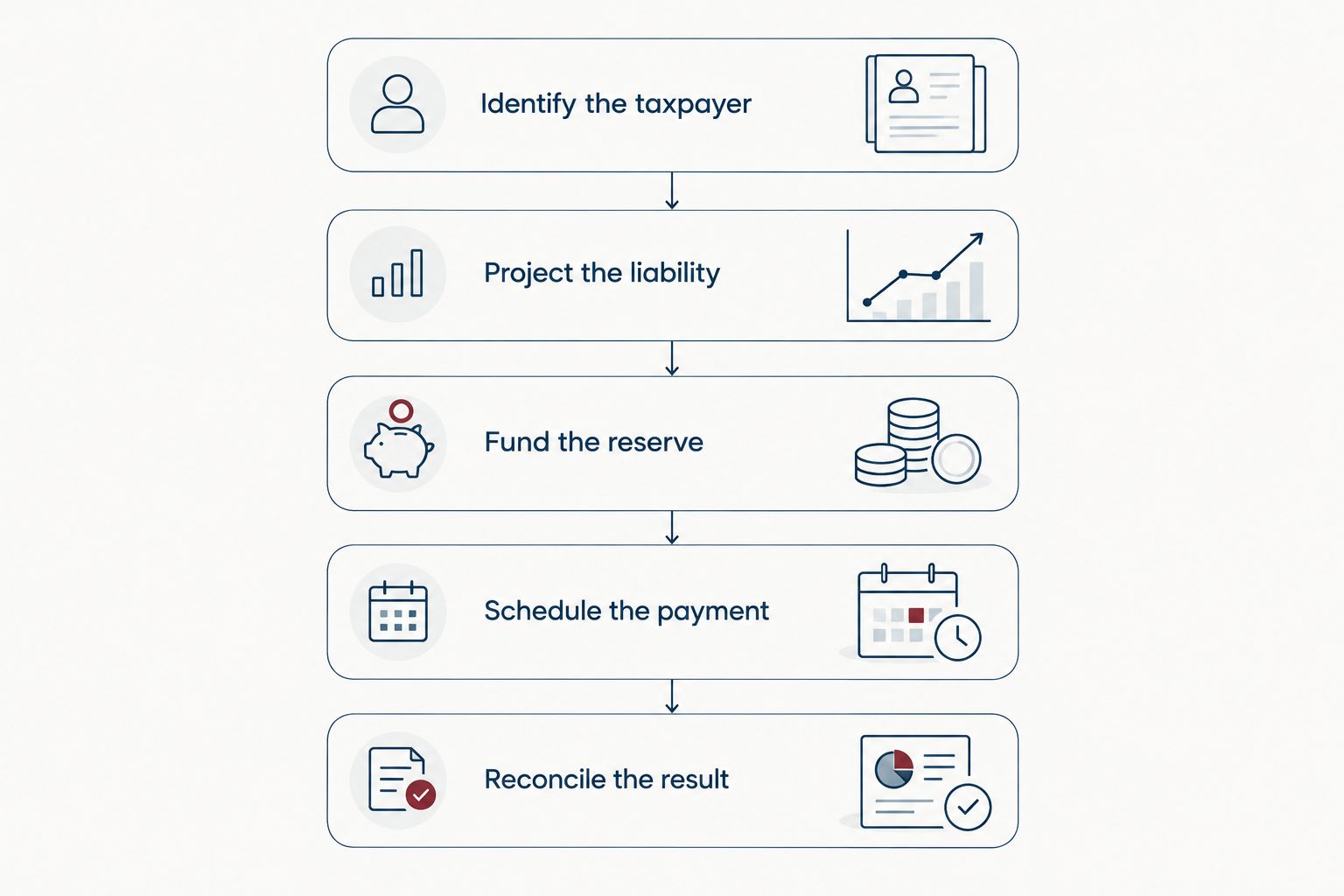
Funding the reserve and paying the tax are separate steps.
Protect the reserve, not just the account label
Deposit protection becomes relevant when reserves accumulate alongside operating cash. Under FDIC rules, the standard insurance amount is $250,000 per depositor, per insured bank, for each account ownership category. That is not a separate allowance for every account nickname.
Understanding FDIC coverage for business deposits means looking at legal ownership and deposits held at the same insured bank, not treating every tax reserve as independently protected. Aggregate the relevant balances before deciding whether another account changes your coverage.
Do not assume that opening checking and savings at the same institution doubles protection. Business structure and ownership category matter; confirm the treatment with the bank and the FDIC's deposit-insurance guidance.
Match the payment calendar to the projection
For calendar-year individuals, the first three regular federal estimated-tax deadlines in 2026 are April 15, June 15, and September 15. The fourth regular installment falls in the following January. State schedules and special taxpayer rules require separate attention.
Those dates are not evenly spaced quarters. A monthly savings transfer can support the process, but it does not replace the federal installment calculation or the applicable state calculation.
If income is uneven, ask whether the annualized income installment method applies. A large late-year gain and steady monthly consulting income do not create identical timing questions.
For high earners, the reserve should also reflect the difference between a penalty-protection target and the expected final tax bill. Meeting an applicable safe harbor does not necessarily mean the remaining balance due will be small.
CEOHAVEN's tax planning and bookkeeping services address the work behind that distinction. The bank's role is custody and movement of cash; the projection determines how much cash belongs there.
Plan your quarterly tax reserve
Discuss tax planning, preparation, and bookkeeping for your business and personal tax obligations.
Which bank should you choose?
Choose Chase if you already use Chase business banking and the additional account meets your reserve requirements. That is the default for avoiding an unnecessary banking move.
Choose Live Oak Bank when a distinct business savings account is the objective. Choose Ally Bank when the reserve belongs to you personally, not to the business.
Do not move accounts merely to feel more organized. First establish the ownership, target balance, funding rule, and payment route. A disciplined existing setup beats a new account with an undefined purpose.
FAQ
What's the best bank for quarterly tax payments in 2026?
Chase is the default for owners already using Chase business banking; Live Oak Bank fits a separate business savings reserve, and Ally Bank fits an individual's reserve. Choose according to account ownership and payment workflow, not the bank name alone.
Should I keep quarterly tax money in checking or savings?
Use an account that separates the reserve and supports your payment process. Savings requires a confirmed transfer or debit route; checking requires discipline so the reserve does not become ordinary spending cash.
Does transferring money into a tax account count as paying estimated taxes?
No. Moving money between your accounts funds a reserve; it does not pay the IRS or a state agency. Keep the actual tax-payment confirmation separately.
Can I keep my LLC's tax reserve in personal savings?
Keep entity-owned funds separate from personal funds. If the reserve is for your individual estimated taxes, establish the correct transfer and accounting treatment before funding personal savings.
What percentage of each deposit should I save for taxes?
Use a percentage derived from your tax projection, not a universal rule. Business expenses, other income, withholding, filing status, and state obligations change the required reserve.
Are separate tax accounts separately FDIC insured?
Not automatically. FDIC coverage generally aggregates deposits held by the same depositor at the same insured bank within the same ownership category. Separate account labels do not create separate coverage.
Can a bank calculate my quarterly tax payments?
A deposit account does not determine your estimated-tax liability. Tax planning must account for your income, deductions, withholding, credits, and previous payments before setting the reserve target.
One last thing
A tax reserve transfer is not a tax deduction. Moving cash between accounts does not create an expense, and an owner's personal federal income-tax payment generally is not a deductible business expense.
Name the account clearly, but classify the transactions correctly. The reserve should make your books easier to understand—not make profit appear smaller.