

An existing relationship with AE Tax Advisors is worth keeping when your advisor knows your portfolio and turns that knowledge into clear decisions. The ceiling comes when your engagement no longer covers the planning, filing, or bookkeeping your properties require. The best AE Tax Advisors alternative to evaluate in 2026 is CEOHAVEN if you need tax planning, tax preparation, and bookkeeping; an independent real estate CPA if you prefer an individually scoped engagement.
TL;DR
- For AE Tax Advisors alternatives for real estate investors, evaluate CEOHAVEN for tax planning, preparation, and bookkeeping.
- Compare written responsibilities, not promises of deductions or automatic rental-loss write-offs.
- An independent real estate CPA suits investors seeking a directly scoped advisory relationship.
- Keep AE Tax Advisors when the existing engagement already meets your portfolio’s needs.
Why this matters
A rental portfolio creates decisions before it creates a tax return. Acquisition records, improvement classifications, financing, participation, and disposition timing all affect what your preparer can report.
Changing firms only helps when the new engagement addresses a specific problem. For your 2026 decision, separate three questions: Who maintains the records? Who evaluates decisions before you act? Who prepares the returns using those decisions?
Buy a defined scope, not a more impressive tax vocabulary. A firm that discusses sophisticated strategies still needs accurate books, documented eligibility, and someone responsible for implementation.
AE Tax Advisors alternatives at a glance
This comparison separates service models rather than assigning unsupported ratings to firms. Use AE Tax Advisors as the baseline: compare what your existing agreement actually delivers against what a prospective engagement puts in writing.
| Option | Best for | Distinguishing focus | Difference from keeping AE Tax Advisors |
|---|---|---|---|
| AE Tax Advisors | Investors whose current engagement already works | Continuity with an existing advisor and records | Baseline; assess your actual service agreement |
| CEOHAVEN | Investors seeking tax planning, tax preparation, and bookkeeping | Those services offered to real estate investors and other business owners | A new firm to evaluate against your current scope |
| Independent real estate CPA | Investors seeking a directly scoped professional relationship | Selecting an individual practitioner around your portfolio’s requirements | Rebuild the engagement around a named professional |
| Specialist-led advisory team | Investors with a defined transaction or technical project | Separate specialists assigned to distinct work | Adds specialist coordination rather than assuming one engagement covers everything |
The right comparison is not which option mentions the most strategies. It is which engagement assigns responsibility for the work your portfolio needs—and identifies what remains outside the agreement.
1. CEOHAVEN: best for planning, preparation, and bookkeeping
CEOHAVEN is a business tax consulting firm serving real estate investors, entrepreneurs, content creators, and high-income professionals in the United States. Its stated services include tax planning, tax preparation, and bookkeeping. That service mix makes it relevant when your investment activity overlaps with business ownership or other substantial income.
Best for: Investors evaluating a firm that offers all three service categories rather than searching for each category separately.
Where CEOHAVEN shines
- The stated service offering includes planning, preparation, and bookkeeping.
- Real estate investors are an explicitly identified client group.
- The client focus also includes entrepreneurs and high-income professionals, matching investors whose financial picture extends beyond rentals.
Where this option falls short
- A tax consulting engagement does not replace transaction counsel, an exchange intermediary, or engineering analysis.
- Offering several services does not establish that every service belongs in your particular engagement.
- You still need to confirm who handles entity returns, personal returns, record cleanup, and coordination with outside professionals.
For a 2026 engagement, ask for a written division of responsibilities before transferring records. Specify the properties and entities involved, the condition of the books, pending transactions, and any elections or carryforwards requiring attention.
Do not treat a broad service menu as proof of a particular outcome. The reason to shortlist this firm is service fit—not an assumed tax reduction.
Verdict: Buy the engagement only after the written scope matches your portfolio.
2. Independent real estate CPA: best for a directly scoped relationship
An independent real estate CPA is an alternative service model, not a guarantee of specialized experience. You select a practitioner whose actual work matches your ownership structure, rental activity, and filing obligations.
This route suits an investor who wants to define the relationship around a particular professional. Before switching, establish whether that person performs the work, reviews it, or delegates it.
Best for: Investors who prioritize a named advisor and a tailored division of responsibilities.
Where an independent real estate CPA shines
- You can scope the search around the precise issues your properties create.
- You can evaluate the proposed advisor directly using your records and transaction plans.
- You can separate recurring tax work from a specific advisory project.
Where an independent real estate CPA falls short
- A CPA credential alone does not demonstrate rental-property expertise.
- An individual engagement still needs a plan for continuity and document access.
- Bookkeeping, tax planning, and preparation must each be addressed; do not assume they are bundled.
Ask the practitioner to explain how rental basis, accumulated depreciation, and suspended losses will move into the new records. A discussion about continuity is more useful than a list of possible deductions.
Verdict: Buy when the practitioner’s experience and written responsibilities match your needs.
3. Specialist-led advisory team: best for a defined technical project
A specialist-led team separates general tax work from a specific assignment. Examples include a cost segregation study, transaction legal work, or exchange coordination. Your tax advisor still needs to evaluate how the resulting work affects your return.
Best for: Investors with an identified technical issue that requires work beyond ordinary bookkeeping and return preparation.
Where a specialist-led advisory team shines
- You can match each assignment to the relevant professional discipline.
- Deliverables can be defined around a transaction or property.
- Your primary tax advisor can assess how specialist findings affect the broader tax picture.
Where a specialist-led advisory team falls short
- Separate providers create additional coordination work.
- A technical report does not establish that a deduction is currently usable.
- Without a designated lead, responsibility for implementation remains fragmented.
This is not automatically a replacement for AE Tax Advisors. It can be an addition to a functioning advisory relationship when the existing advisor coordinates the broader work.
Verdict: Buy the specialist assignment; hold on replacing the primary advisor unless a separate problem exists.
Why people switch from AE Tax Advisors
A defensible reason to switch is a mismatch between your current agreement and your current needs—not an assumption about AE Tax Advisors’ performance. Judge your own engagement against the work your portfolio requires.
Use these as decision triggers, not claims about the firm:
- Your needs changed. A purchase, sale, partnership, or new business creates work outside the existing scope.
- You need planning. Your agreement covers filing, but you now want decisions evaluated before a transaction.
- Record ownership is unclear. You cannot identify who maintains property-level basis and depreciation schedules.
- Responsibilities are fragmented. Your bookkeeper, preparer, and specialists lack an agreed handoff.
First ask whether the existing engagement can address the issue. A revised scope can solve a problem without the disruption of changing firms.
For 2026, write down the unresolved decision before requesting proposals. “Evaluate the tax consequences before selling this property” gives a prospective advisor something concrete to address. “Find more write-offs” does not.
Test the advice against real estate tax rules
The strongest comparison questions concern eligibility and execution. Use your own facts to test whether a prospective advisor explains both the potential benefit and the limiting rule.
Rental losses are not automatically usable
For federal tax purposes, rental activities are generally passive, subject to exceptions. Real estate professional status requires more than 750 hours in qualifying real property trades or businesses and more than half of the taxpayer’s personal services in those activities; material participation remains a separate requirement for treating rental losses as nonpassive.
Ask how the advisor evaluates your activities and supporting records. A confident promise to offset employment income is not a substitute for applying those tests.
Depreciation timing is not the whole decision
Cost segregation concerns the classification of property components for depreciation. Accelerating deductions does not, by itself, establish that you can use the resulting losses immediately.
Ask the advisor to connect depreciation recommendations to basis, passive activity limitations, expected holding period, and eventual disposition. Review the broader tax planning guide for real estate investors before turning one strategy into the entire engagement.
Exchange deadlines require advance coordination
A deferred Section 1031 exchange generally requires identification of replacement property within 45 days. Receipt generally must occur within 180 days or by the applicable return due date, including extensions, if earlier.
Those deadlines are not a reason to rush into a replacement property. They are a reason to discuss transaction structure before closing and coordinate with the appropriate exchange professionals.
Compare proposals without losing the important details
Use the same sequence for every prospective engagement. The goal is to make responsibilities visible before you authorize a transfer.
- Define scope: List properties, entities, returns, bookkeeping work, and pending decisions.
- Assign ownership: Name the person responsible for advice, records, filings, and specialist coordination.
- Review records: Identify what must transfer and what requires correction.
- Set handoff: Agree on open tasks, filing responsibilities, and transition dates.
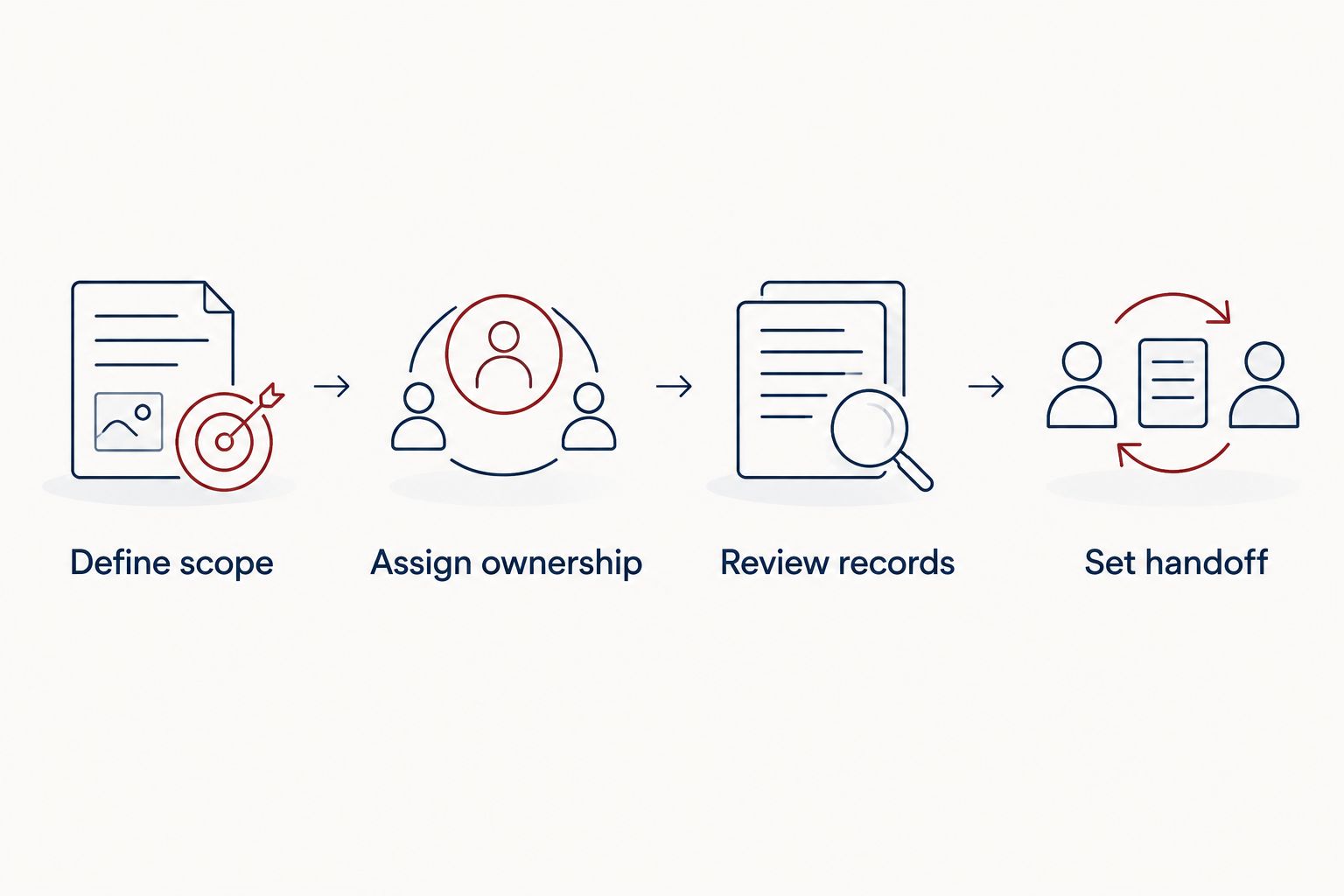
Define responsibilities before moving records to a new advisor.
Request a proposal that follows those same categories. A clear engagement identifies deliverables and exclusions; it does not leave you to infer coverage from a sales conversation.
For a 2026 transition, distinguish the professional responsible for outstanding filings from the professional advising on new decisions. Changing firms does not erase deadlines or resolve incomplete records.
Define your next tax engagement
Discuss tax planning, tax preparation, and bookkeeping for your real estate portfolio.
When staying with AE Tax Advisors is right
Stay with AE Tax Advisors when the existing engagement delivers the work you need and explains decisions clearly. Continuity has practical value when records are complete, responsibilities are understood, and advice arrives before you act.
Ask for a scope review before assuming a change is necessary. Adding a defined planning assignment or an outside specialist can be more appropriate than replacing an otherwise effective relationship.
Use the same standard for staying as for switching: documented responsibilities, usable records, and advice tied to your circumstances. A new firm name is not itself an improvement.
FAQ
What’s the best AE Tax Advisors alternative for a real estate investor?
CEOHAVEN is an alternative to evaluate when you need tax planning, tax preparation, and bookkeeping. An independent real estate CPA is another route when you want an individually scoped professional relationship. Choose against your actual requirements rather than a blanket ranking.
Is changing tax advisors better than adding a specialist?
Changing advisors addresses a broader engagement mismatch; adding a specialist addresses a defined technical assignment. If your primary relationship works, outside transaction, engineering, or exchange support does not automatically require replacing it.
Can a new tax advisor guarantee rental losses will offset my salary?
No advisor can make rental losses deductible against salary without applying the relevant tax rules to your facts. Passive activity rules, real estate professional status, material participation, and other limitations require separate analysis.
What records should I transfer when changing real estate tax advisors?
Transfer the records needed to establish filings, property basis, depreciation, carryforwards, and current activity. These generally include prior returns, depreciation schedules, closing documents, improvement records, entity information, and bookkeeping records. Agree on the complete list with the receiving advisor.
Should I hire a tax advisor before selling a rental?
Yes, seek advice before committing to the transaction structure. A sale can raise gain, depreciation recapture, state tax, and exchange questions that require evaluation before closing.
Does a cost segregation study guarantee an immediate tax benefit?
No, a cost segregation study does not establish that resulting deductions are immediately usable. Your advisor must evaluate depreciation treatment alongside passive activity rules and other applicable limitations.
When should I keep AE Tax Advisors instead of switching?
Keep AE Tax Advisors when your current agreement meets your needs, records are maintained, and responsibilities are clear. Request a scope review if a new property or transaction creates additional work before deciding to replace the relationship.
One last thing
Before changing advisors in 2026, ask for a property-by-property reconciliation of basis, accumulated depreciation, and suspended losses. Those balances carry the history that a new engagement must preserve.
A clean handoff matters more than an ambitious strategy list. If nobody can explain the opening balances, make record reconciliation the first assignment—not an afterthought.