

Content creators juggle 1099s from five platforms, sponsorship invoices in different currencies, and quarterly tax deadlines that don't care whether your last brand deal actually paid on time. The right accounting software fixes half of that mess before your tax preparer ever opens a file.
Best overall: QuickBooks Online. Best for freelance banking plus tax estimates: Found. Best free option for creators just starting out: Wave.
TL;DR
- QuickBooks Online is the best accounting software for content creators once you form an LLC or S-corp and need real reports.
- Found bundles business banking with quarterly tax estimates, built for solo creators who hate spreadsheets.
- Wave stays free for creators with simple income who just need clean books, not payroll or inventory.
- FreshBooks wins on invoicing for sponsorships and brand deals with built-in payment reminders.
- Xero handles multi-currency income better than any competitor here, which matters for AdSense and overseas sponsors.
Why this matters
Most content creators start doing books in a Google Sheet and keep doing it long after the income outgrows the method. By the time a creator hits six figures across YouTube AdSense, brand deals, and a Patreon or Substack, mixing personal and business transactions in one bank feed makes quarterly estimated tax calculations close to guesswork.
The software you pick in 2026 decides how clean your numbers are when CEOHAVEN's tax planning team builds your entity structure or files your return. Clean books mean fewer questions at tax time and a faster path to decisions like an S-corp election — worth reading the breakdown on when an S-corp is worth it at break-even income before you assume the switch pays off.
What makes the best accounting software for content creators
- Separates personal and business money automatically — no manual sorting of a mixed bank feed
- Tracks 1099 income from multiple platforms — YouTube, brand deals, affiliate links, Patreon, all in one ledger
- Calculates quarterly estimated taxes — creators owe the IRS four times a year, not once
- Invoices sponsorships professionally — brand deals close faster with a real invoice, not a Venmo request
- Tracks deductible expenses — gear, editing software subscriptions, a home studio, travel for shoots
- Scales into entity accounting — the software should still work after you form an LLC or elect S-corp status
Accounting software for content creators at a glance
| Software | Best for | Standout feature | Key limitation |
|---|---|---|---|
| QuickBooks Online | Creators scaling into an LLC or S-corp | Full reports (P&L, balance sheet) and payroll add-ons | Steeper learning curve for a first-time user |
| Found | Freelance creators wanting banking + tax estimates | Automatic quarterly tax set-asides tied to a business checking account | Not built for creators who already run an LLC or S-corp |
| Wave | Creators just starting out | Free invoicing and bookkeeping core | Customer support and add-ons lag behind paid tools |
| FreshBooks | Invoicing brand deals and sponsorships | Automated payment reminders and late fees | Reporting is thinner once you add contractors or inventory |
| Xero | Creators with multi-currency income | Native multi-currency invoicing and bank reconciliation | Fewer built-in integrations with US-specific 1099 tools |
| Zoho Books | Budget-conscious creators already on Zoho apps | Bundles cleanly with Zoho CRM and Zoho Invoice | Smaller US accountant network familiar with the platform |
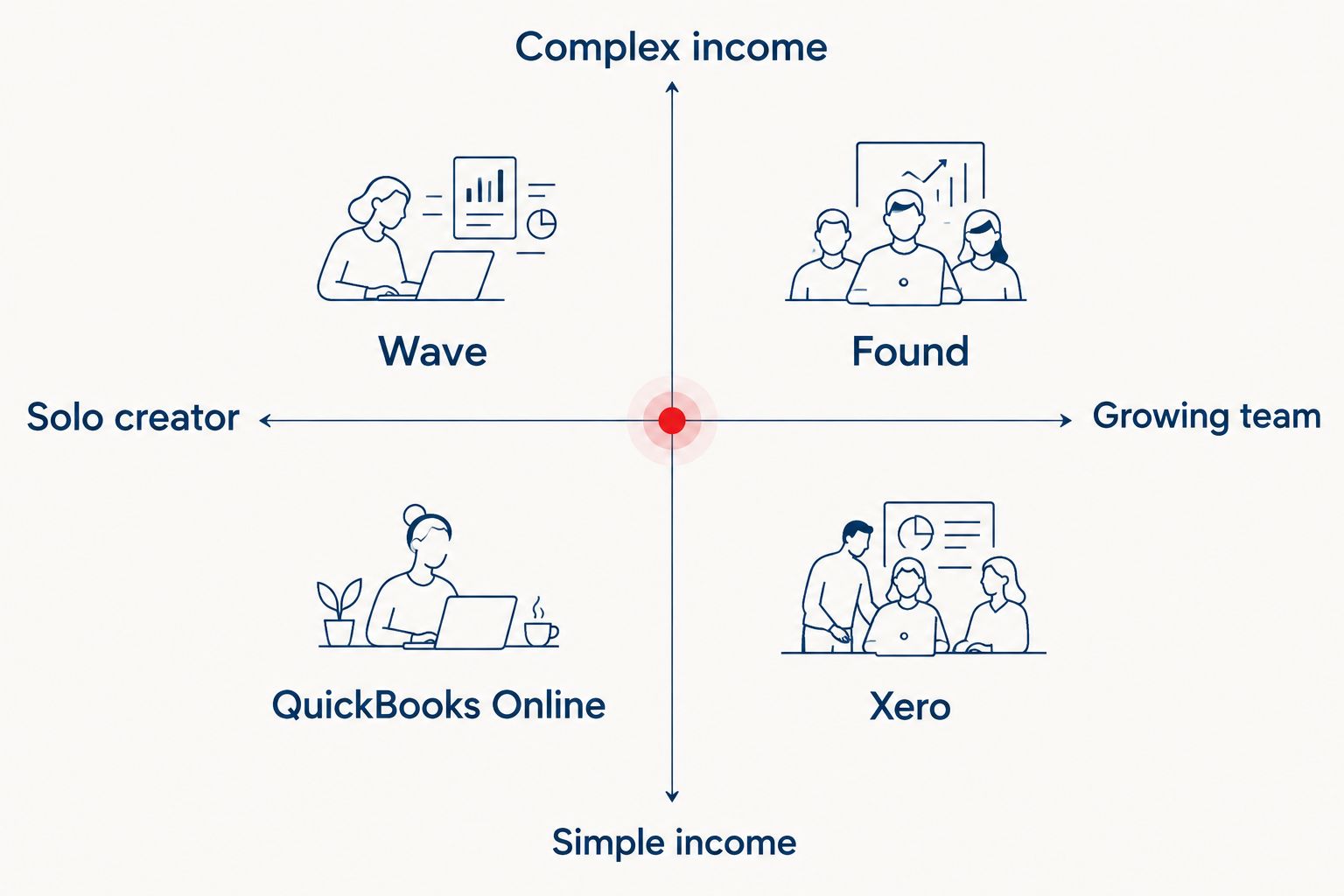
Income complexity and team size decide the software match faster than any feature list.
1. QuickBooks Online: best accounting software for content creators formalizing into an LLC or S-corp
QuickBooks Online runs full double-entry accounting, generates a profit-and-loss statement and balance sheet, and connects to payroll once you're paying yourself a salary through an S-corp. It's the standard most tax preparers and bookkeepers already know, which shortens the handoff at filing time.
QuickBooks Online pros:
- Reports match what a CPA or tax preparer expects to see
- Payroll and contractor 1099 filing built into the same platform
- Scales from sole proprietor through S-corp without switching software
QuickBooks Online cons:
- The interface overwhelms a creator with one income stream and no bookkeeping background
- Multi-currency support is limited compared to Xero
QuickBooks Online verdict: Buy if you've formed an LLC or plan to elect S-corp status in 2026 — this is the platform your tax preparer will thank you for using.
2. Found: best accounting software for content creators who want banking and tax estimates in one place
Found combines a business checking account with expense tracking and automatic quarterly tax set-asides calculated from your actual income. For a creator still filing as a sole proprietor, it removes the guesswork of "how much do I owe the IRS in September."
Found pros:
- Tax set-asides update automatically as income comes in
- No separate bookkeeping software needed for a simple 1099 setup
- Built specifically around self-employed income patterns
Found cons:
- Doesn't handle payroll or S-corp accounting once you outgrow sole proprietor status
- Reporting depth is thinner than QuickBooks Online or Xero
Found verdict: Buy if you're a solo creator still filing as a sole proprietor and want tax estimates handled without opening a second app.
3. Wave: best free accounting software for content creators just starting out
Wave gives you free invoicing, expense tracking, and basic bookkeeping without a monthly fee. For a creator earning irregular income from a handful of brand deals, it's enough to keep books clean without paying for features you don't need yet.
Wave pros:
- No subscription cost for core bookkeeping and invoicing
- Clean interface for a creator with no accounting background
- Handles basic 1099 income tracking
Wave cons:
- Customer support is slow compared to paid competitors
- No built-in tax estimate calculator
- Doesn't scale well once you add contractors or multiple entities
Wave verdict: Buy if your content income is under a few brand deals a year and you're not ready to pay for software yet — Skip once income gets steady enough to need real reporting.
4. FreshBooks: best accounting software for content creators invoicing brand deals and sponsorships
FreshBooks is built around invoicing first, bookkeeping second. Automated payment reminders and late fees matter when a brand's accounts payable department sits on your invoice for six weeks.
FreshBooks pros:
- Professional invoice templates built for project-based sponsorship work
- Automated reminders reduce late payments from brand partners
- Time tracking useful for creators who also do freelance editing or consulting
FreshBooks cons:
- Reporting is limited once you bring on contractors or an editor
- Less useful once you're running payroll through an S-corp
FreshBooks verdict: Buy if sponsorship invoicing and getting paid on time is your biggest pain point right now.
5. Xero: best accounting software for content creators with international sponsors
Xero handles multi-currency invoicing and bank reconciliation natively, which matters for a creator earning AdSense in one currency and sponsorship payments in another. Bank feeds reconcile cleanly across accounts in different countries.
Xero pros:
- Multi-currency invoicing without a third-party add-on
- Strong bank reconciliation across international accounts
- Solid reporting once you scale into an entity
Xero cons:
- Fewer US-specific integrations for 1099-NEC filing than QuickBooks Online
- Smaller pool of US bookkeepers and tax preparers who work in it daily
Xero verdict: Buy if a meaningful share of your income comes from overseas sponsors or platforms paying in foreign currency.
6. Zoho Books: best accounting software for content creators already using other Zoho apps
Zoho Books fits creators who already run Zoho CRM or Zoho Invoice for their brand deal pipeline. It bundles cleanly into that ecosystem without forcing a separate login and separate contact list.
Zoho Books pros:
- Bundles with other Zoho apps a creator may already use
- Solid invoicing and expense tracking for the core price tier
Zoho Books cons:
- Smaller network of US accountants and tax preparers familiar with the platform
- Less intuitive for a creator with no prior Zoho experience
Zoho Books verdict: Hold unless you're already inside the Zoho ecosystem — otherwise QuickBooks Online or Wave serve the same need with a bigger support network.
How we ranked these
Each platform was measured against the criteria above: how cleanly it separates personal and business money, whether it tracks 1099 income from multiple platforms, quarterly tax estimate support, invoicing quality for sponsorships, and how well it scales once a creator forms an LLC or elects S-corp status in 2026. QuickBooks Online and Xero score highest on scalability; Found and Wave win on simplicity for creators still filing as sole proprietors.
Which accounting software should a content creator choose?
If you're still deciding, default to QuickBooks Online once you've formed an LLC or are within a year of a possible S-corp election — the reporting will already match what your tax preparer needs. Stay on Wave only while income is inconsistent and simple. Pick Found if banking and quarterly tax set-asides in one app matter more than deep reporting right now.
None of these tools replace a tax strategy. Software tracks what happened; a tax planning team decides what should happen next, including whether an S-corp election actually saves money at your income level.
Get your books ready for tax planning
See how CEOHAVEN pairs your accounting data with a real tax strategy.
FAQ
What's the best accounting software for content creators in 2026?
QuickBooks Online is the best overall pick for content creators in 2026 once income justifies an LLC or S-corp, because its reporting matches what tax preparers already use. Solo creators with simple income often do better starting with Found or Wave.
Is QuickBooks Online better than Wave for content creators?
QuickBooks Online offers deeper reporting and scales into payroll and S-corp accounting, while Wave stays free and simpler for creators with basic 1099 income. Choose Wave while income is inconsistent, then move to QuickBooks Online once you form an entity.
Do content creators need accounting software if they only have one income stream?
Yes, even a single income stream benefits from separating business and personal transactions from day one. It keeps quarterly tax estimates accurate and makes year-end filing faster.
How do content creators track quarterly estimated taxes?
Tools like Found calculate and set aside estimated tax payments automatically as income comes in, while QuickBooks Online and Xero require manual quarterly calculations or an add-on. Creators filing as sole proprietors owe the IRS four times a year regardless of the tool used.
Can accounting software replace a bookkeeper for content creators?
Software handles data entry and categorization, but it doesn't catch missed deductions or flag when an entity change would save money. Most creators past six figures pair the software with a bookkeeper or tax planning team.
What accounting software works best for sponsorship invoicing?
FreshBooks is built specifically for project-based invoicing, with automated payment reminders that help when a brand's accounts payable team is slow to pay. QuickBooks Online and Xero also support invoicing but with less automation around late payments.
Does accounting software handle 1099-NEC forms from brand deals?
QuickBooks Online generates and files 1099-NEC forms directly if you're paying contractors like an editor or assistant. It also tracks 1099 income you receive from brands and platforms for your own tax filing.
Is Xero good for creators with international sponsors?
Xero handles multi-currency invoicing and bank reconciliation natively, which makes it the strongest option here for creators earning income in more than one currency. QuickBooks Online and Wave both lag on multi-currency support.
One last thing
The creators who run into trouble in 2026 aren't the ones using the "wrong" software — they're the ones who never revisit the choice as income changes. A tool that fit a $3,000-a-month sole proprietor stops fitting the moment brand deals push past six figures and an S-corp election starts making sense. Check the software fit every time you check the entity structure, not just at tax season.