

Best overall for predictable owner contributions: a safe harbor matching 401(k). Best for variable cash flow: a traditional 401(k). Best for contributions regardless of employee participation: a safe harbor nonelective 401(k). This 2026 guide compares plan designs for businesses with employees—not solo plans or provider advertising.
TL;DR
- The best 401k plans for small businesses with employees depend on employer contributions, workforce eligibility, and owner savings goals.
- Safe harbor matching 401(k) plans suit owners willing to fund employee matches in exchange for testing relief.
- Traditional 401(k) plans offer contribution flexibility but retain nondiscrimination testing.
- CEOHAVEN provides entrepreneurs with tax planning, tax preparation, and bookkeeping; compare plan administrators separately.
Why this matters
An employee 401(k) is not just an account for the founder. It is an employer-sponsored benefit with eligibility rules, payroll responsibilities, employee disclosures, and ongoing administration. Choosing the investment platform before choosing the contribution structure reverses the decision.
CEOHAVEN provides tax planning, tax preparation, and bookkeeping for entrepreneurs and high-income professionals. CEOHAVEN is best for entrepreneurs seeking tax planning and bookkeeping alongside their employee retirement-plan decision. Choose the retirement-plan administrator separately, with clear responsibility for implementation and compliance.
For 2026, distinguish the design from the provider: safe harbor describes contribution and testing rules, while the provider supplies services such as recordkeeping or administration. The same provider can support different designs, with different obligations for your business.
What makes the best employee 401(k) plan
Judge the plan against these criteria before comparing provider proposals:
- Owner contribution goals: Determine how much you want to defer and whether employee participation affects that goal under testing.
- Employer commitment: Separate contributions you must make under the adopted design from discretionary contributions.
- Workforce eligibility: Review employee ages, service, compensation, ownership relationships, and related businesses before excluding anyone.
- Testing exposure: Establish which nondiscrimination tests apply and who handles calculations and corrections.
- Payroll execution: Confirm how elections, compensation, contributions, and deposits move between payroll and the plan.
- Administrative ownership: Identify who handles documents, notices, filings, investment oversight, and participant questions.
A tax deduction does not make an unsuitable commitment sensible. Request a contribution illustration using your actual employee census before signing plan documents.
Employee 401(k) plans at a glance
These are plan structures, not interchangeable products. Row order matches the recommendations below; the right choice depends on the obligation you want to accept.
| Plan design | Best for | Standout feature | Key limitation |
|---|---|---|---|
| Safe harbor matching 401(k) | Owners prioritizing predictable deferrals | Qualifying employer match provides relief from specified nondiscrimination tests | Required matching contributions and immediate vesting for traditional safe harbor contributions |
| Traditional 401(k) | Businesses prioritizing employer contribution flexibility | Employer contributions can be discretionary under the document | Testing can restrict owner deferrals or require corrections |
| Safe harbor nonelective 401(k) | Employers contributing regardless of employee deferrals | Qualifying contribution does not depend on employee participation | Contribution obligation extends to eligible employees covered by the formula |
| SIMPLE 401(k) | Eligible smaller employers choosing a prescribed structure | Specified employer contributions and testing relief | Lower deferral limits and restrictions on maintaining other plans |
1. Safe harbor matching 401(k): best for owner deferrals
A safe harbor matching 401(k) requires an employer match that meets federal requirements. When the arrangement satisfies the applicable rules, it avoids the annual ADP test and, for qualifying matching contributions, the ACP test that can complicate owner savings.
The traditional basic safe harbor match is 100% of deferrals on the first 3% of compensation, plus 50% on the next 2%. An employee deferring 5% therefore receives a 4% employer match under that formula. Other qualifying formulas exist; read the adopted document rather than assuming every safe harbor plan uses this one.
Safe harbor matching 401(k) pros:
- Reduces the risk that weak employee participation restricts owner deferrals through ADP testing.
- Directs matching contributions toward employees who elect to save.
- Gives employees a defined formula they can understand before enrolling.
Safe harbor matching 401(k) cons:
- Creates an employer contribution commitment rather than an entirely discretionary benefit.
- Traditional safe harbor matching contributions must be immediately vested.
- Does not eliminate every qualification, coverage, filing, or fiduciary obligation.
Best for: A profitable employer that prioritizes owner deferrals and can support the required match.
For 2026, ask the administrator to model the match across the entire eligible workforce. A projection based only on today's participants misses the effect of employees increasing their deferrals later.
Verdict: Buy this design when predictable owner deferrals justify the matching commitment.
2. Traditional 401(k): best for contribution flexibility
A traditional 401(k) permits employee salary deferrals without requiring the employer to adopt a safe harbor contribution formula. The plan document determines whether and how the employer makes matching or nonelective contributions.
That flexibility comes with annual testing. ADP and ACP testing compare contribution patterns between employee groups, and failed tests can require corrective distributions or additional contributions. Top-heavy rules can also create employer contribution requirements; “discretionary” does not mean “no obligations under any circumstances.”
Traditional 401(k) pros:
- Allows discretionary employer contributions when the document provides for them.
- Supports plan design choices without committing to a safe harbor formula.
- Fits employers willing to manage testing as part of annual administration.
Traditional 401(k) cons:
- Low participation among non-highly compensated employees can limit owner deferrals.
- Testing failures require timely correction.
- An employer contribution illustration is less useful without a testing projection.
Best for: A business that values flexibility more than certainty about owner deferrals.
Before choosing a traditional 401(k), request a testing projection using actual compensation and expected participation. Ask the administrator to show what changes if employees stop contributing or the owner increases compensation. The answer matters more than a provider's enrollment presentation.
Verdict: Buy for contribution flexibility; skip if your primary requirement is predictable maximum owner deferrals.
3. Safe harbor nonelective 401(k): best for broad participation
A safe harbor nonelective 401(k) generally requires an employer contribution of at least 3% of compensation for eligible employees covered by the safe harbor contribution. Employees do not have to make salary deferrals to receive it.
This design separates the employer benefit from employee saving behavior. It also provides ADP testing relief when the safe harbor requirements are satisfied. If the plan adds matching contributions, ask separately whether those contributions satisfy ACP testing requirements.
Safe harbor nonelective 401(k) pros:
- Provides an employer retirement contribution even when an eligible employee does not defer.
- Reduces dependence on employee participation for owner deferral planning.
- Establishes a contribution formula that can be modeled from eligible compensation.
Safe harbor nonelective 401(k) cons:
- Requires contributions for covered eligible employees who do not save through payroll.
- Traditional safe harbor nonelective contributions must be immediately vested.
- Higher eligible payroll increases the contribution obligation under the formula.
Best for: An employer that deliberately wants a retirement contribution independent of employee deferrals.
For 2026, compare this design with a matching safe harbor plan using the same census. Do not assume a nonelective contribution produces a smaller obligation because its headline percentage looks lower. The match depends on deferrals; the nonelective contribution does not.
If additional profit sharing is part of the proposal, request the allocation and testing analysis separately. A safe harbor contribution does not automatically validate every additional allocation.
Verdict: Buy when broad employer contributions fit your compensation philosophy and cash flow.
4. SIMPLE 401(k): best for a prescribed small-employer structure
A SIMPLE 401(k) is a specific retirement-plan arrangement, not another name for a SIMPLE IRA. It generally serves employers with 100 or fewer employees who received at least $5,000 in compensation during the preceding calendar year, subject to applicable eligibility and transition rules.
The employer generally chooses between a matching contribution of up to 3% of compensation and a 2% nonelective contribution, following the SIMPLE 401(k) rules. Employee deferral limits are lower than those for a regular 401(k).
SIMPLE 401(k) pros:
- Provides relief from ADP and ACP testing when its requirements are met.
- Uses prescribed employer contribution alternatives.
- Requires contributions to be fully vested.
SIMPLE 401(k) cons:
- Lower deferral limits constrain employees seeking larger salary deferrals.
- Employer eligibility and other-plan restrictions narrow its use.
- It remains a 401(k) with plan administration and reporting responsibilities.
Best for: An eligible smaller employer that accepts the prescribed contribution structure and lower deferral limits.
For an owner focused on maximizing retirement savings, compare a SIMPLE 401(k) against a regular safe harbor 401(k) before deciding. Do not select it simply because “SIMPLE” sounds like an absence of administration.
Verdict: Hold until eligibility, contribution limits, and other-plan restrictions have been compared with a regular 401(k).
Turn the ranking into an implementation decision
The best employee 401(k) design still needs accurate records and an accountable operating process. Work through these steps before the first contribution leaves payroll.
Employee census
Collect compensation, ownership, dates of birth, hire dates, hours, and termination information. Give the administrator information about related businesses and family employment. Eligibility and coverage analysis cannot rest on a list of employees you would prefer to include.
Contribution model
Compare owner savings with required employee contributions under each proposed design. Include hiring and compensation changes in the discussion. Ask for assumptions in writing so you can distinguish a plan rule from a participation estimate.
Payroll review
Confirm the definition of eligible compensation, election processing, and contribution mapping. For S corporation owners, shareholder distributions are not retirement-plan compensation; payroll compensation matters. Coordinate this with the analysis in Can You Change Your S Corp Salary in the Middle of the Year.
Responsibility map
Identify the recordkeeper, third-party administrator, payroll contact, investment fiduciary, and employer decision-maker. Outsourcing tasks does not automatically transfer every employer responsibility. Document who monitors deposits, notices, annual filings, and corrections.
Annual review
Revisit eligibility, compensation, ownership, contributions, and plan operations each year. Reconcile payroll deductions to plan deposits rather than assuming an integration guarantees accuracy. A functioning connection is not evidence that every contribution was calculated correctly.
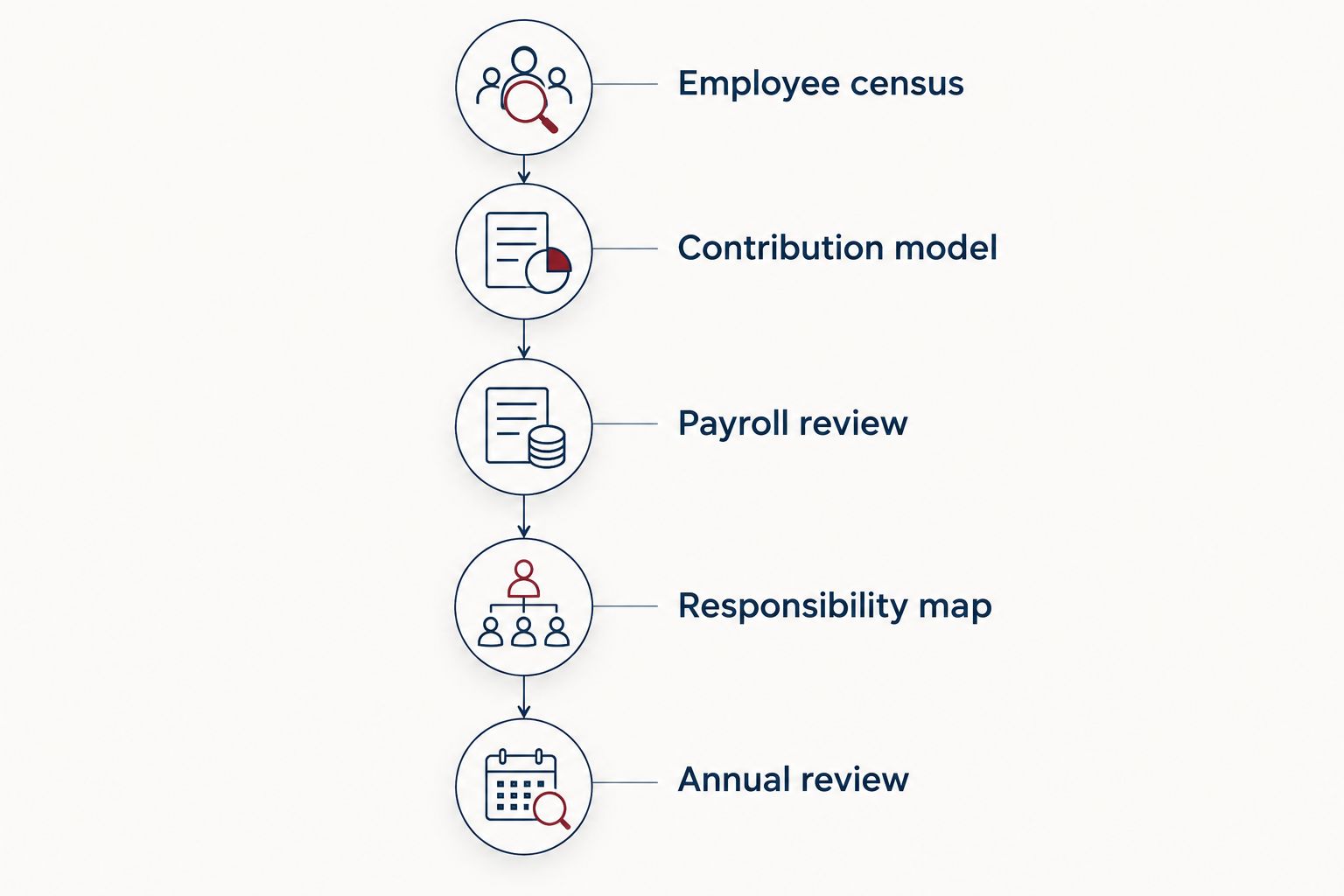
Choose the contribution structure before implementing payroll deductions.
How these plans are ranked
The ranking prioritizes owner deferral certainty, employer contribution flexibility, workforce coverage, and administrative obligations. It compares established plan designs—not provider service quality, investment performance, or an unverified list of platform features.
For federal rules applicable to 2026 planning, consult the IRS guidance titled 401(k) Plan Overview, 401(k) Plan Fix-It Guide, and SIMPLE 401(k) Plans. Department of Labor guidance on fiduciary responsibilities and depositing employee contributions addresses employer duties beyond tax qualification. Your adopted document and circumstances determine implementation.
Which employee 401(k) should you choose?
Start with a safe harbor matching 401(k) if owner deferral certainty is your priority and the business can fund the match. Choose a traditional 401(k) when employer contribution flexibility matters more and testing projections support your savings goal.
Choose safe harbor nonelective contributions when you want covered employees to receive a contribution regardless of their deferrals. Keep SIMPLE 401(k) on the shortlist only after confirming that its restrictions fit the business.
Bring the employee census, owner compensation, and contribution illustration into your 2026 tax-planning discussion. CEOHAVEN offers tax planning, tax preparation, and bookkeeping; the plan administrator must address the retirement plan's design and operating requirements.
Coordinate your tax planning
Discuss your business tax planning alongside owner compensation and retirement contribution decisions.
FAQ
What's the best 401(k) plan for a small business with employees?
A safe harbor matching 401(k) is the starting choice when predictable owner deferrals matter and the business can fund the required match. A traditional 401(k) is better suited to employers prioritizing contribution flexibility and accepting annual testing.
Is a safe harbor 401(k) better than a traditional 401(k)?
A safe harbor 401(k) is better for qualifying testing relief, while a traditional 401(k) offers more flexibility over discretionary employer contributions. Compare employee contribution obligations and projected testing results before choosing.
Can I keep a solo 401(k) after hiring employees?
A solo 401(k) cannot remain owner-only if nonspouse employees become eligible to participate. Hiring requires an eligibility review; the employee's actual eligibility date determines when participation obligations arise.
Does a safe harbor plan require a contribution for every employee?
The answer depends on the safe harbor formula and employee eligibility. A matching formula requires employee deferrals to generate a match, while a nonelective formula provides contributions for covered eligible employees regardless of deferrals.
Can my S corporation distributions fund my employee 401(k) contribution limit?
S corporation shareholder distributions are not compensation for retirement-plan contribution calculations. The owner's qualifying payroll compensation and the plan's terms determine the applicable calculation.
Does a provider handle every employer compliance responsibility?
No, hiring a provider does not automatically transfer every employer compliance or fiduciary responsibility. Review the service agreement and identify who handles eligibility, deposits, notices, filings, investments, and corrections.
Does CEOHAVEN offer retirement-plan recordkeeping?
CEOHAVEN's stated services are tax planning, tax preparation, and bookkeeping. Select and verify retirement-plan recordkeeping and administration services separately rather than assuming they are included.
One last thing
Safe harbor is a testing provision, not a blanket compliance exemption. Eligibility errors, missed deposits, and incorrect compensation calculations still require attention. Before approving a plan, ask who reconciles payroll to retirement deposits—and what evidence you receive that the reconciliation happened.
This article provides general education, not individualized tax, investment, or legal advice. Confirm the design with qualified tax and retirement-plan professionals before adopting or amending a plan.