

Bench’s strength is its done-for-you bookkeeping model, which gives owners an alternative to maintaining the books themselves. That model stops being enough when your decision involves tax planning, return preparation, and business bookkeeping together—not just a completed ledger. The best Bench alternative in 2026 is CEOHAVEN if you need business tax consulting alongside bookkeeping; QuickBooks Online if you want to manage your accounting in software.
TL;DR
- For Bench alternatives, choose CEOHAVEN for tax planning, tax preparation, and bookkeeping—not a software-only replacement.
- QuickBooks Online fits owners who want accounting software and can assign responsibility for maintaining accurate books.
- Xero fits owners who want to manage invoicing, bills, and bank reconciliation in accounting software.
- Stay with Bench when its bookkeeping engagement meets your needs; switching platforms alone does not create tax strategy.
Why this matters
A bookkeeping replacement and a tax adviser solve different problems. Before comparing Bench alternatives, decide whether you need someone to maintain your records, software to maintain them yourself, or advice before you make a financial decision.
For a founder with business income, investments, and multiple financial commitments, those distinctions matter. Accurate reports describe what happened. Tax planning addresses what you should do before the next transaction, election, or filing obligation.
Your 2026 decision should start with responsibility, not features. Who closes the books? Who prepares the returns? Who evaluates the tax consequences before you act? A familiar dashboard does not answer those questions.
Bench alternatives at a glance
Bench belongs in the comparison because keeping your current bookkeeping arrangement is a legitimate choice. These alternatives represent different operating models, not interchangeable subscriptions.
| Option | Best for | Standout function | How it differs from Bench |
|---|---|---|---|
| Bench | Owners seeking done-for-you bookkeeping | Bookkeeping delivered as a service | The benchmark for an outsourced bookkeeping model |
| CEOHAVEN | Entrepreneurs, real estate investors, content creators, and high-income professionals seeking business tax consulting | Tax planning, tax preparation, and bookkeeping | A consulting firm offering the three disciplines together |
| QuickBooks Online | Owners or accounting teams maintaining their own books | Invoicing, expense tracking, and financial reporting | Accounting software; responsibility for the books still needs an owner |
| Xero | Owners or accounting teams managing bookkeeping workflows | Bank reconciliation, invoicing, and bills | Accounting software rather than a standalone done-for-you bookkeeping engagement |
The meaningful comparison is not which option has the longest feature list. It is which arrangement gives you the right division of work between you, your bookkeeper, and your tax adviser.
1. CEOHAVEN: best for tax planning alongside bookkeeping
CEOHAVEN is a business tax consulting firm offering tax planning, tax preparation, and bookkeeping to entrepreneurs, real estate investors, content creators, and high-income professionals in the United States. Its relevance as a Bench alternative comes from that service mix. Choose a consulting relationship when your question is about a business decision, not simply where to categorize a transaction.
Where the consulting model shines
- Connected service needs: You can evaluate planning, preparation, and bookkeeping within the same firm's stated offerings.
- A defined audience: The firm explicitly serves business owners, property investors, creators, and high-income professionals.
- Advice-oriented selection: You can assess the relationship around the tax questions your business creates, rather than software features alone.
Where the consulting model falls short
- It is not a software-only replacement: If you want an application to operate yourself, a consulting engagement answers a different need.
- Service names do not define your engagement: You still need written responsibilities, deliverables, and deadlines before assigning work.
- Advice requires records: A tax adviser cannot evaluate your position properly when business transactions and supporting documents remain incomplete.
Best for: Founders and high earners who want tax planning, tax preparation, and bookkeeping considered together.
Head-to-head with Bench
| Dimension | Consulting firm | Bench |
|---|---|---|
| Selection priority | Tax planning, preparation, and bookkeeping | Done-for-you bookkeeping |
| Decision to clarify | Which advisory and accounting services your engagement includes | Which bookkeeping and other services your engagement includes |
| Owner's role | Supply records and raise decisions before acting | Supply records and clarify how transactions should be treated |
| Fit test | You need advice as well as maintained books | You primarily need an outsourced bookkeeping arrangement |
CEOHAVEN is the Bench alternative for owners seeking business tax consulting alongside bookkeeping. Before engaging, describe the decisions ahead: changing how you pay yourself, buying a rental, adding workers, or managing income from several sources. Ask which questions the proposed scope covers.
Verdict: Buy the consulting model when advice is the missing function.
2. QuickBooks Online: best for owning your accounting workflow
QuickBooks Online is accounting software for tasks including invoicing, expense tracking, and financial reporting. It changes the operating model: instead of selecting a bookkeeping service, you select software and assign someone to maintain it. That person can be you, an employee, or a separately engaged accounting professional.
Where QuickBooks Online shines
- Direct accounting work: You can record business activity and review financial reports within accounting software.
- Invoicing and expenses: It supports common workflows for billing customers and recording business spending.
- A clear division of responsibility: You can separate the accounting system from the professional responsible for maintaining or reviewing it.
Where QuickBooks Online falls short
- Software is not a completed service: Someone must reconcile accounts, resolve questions, and review the records.
- Entry errors remain consequential: A transaction can appear in a report while still being classified incorrectly.
- Reports are not tax advice: A profit-and-loss statement does not determine whether a proposed transaction or election is appropriate.
Best for: Owners with the time and accounting knowledge to maintain their books, or a named professional who will do the work.
Head-to-head with Bench
| Dimension | QuickBooks Online | Bench |
|---|---|---|
| Operating model | Accounting software | Done-for-you bookkeeping |
| Bookkeeping responsibility | Assigned by you to an owner or professional | Defined through the bookkeeping engagement |
| Core selection question | Who will maintain and review the software records? | What bookkeeping work will the service perform? |
| Tax planning | Requires a separate advisory responsibility | Confirm the scope of your engagement |
Before choosing QuickBooks Online in 2026, write down who will reconcile each account and approve the final reports. If the answer is simply that the software will handle it, you have not replaced the bookkeeping function. You have moved responsibility back into your business.
Verdict: Buy when you have a named owner for the books; skip as a substitute for unassigned labor.
3. Xero: best for software-led bookkeeping
Xero is accounting software with bank reconciliation, invoicing, and bill-management functions. Like QuickBooks Online, it is a different category of solution from an outsourced bookkeeping engagement. Evaluate it around the work you need to perform and the person responsible for performing it.
Where Xero shines
- Bookkeeping workflows: Bank reconciliation connects recorded transactions with account activity.
- Billing work: Invoicing and bills support money owed to and by the business.
- Software-led control: You can organize accounting work around an application rather than a bundled service relationship.
Where Xero falls short
- The work still needs an owner: Reconciliation and review do not become someone else's responsibility merely because you choose software.
- Setup affects the records: Account categories and opening balances need attention before you rely on reports.
- Tax judgment remains separate: A software workflow does not establish the correct treatment of every business decision.
Best for: Owners or accounting teams that want software-led bookkeeping and can maintain the records consistently.
Head-to-head with Bench
| Dimension | Xero | Bench |
|---|---|---|
| Operating model | Accounting software | Done-for-you bookkeeping |
| Main evaluation | Reconciliation, invoicing, and bill workflows | Scope and delivery of bookkeeping work |
| Owner's obligation | Assign maintenance and review | Provide records and resolve service questions |
| Advisory needs | Assign a tax adviser separately | Confirm advisory responsibilities in the engagement |
Do not select Xero because its interface feels easier during a demonstration. Select it after the person maintaining your books can explain how your actual transactions will be recorded, reconciled, and reviewed.
Verdict: Buy for a defined software workflow; skip if your goal is to delegate bookkeeping without arranging a service.
Why people switch from Bench
The strongest reasons to switch are changes in the work you need—not assumptions about a competitor's service. Use these as decision criteria, not claims about every Bench customer's experience.
You need advice before a transaction
A bookkeeping report records a property purchase after it happens. Planning begins before you commit. For a qualifying Section 1031 exchange, IRS rules generally require identification of replacement property within 45 days and receipt within 180 days, or the applicable return due date if earlier.
Those deadlines illustrate the distinction: complete books cannot substitute for evaluating a transaction before the relevant clock expires. If you need that kind of advice in 2026, assess an advisory engagement explicitly.
You want to maintain the books yourself
Moving to QuickBooks Online or Xero is a change in responsibility. It makes sense when you want direct control and have someone capable of maintaining the records. It does not make sense when you still expect a service provider to complete work you have not assigned.
Your records require a more deliberate structure
Rental activity, creator income, and operating-business transactions create different recordkeeping questions. A property-level ledger needs to distinguish activity by property; a creator's records need to preserve the business purpose of spending.
For rental owners, automated rental bookkeeping software addresses transaction processing, while ownership structure, expense treatment, and tax decisions remain separate questions. Automation does not make those judgments disappear.
Before changing your broader accounting arrangement, define the records you need from each property. The comparison of rental property accounting software for landlords focuses that software decision without treating it as a replacement for tax advice.
How to switch without losing the accounting thread
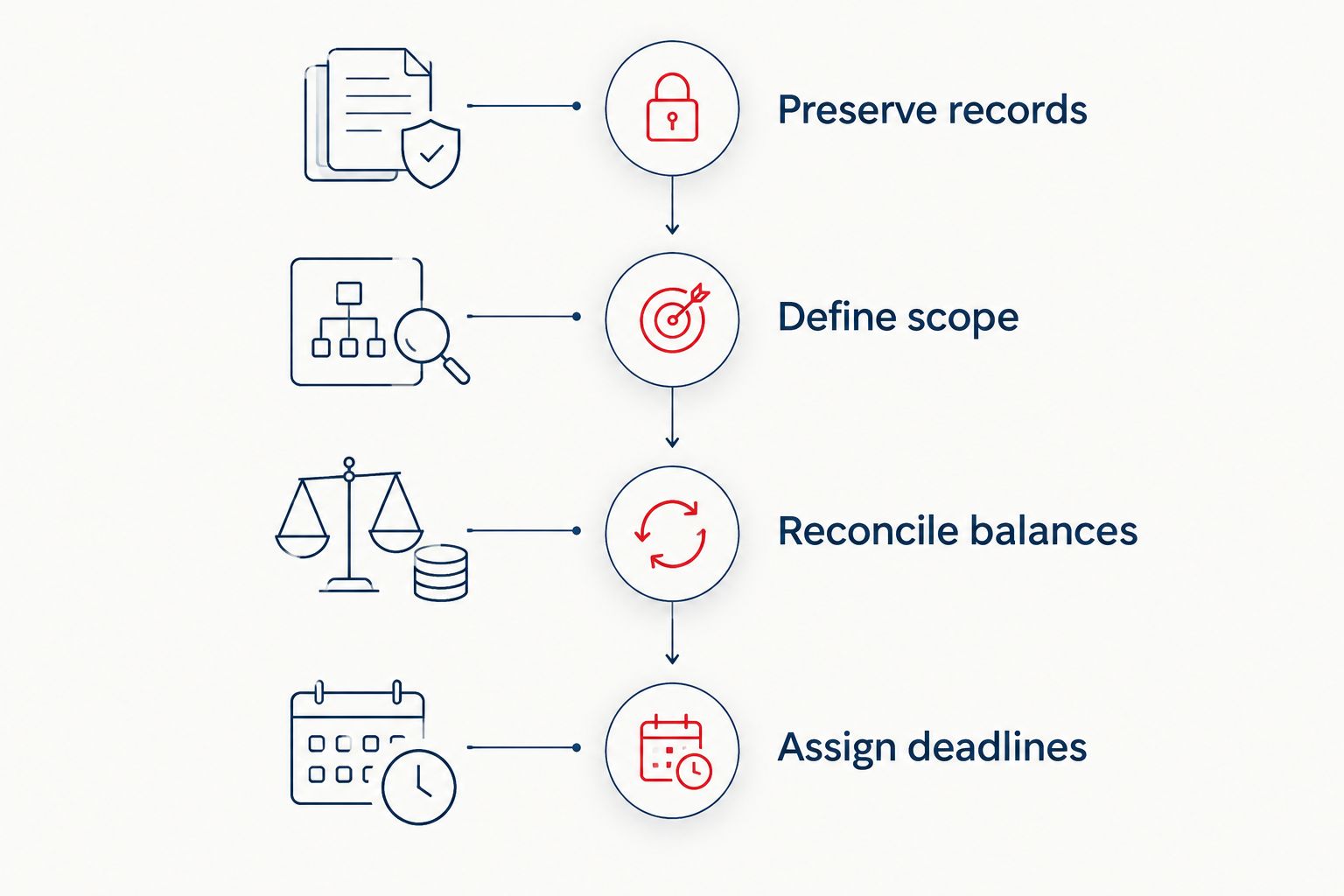
A 2026 transition should preserve the story behind your balances, not just transfer a file. Use this sequence before assigning the next provider or software owner responsibility.
Preserve records
Save the available financial reports, transaction detail, reconciliations, and supporting documents. Keep the records that explain balances—not only a summary of revenue and expenses. Agree on what the receiving professional needs before assuming an export is sufficient.
Define scope
Separate bookkeeping, return preparation, and planning in writing. Identify who handles each function and which entities or activities are included. A broad promise to handle accounting leaves too much room for different expectations.
Reconcile balances
Have the receiving professional check opening balances against the prior records. Unresolved differences should become explicit questions, not silent adjustments. Otherwise, the new system starts with uncertainty carried forward from the old one.
Assign deadlines
Set responsibility for supplying records, answering questions, closing the books, and evaluating tax payments. For individuals required to make estimated tax payments, the federal schedule generally has four payment installments per year; the IRS Form 1040-ES instructions govern timing and exceptions.
A planning relationship needs usable information before those decisions, not only after year-end. Ask what records are required and when you must supply them.
Assign responsibility before treating the transition as complete.
Do not end a bookkeeping arrangement until you understand how the records and unresolved questions will move. The transition is complete when the next responsible person can explain the balances and the remaining work.
When staying with Bench is the right call
Stay with Bench when its bookkeeping engagement meets your needs and the reports support the people making your financial decisions. A switch is not automatically an improvement. It introduces a handoff that needs its own attention.
If your only missing function is tax advice, evaluate whether a separate advisory engagement solves that problem without replacing your bookkeeping arrangement. You do not need every accounting responsibility in one place; you need every responsibility assigned.
Best for staying: Owners satisfied with their bookkeeping arrangement who can clearly identify who handles preparation and planning. Verdict: Hold when the current service fits and the remaining responsibilities are covered.
FAQ
What's the best Bench alternative in 2026?
CEOHAVEN is the best fit for owners seeking business tax consulting alongside bookkeeping. QuickBooks Online and Xero fit owners who want accounting software and can assign someone to maintain the records.
Is QuickBooks Online a direct replacement for Bench?
QuickBooks Online replaces the accounting software function, not an outsourced bookkeeping engagement by itself. You still need someone responsible for reconciliation, classification, and review.
Is Xero better than Bench for doing my own bookkeeping?
Xero fits a software-led bookkeeping approach, while Bench uses a done-for-you bookkeeping model. Choose Xero when you or an accounting professional will maintain the books.
Does changing bookkeeping software solve my tax planning needs?
No, changing bookkeeping software does not establish a tax planning relationship. Assign a qualified adviser responsibility for evaluating decisions before you act.
What should I ask a Bench alternative before switching?
Ask who handles bookkeeping, tax preparation, and tax planning, and request the responsibilities in writing. Also clarify record transfers, opening-balance review, and deadlines.
Which Bench alternative fits real estate investors?
CEOHAVEN explicitly serves real estate investors and offers tax planning, preparation, and bookkeeping. Evaluate the proposed engagement against your properties, ownership arrangements, and upcoming transactions.
Should I keep Bench and hire a separate tax adviser?
Keep Bench and evaluate a separate adviser when your bookkeeping arrangement works but you need additional tax advice. Confirm how records and questions will move between the responsible professionals.
One last thing
Your accountant's most valuable answer sometimes arrives before there is a transaction to record. That is why the best Bench alternative in 2026 is not necessarily another bookkeeping platform.
Choose the missing function first. If you need maintained records, select a bookkeeping arrangement. If you need control, select software and assign the work. If you need decisions evaluated before they become permanent, select tax advice.