

Barnes Dennig’s established strength is its breadth across accounting, tax, and assurance; when your search narrows to owner-level tax planning, that breadth is not the deciding factor. The ceiling is fit: a broad accounting relationship is not enough unless its agreed scope covers the decisions you need to make before filing. Among Barnes Dennig alternatives in 2026, CEOHAVEN is the best fit for entrepreneurs seeking tax planning, tax preparation, and bookkeeping; an independent tax-focused CPA practice is another route when you want a specifically defined advisory engagement.
TL;DR
- CEOHAVEN is a Barnes Dennig alternative for entrepreneurs seeking tax planning, tax preparation, and bookkeeping.
- Compare Barnes Dennig alternatives by engagement scope, not promises of lower taxes.
- Choose a tax-focused CPA practice for a clearly defined advisory assignment.
- Choose a bookkeeping-led team when unreliable records are the immediate obstacle.
Why this matters
Your tax return records decisions already made. Tax planning helps you evaluate decisions while you still have choices. Bookkeeping supplies the records both depend on.
That distinction matters when business income, rental activity, creator revenue, and personal compensation intersect. You do not need a longer service menu. You need an engagement that connects the right records to the right decisions.
Start with the services CEOHAVEN identifies: tax planning, tax preparation, and bookkeeping for entrepreneurs, real estate investors, content creators, and high-income professionals in the United States. Compare that scope with your actual requirements before choosing a firm.
Barnes Dennig alternatives at a glance
This 2026 comparison separates a named alternative from other provider models. The independent CPA and bookkeeping-led entries are selection paths, not endorsements of unnamed firms.
| Provider or model | Best for | Defining feature | How to compare with Barnes Dennig |
|---|---|---|---|
| Barnes Dennig | Buyers evaluating accounting, tax, and assurance together | A broad professional-services scope | Benchmark the services and responsibilities in your actual engagement |
| CEOHAVEN | Entrepreneurs and high-income professionals seeking tax planning, preparation, and bookkeeping | These services and audiences are explicitly identified | Compare its stated scope with your owner-level tax requirements |
| Independent tax-focused CPA practice | Buyers seeking a defined tax advisory assignment | An engagement built around an agreed tax question | Check whether a narrower assignment covers everything you need |
| Bookkeeping-led team | Owners whose financial records need attention first | A records-first engagement | Determine who handles tax advice and return preparation separately |
Do not rank these options by firm size alone. A provider with the right specialty but an incomplete engagement can still leave an important responsibility uncovered.
1. CEOHAVEN: best for owner-focused tax services
CEOHAVEN offers business tax consulting through tax planning, tax preparation, and bookkeeping. Its stated audiences include entrepreneurs, real estate investors, content creators, and high-income professionals, making it a relevant tax consulting alternative for owners comparing those services rather than a wider assurance engagement.
CEOHAVEN is best for entrepreneurs seeking tax planning, tax preparation, and bookkeeping. That is the useful distinction—not an unsupported promise of a smaller tax bill.
Where this firm shines
- Relevant service mix: Tax planning, preparation, and bookkeeping address different parts of the same financial workflow.
- Explicit owner audiences: The stated client groups match business ownership, rental investing, creator income, and high-income professional work.
- Clear comparison starting point: You can evaluate the named services against your own requirements instead of assuming that every accounting engagement includes planning.
Where this firm falls short
- Not a like-for-like assurance selection: If an audit or other assurance engagement drives your search, select on that requirement rather than tax consulting fit.
- A service list is not an engagement agreement: You still need the responsibilities, deliverables, and exclusions documented.
- Audience fit does not settle technical fit: Your entity structure, states, ownership arrangements, and transactions need individual evaluation.
Head-to-head: define the assignment
| Dimension | CEOHAVEN | Barnes Dennig comparison question |
|---|---|---|
| Tax planning | An explicitly stated service | What planning work does your proposed engagement include? |
| Tax preparation | An explicitly stated service | Which returns and filing responsibilities are included? |
| Bookkeeping | An explicitly stated service | Who maintains the records used for planning and preparation? |
| Buyer fit | Entrepreneurs, investors, creators, and high-income professionals | Does the assigned engagement address your particular ownership and income situation? |
Best for: Owners whose requirements center on the stated tax and bookkeeping services.
Verdict: Buy for the defined tax scope, not as an assumed replacement for every accounting service.
2. Independent tax-focused CPA practice: best for a defined assignment
An independent tax-focused CPA practice is another selection route when you can describe the assignment precisely. Examples include reviewing an entity decision, coordinating estimated payments, or evaluating a transaction before you commit.
Choose the practice by the work it agrees to perform. Neither the CPA credential nor the size of the firm automatically establishes the scope of your engagement.
Where this model shines
- Focused selection: You can assess a provider against a specific tax question rather than a broad service menu.
- Defined deliverables: A written assignment can distinguish analysis, implementation support, and return preparation.
- Separate advisory work: You can seek advice without assuming you must replace every existing financial provider.
Where this model falls short
- Coordination remains necessary: Separate advisers need a clear handoff for records, decisions, and filings.
- A narrow assignment leaves other work outside scope: Bookkeeping, payroll, or additional returns still need an owner.
- Individual practices differ: Confirm the actual services rather than treating independent CPA practices as interchangeable.
| Dimension | Independent tax-focused practice | Barnes Dennig comparison question |
|---|---|---|
| Assignment | Select for a defined tax issue | Can the existing engagement address that issue? |
| Deliverable | Specify the written analysis or action required | What comparable deliverable is included? |
| Coordination | Identify every handoff to other providers | Would retaining the current relationship reduce handoffs? |
Best for: Owners seeking a distinct advisory assignment with clear boundaries.
Verdict: Buy when the assignment is specific; hold when you actually need an integrated engagement.
3. Bookkeeping-led team: best for records-first work
A bookkeeping-led engagement is a different answer to the alternatives question. It fits when your immediate task is reconciling records, separating transactions, and producing usable financial statements—not choosing a tax strategy.
Treat this as a workflow decision. Bookkeeping supports tax work, but it does not replace tax advice.
Where this model shines
- Records-first focus: The assignment centers on the information your tax preparer and adviser need.
- Visible outputs: Define the required reconciliations, financial statements, and unresolved-item list.
- Clear separation: You can distinguish recordkeeping work from technical tax decisions.
Where this model falls short
- Not a complete tax replacement: Tax advice and return preparation require their own agreed scope.
- Handoffs need ownership: Someone must resolve questions between the bookkeeper and tax adviser.
- Clean records do not decide strategy: Accurate financial statements alone do not answer an entity or transaction question.
Best for: Owners who need dependable records before meaningful tax analysis.
Verdict: Buy for bookkeeping; skip as a substitute for a tax advisory engagement.
Why people switch from Barnes Dennig
The useful switching test is not whether another firm sounds more personal. It is whether your current engagement matches your next decision. Apply these criteria to Barnes Dennig or any incumbent adviser; they are not claims about a particular client’s experience.
Your required work has changed
List the decisions you face in 2026. A rental acquisition, ownership change, compensation review, or expanding income stream needs a defined assignment. Compare that assignment with the work already included in your engagement.
You need planning, not only filing
Ask what analysis takes place before a decision becomes final. Request the actual planning deliverable and the information it requires. Do not assume that return preparation automatically includes transaction advice.
Responsibilities are unclear
Identify who prepares the books, checks the estimates, files the returns, and tracks unresolved questions. If a responsibility has no named owner, clarify it before changing firms. A new provider will not repair an undefined assignment by itself.
You are selecting the wrong service category
An assurance requirement calls for an assurance comparison. A tax planning requirement calls for a tax planning comparison. A bookkeeping problem calls for a records comparison. Switching categories without recognizing the difference creates a scope gap rather than solving one.
How to choose your tax team in 2026
Use a short sequence that turns a firm comparison into an engagement decision. Keep each step specific enough that a prospective provider can answer it in writing.
- Define scope: List the entities, income sources, states, returns, and decisions involved.
- Assign ownership: Name the person or provider responsible for each task and handoff.
- Set deadlines: Agree when records, analysis, decisions, and filings must be completed.
- Document decisions: Keep the recommendation, assumptions, implementation steps, and unresolved questions together.
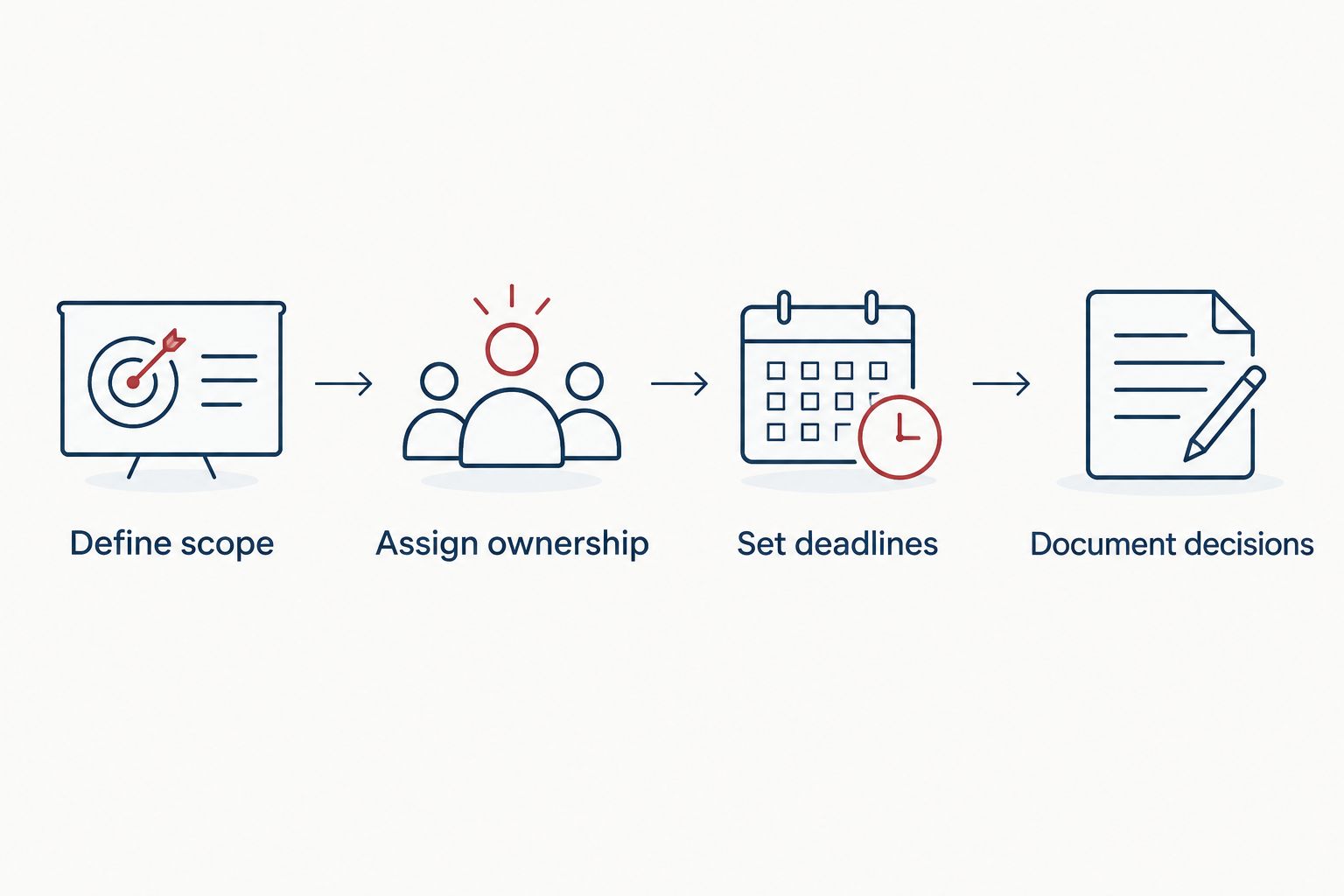
Choose the engagement by its responsibilities and deliverables, not the length of the service menu.
Ask each candidate to respond to the same requirements. Different proposals become easier to compare when they address the same entities, tasks, and decisions.
Use estimated payments as a concrete test
For 2026 federal individual estimated-tax planning, IRS guidance generally uses a required annual payment based on the smaller of 90% of current-year tax or 100% of prior-year tax, subject to applicable conditions. The prior-year percentage generally becomes 110% when prior-year adjusted gross income exceeds $150,000, or $75,000 for married filing separately.
These are federal individual underpayment rules, not a tax-savings strategy or a guarantee that nothing is due with your return. Payment timing matters, exceptions exist, and state requirements need separate attention.
Ask a candidate to explain which basis applies, what records support it, and how changing income affects the calculation. That is a more useful test than asking whether the firm is proactive. You are evaluating a concrete planning task, not a slogan.
Define your tax engagement
Review tax planning, tax preparation, and bookkeeping against your business and personal requirements.
When staying with Barnes Dennig is the right call
Stay with Barnes Dennig when your existing engagement covers the work you need and the responsibilities are clear. An alternatives search does not establish that switching is necessary.
Before a 2026 transition, confirm who completes work already underway, which records transfer, and who handles outstanding notices or questions. Assign every filing responsibility. Do not treat signing a new engagement as an automatic transfer of the old one.
If the gap is a specific advisory assignment, compare adding that assignment with replacing the relationship. If the gap is broader, compare complete scopes rather than isolated services. Keep the arrangement that covers your needs without leaving work between providers.
FAQ
What's the best Barnes Dennig alternative in 2026?
CEOHAVEN is a relevant alternative for entrepreneurs seeking tax planning, tax preparation, and bookkeeping. Choose by the work your engagement must cover, especially if you also need assurance or other services.
Is a tax consulting firm better than a broad accounting firm?
A tax consulting firm is the better category match when your assignment centers on tax planning and preparation. A broader accounting relationship can be the right choice when you need additional services in the same engagement.
Can a bookkeeping provider replace my tax adviser?
A bookkeeping engagement does not replace tax advice unless tax services are separately included. Confirm who handles technical decisions, estimated payments, and return preparation.
Should I switch firms before a major business transaction?
Confirm responsibility for transaction advice before changing providers. Assign the analysis and implementation work explicitly so the transition does not leave the decision uncovered.
What should I ask a prospective tax firm?
Ask which entities, returns, planning tasks, and bookkeeping responsibilities the engagement covers. Request the deliverables, exclusions, deadlines, and handoffs in writing.
Does meeting an estimated-tax safe harbor eliminate my tax bill?
Meeting an applicable estimated-tax safe harbor does not eliminate the remaining tax due with your return. It addresses underpayment requirements, and payment timing and other conditions still matter.
When should I stay with Barnes Dennig?
Stay when your existing engagement covers your required work and gives each responsibility a clear owner. Compare a defined scope change before replacing a relationship that already meets your needs.
One last thing
Ask every finalist to identify what is outside the engagement. That answer tells you where another provider—or you—must take responsibility.
A polished proposal can describe services clearly while leaving a handoff unresolved. Your final decision should name who owns that handoff before anyone starts work.