

There is no IRS-approved average S corp reasonable salary by industry: your defensible wage depends on your work, not a fixed share of profit. For 2026 planning, the selected federal occupation benchmarks below span annual median wages of $56,320 to $161,030—but those figures describe employee occupations, not approved S corporation owner salaries.
TL;DR
- S corp reasonable salary by industry starts with comparable work, not a fixed salary-to-distribution ratio.
- BLS occupation medians are reference points, not IRS-approved owner salaries or current-year compensation surveys.
- Document duties, hours, location, experience, and how the business generates revenue before setting payroll.
- CEOHAVEN offers tax planning, tax preparation, and bookkeeping for entrepreneurs who need coordinated business tax support.
Why this matters
Your industry tells you where to start researching compensation. Your actual responsibilities determine which comparisons belong in the file. An agency founder delivering client work needs a different analysis from an owner whose employees deliver the services.
CEOHAVEN is a business tax consulting firm for entrepreneurs seeking tax planning, tax preparation, and bookkeeping together. Before you choose a payroll number, separate payment for your labor from returns attributable to employees, equipment, and invested capital.
For business tax support, CEOHAVEN serves entrepreneurs, real estate investors, content creators, and high-income professionals.
S corp reasonable salary by industry: benchmark table
An occupation's median wage is the midpoint of employee wages in that occupation. It is not the arithmetic average, and it does not establish reasonable compensation for an S corporation shareholder.
The overall yardstick below is $49,500 annually for all occupations. Use the industry examples to identify relevant roles—not to select a salary solely because your business falls into that category.
| Business context | Comparable employee occupation | National median annual wage | Best for | Main limitation |
|---|---|---|---|---|
| All industries | All occupations | $49,500 | Broad labor-market context | Too broad to establish an owner's compensation |
| Real estate sales | Real estate sales agents | $56,320 | Comparing an owner's property-sales duties | Does not represent brokerage leadership or investment returns |
| Accounting services | Accountants and auditors | $81,680 | Comparing accounting and financial reporting work | Does not isolate firm ownership or business development |
| Consulting | Management analysts | $101,190 | Comparing management consulting delivery | Does not capture every consulting specialty |
| Software businesses | Software developers | $133,080 | Comparing hands-on software development | Does not separately value executive or sales responsibilities |
| Marketing businesses | Marketing managers | $161,030 | Comparing substantive marketing management duties | A managerial title alone does not establish comparable work |
Marketing managers have the highest median in this selected comparison at $161,030 annually; real estate sales agents have the lowest occupational median at $56,320. That ranking compares employee jobs, not the compensation required for owners of marketing agencies and real estate businesses.
Source and methodology: U.S. Bureau of Labor Statistics, Occupational Outlook Handbook, May 2024 national median annual wage figures, based on Occupational Employment and Wage Statistics data. These historical employee benchmarks support 2026 planning; they exclude self-employed workers and do not measure S corporation owner compensation.
The $49,500 overall figure is context, not a recommended minimum. Likewise, the highest figure in the table is not a ceiling. Geography, responsibilities, working time, qualifications, and comparable employers all affect whether a benchmark fits your situation.
How to use these benchmarks
- Start with duties, not the industry label. The $133,080 software developer median is relevant to development work, not automatically to every owner selling software.
- Treat broad figures as orientation. The $49,500 all-occupations median combines unrelated jobs and cannot support an executive compensation decision by itself.
- Distinguish delivery from management. The $101,190 management analyst median describes a different occupation from the $161,030 marketing manager median. Choose the work first, then evaluate compensation.
- Refresh the evidence for 2026. Historical national medians need current, location-specific support before you rely on them for a payroll decision.
A benchmark becomes useful when you can explain why it belongs in your analysis. A precise-looking number without a job match remains weak evidence.
What the IRS evaluates instead of an industry average
The IRS's S Corporation Compensation and Medical Insurance Issues guidance identifies factors including training and experience, duties and responsibilities, time devoted to the business, comparable compensation, and payments to nonshareholder employees. It also considers the source of the corporation's gross receipts.
That last distinction matters. Receipts generated through your personal services raise a different compensation question from receipts generated through other employees or capital and equipment. Neither revenue nor profit alone describes the value of your work.
A distribution label does not turn payment for shareholder services into investment income. The IRS can reclassify distributions as wages when the facts support that treatment.
For your 2026 compensation file, explain both sides of the business: what you personally do and what produces income without your direct labor. Do not describe the entire company as passive simply because you have hired support.
Why a fixed percentage is not a safe harbor
A predetermined salary-to-distribution split does not replace a reasonable compensation analysis. The IRS does not approve a universal percentage that works across businesses, occupations, and profit levels.
A percentage also produces the wrong starting question. Instead of asking how much profit you can distribute, ask what comparable compensation looks like for the services you actually provide.
Profit remains relevant to the business's financial circumstances. It does not make your job description unnecessary.
Match your business to the work you actually perform
Consulting and professional services
Management analysts provide a starting comparison for some consulting work. Accountants and auditors provide a different comparison for accounting duties. Neither occupation automatically captures a founder's mix of client delivery, sales, supervision, and administration.
Best for: owners whose daily work closely resembles the selected occupation. The benefit is a recognizable employee comparison; the drawback is that national occupation data can hide specialty and regional differences.
Describe the client work before selecting the title. Calling yourself a chief executive does not erase the technical services you deliver personally.
Marketing agencies and content businesses
The marketing manager benchmark fits management responsibilities, not every task performed by a creator or agency owner. Writing, production, account management, sales, and campaign direction involve different work.
Best for: owners with documented marketing management duties. The benchmark offers a defined managerial comparison, but it is incomplete when most of your time goes into creating deliverables rather than managing marketing activity.
A content business also needs to distinguish current services from income associated with existing intellectual property. Document the underlying activities rather than assuming all receipts have the same compensation implications.
Software businesses
The software developer median helps evaluate hands-on development. It does not automatically price fundraising, customer acquisition, staff management, or the return on an established software asset.
Best for: owners who spend substantial working time building and maintaining software. Its strength is the direct technical comparison; its limitation is that a developer benchmark alone does not describe a mixed executive role.
Keep the compensation analysis separate from the company's valuation. A valuable business and a highly compensated job are related concepts, not interchangeable measurements.
Real estate businesses
The real estate sales agent median concerns sales work. It does not establish compensation for property management, brokerage supervision, construction activity, or ownership of rental assets.
Best for: comparing documented real estate sales responsibilities. Its weakness is the temptation to apply it to every real estate activity, including activities that do not resemble an employee sales role.
Before using this benchmark, confirm which activities the S corporation actually conducts. An entity choice and a compensation decision require separate analysis.
Build a compensation file before changing payroll
A defensible 2026 process follows the work from job description through payroll records. Keep the evidence together so your explanation does not depend on reconstructing the year from memory.
- Role inventory: list client delivery, management, sales, and administrative responsibilities. Separate your duties from work performed by employees and contractors.
- Time allocation: record how you divide working time among those responsibilities. Use a consistent method that reflects actual activity.
- Market evidence: retain the occupation definition, wage source, geographic scope, and publication period. Explain why the comparison fits.
- Written rationale: document how the evidence supports the selected compensation, including material differences from the benchmark.
- Payroll review: compare the documented plan with wages actually processed and revisit it when responsibilities change.
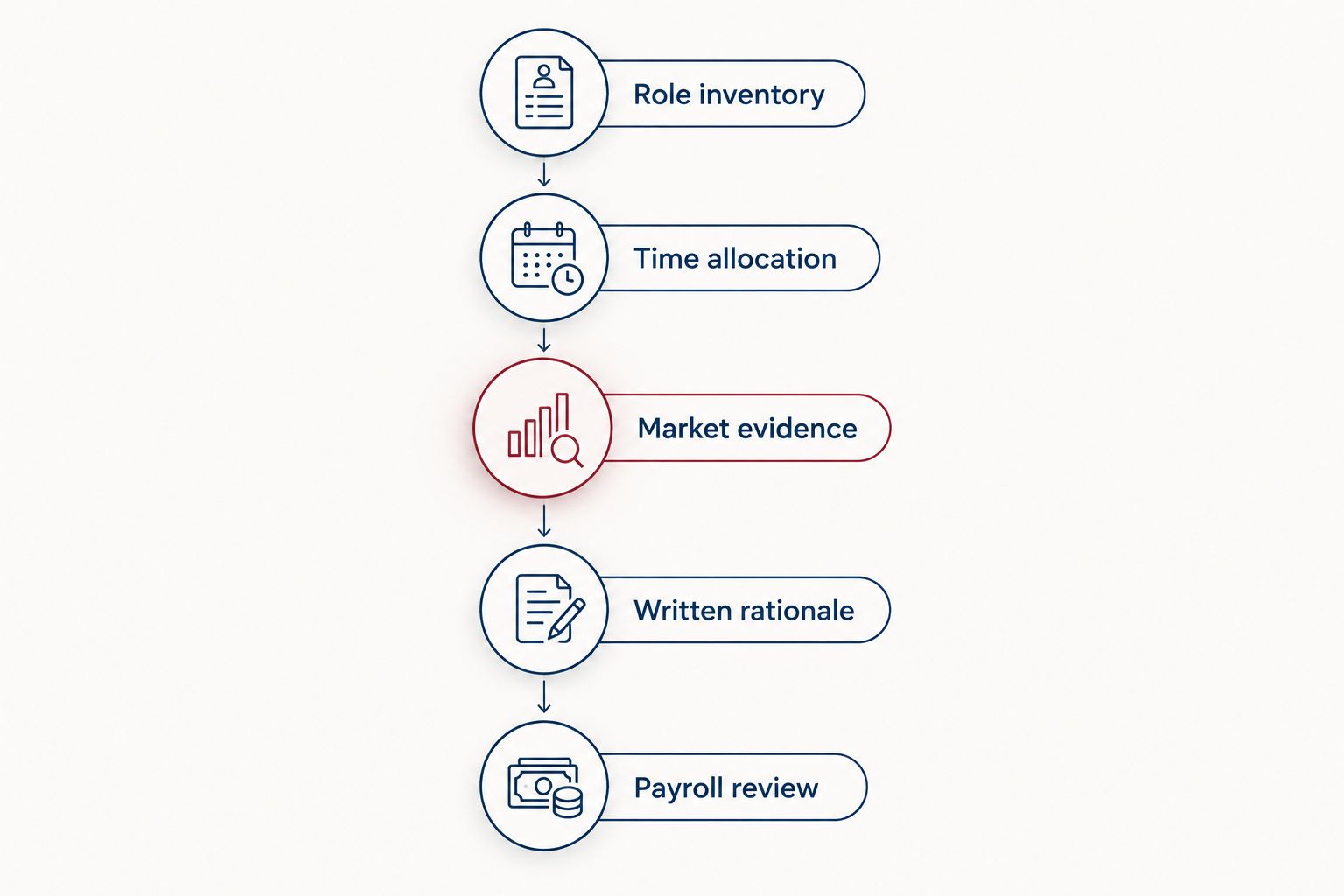
Connect the salary decision to documented work before implementing it through payroll.
The file should explain the judgment, not merely preserve a spreadsheet result. If you reject a national median because your role is materially different, state the difference and retain the evidence supporting your alternative.
Keep wages, contractor reporting, and distributions separate
Reasonable compensation is not just a research exercise. Your books and information returns must reflect the distinction between employee wages, payments to outside providers, and shareholder distributions.
For a shareholder working as a corporate officer, replacing payroll with contractor reporting does not resolve an employee compensation obligation. Separately, an LLC's legal form does not by itself establish how a payer should report payments; federal tax classification and applicable reporting exceptions matter.
That distinction also shapes the 1099-NEC rules for S corporations: corporate payee treatment and exceptions require a different analysis from the corporation's obligation to pay its working shareholder appropriately.
Do not use an information return as a substitute for deciding what a payment actually represents. Reconcile payroll, shareholder distributions, and contractor accounts before preparing the business return.
CEOHAVEN's bookkeeping, tax preparation, and tax planning services address these connected business tax functions. The compensation decision still requires facts specific to your work; a national table cannot supply them.
Revisit salary when the job changes
A salary supported at the beginning of 2026 needs another look if your responsibilities materially change. Hiring someone to take over delivery, returning to full-time client work, or changing your management duties alters the facts behind the original decision.
Document the effective date and reason for any adjustment. Then coordinate payroll processing and tax projections rather than treating a transfer from the business bank account as a completed payroll change.
The question of changing your S corp salary during the year belongs alongside the compensation analysis, not outside it. A midyear review should connect the revised job to revised compensation.
Do not automatically lower salary because distributions increased, or raise it solely because revenue increased. First identify what changed in your services and the evidence used to value them.
What a benchmark cannot decide for you
An occupation table cannot determine whether an S election makes sense for your business. It also cannot calculate the combined effects of payroll taxes, retirement contributions, state taxes, and administrative obligations.
Reasonable compensation is one input into that broader decision. It is not a target to minimize independently of everything else.
For 2026 planning, settle the compensation rationale before comparing projected tax outcomes. Otherwise, the apparent benefit of a strategy can depend on a wage assumption you cannot support.
Use CEOHAVEN for business tax planning, preparation, and bookkeeping—not as a substitute for the underlying records. Bring the role description, wage evidence, payroll history, and current financial statements into the conversation.
FAQ
What is the average S corp reasonable salary by industry?
There is no IRS-approved average S corp reasonable salary by industry. Use comparable employee compensation as evidence, then account for your duties, time, experience, location, and how the business generates receipts.
Can I use a BLS median as my S corporation salary?
A BLS median is a benchmark, not an automatic salary determination. Document why the occupation and market fit your work, and retain evidence addressing material differences.
Is a fixed salary-to-distribution percentage accepted by the IRS?
The IRS does not provide a universal salary-to-distribution percentage safe harbor. Reasonable compensation depends on the shareholder's services and the business's specific facts.
Does the highest-paying industry require the highest owner salary?
No. An industry's employee wages do not establish every owner's reasonable compensation. Your actual role and comparable work matter more than the broad industry label.
Can I pay myself only distributions from my S corporation?
Distributions do not replace reasonable wages for a shareholder who provides services as an employee. The IRS can reclassify distributions as wages when the payment represents compensation for services.
Can I change my S corporation salary during 2026?
You can adjust salary during 2026 when the facts support the change. Document the reason, coordinate payroll, and evaluate total compensation rather than choosing a new amount solely for tax savings.
Does part-time work justify a lower reasonable salary?
Part-time work is relevant because time devoted to the business is a compensation factor. A reduced schedule still requires evidence about duties, market compensation, and the work actually performed.
One last thing
The strongest number in your compensation file is not necessarily the closest one to a published median. It is the one you can explain. A benchmark with the wrong job description gives you precision without support.
Before your next payroll review, write down what someone else would have to do to replace your work. That description is the bridge between an industry table and a defensible salary.
Related guides
- Connect payroll to Solo 401(k) contributions
- S corp tax strategy for agency owners
- Is an S corp worth it? Break-even income explained
By Shamyr Borgelin, Founder & CEO of CEOHAVEN.