

An established relationship with AE Tax Advisors has value when your adviser already understands your entities, returns, and financial history. That continuity stops being enough when your engagement no longer covers the decisions you need to make before filing. The best AE Tax Advisors alternative in 2026 is CEOHAVEN if you need tax planning, tax preparation, and bookkeeping; an independent CPA is the alternative to evaluate if you want a narrowly defined engagement.
TL;DR
- Compare AE Tax Advisors alternatives by engagement scope, decision ownership, and implementation—not promises of tax savings.
- CEOHAVEN is the tax consulting choice for entrepreneurs needing planning, preparation, and bookkeeping.
- Evaluate an independent CPA for a defined assignment and a transaction specialist for a specific technical decision.
- Stay with AE Tax Advisors when your current engagement delivers the planning and execution you need.
Why this matters
Choosing a tax adviser is a decision about responsibility. Someone must maintain usable records, interpret the tax consequences, prepare the returns, and make sure agreed actions happen.
Those responsibilities are related, but they are not interchangeable. Accurate bookkeeping does not itself establish a tax strategy; a strategy conversation does not itself complete an election or update payroll.
For your 2026 comparison, start with the work your business requires. Then compare written scopes against that work—not against a firm's most persuasive introduction.
AE Tax Advisors alternatives at a glance
This comparison separates service models rather than pretending every provider is interchangeable. For AE Tax Advisors, benchmark the engagement you actually have or have been offered.
| Option | Best for | Defining feature | Difference to evaluate against AE Tax Advisors |
|---|---|---|---|
| CEOHAVEN | Entrepreneurs, real estate investors, content creators, and high-income professionals seeking business tax support | Offers tax planning, tax preparation, and bookkeeping | Compare those services with your current contracted scope and responsibilities |
| Independent CPA | An owner seeking a defined assignment with an individual professional | An engagement built around a specified professional assignment | Compare the exact deliverables, technical fit, and allocation of responsibility |
| Transaction-specific tax specialist | An owner approaching a particular transaction or technical decision | Focus on a defined issue rather than the entire accounting relationship | Determine whether specialist advice supplements or replaces any current work |
| AE Tax Advisors | An existing client whose engagement still meets their needs | Continuity of the existing advisory relationship | Use your current scope, work product, and communication as the baseline |
The right alternative closes a documented gap without creating an ownership gap elsewhere. A new specialist does not automatically replace your preparer, and a new preparer does not automatically take responsibility for planning.
1. CEOHAVEN: best for planning, preparation, and bookkeeping
CEOHAVEN is a business tax consulting firm offering tax planning, tax preparation, and bookkeeping for entrepreneurs, real estate investors, content creators, and high-income professionals in the United States. That service mix makes it a relevant option when your search concerns more than completing an annual return.
Best for: Owners who want to evaluate planning, preparation, and bookkeeping within one firm's service offering.
Where CEOHAVEN shines
- Relevant service breadth: Planning, preparation, and bookkeeping are all part of the stated offering.
- A defined audience: Entrepreneurs, property investors, creators, and high-income professionals are explicitly served.
- A useful comparison point: You can assess the full list of required services instead of comparing tax preparation alone.
Where this option falls short
- Hiring a consulting firm does not transfer your responsibility to provide complete records or authorize decisions.
- A broad service offering is not a substitute for an engagement letter. Specify which services you are purchasing and who completes each task.
- A full-service relationship is unnecessary when your actual need is a single, isolated technical opinion.
Ask how your books will inform planning, how planning decisions will reach the preparer, and which actions remain yours. These questions test the engagement without assuming that every service is automatically bundled together.
For an S corporation owner, make the discussion concrete: who reviews compensation, who instructs payroll, and who checks that the return reflects what happened? For a property investor, ask who maintains the depreciation records and reviews a planned disposition.
Verdict: Hold until the written scope connects your required services to named responsibilities; then select the engagement that fits.
2. Independent CPA: best for a defined professional assignment
An independent CPA is a service model to evaluate, not a guarantee of a particular specialty. The credential does not tell you whether an individual accepts bookkeeping work, handles your entity type, or offers ongoing planning.
Best for: Owners who can describe the exact assignment and want to assess an individual professional against it.
Where an independent CPA shines
- You can define the engagement around a particular return, review, or advisory question.
- You can ask the prospective professional to explain their experience with your specific facts.
- A narrow assignment gives you a clear basis for evaluating the resulting work product.
Where an independent CPA falls short
- A return-preparation assignment does not establish responsibility for year-round planning.
- Dividing work among separate providers leaves coordination tasks that someone must own.
- Professional credentials alone do not establish experience with your transaction or business model.
Before engaging an independent CPA, describe the deliverable in plain language. “Review whether my existing entity structure fits my business” is an assignment; “help me save taxes” leaves the work undefined.
Ask what the final output contains: a filed return, written analysis, implementation instructions, or a discussion. Those are different deliverables. Compare each proposed engagement with the actual AE Tax Advisors scope before treating it as a replacement.
Verdict: Buy a defined assignment, not an undefined expectation of ongoing advice.
3. Transaction-specific tax specialist: best for a consequential decision
A transaction-specific specialist is an option when the immediate problem is a property sale, entity restructuring, or another technical event. Evaluate the specialist for that assignment rather than assuming a transaction engagement replaces your ongoing tax relationship.
Best for: Owners who need technical analysis before committing to a specific transaction.
Where a specialist shines
- The engagement can focus on the facts, deadlines, and documents that determine the transaction's tax treatment.
- A defined issue gives your existing preparer a specific analysis to review and incorporate.
- You can separate a transaction decision from a broader decision about replacing your adviser.
Where a specialist falls short
- Transaction advice does not replace bookkeeping or return preparation unless the agreement explicitly includes them.
- Recommendations still require implementation and coordination with other professionals.
- A technically valid approach still needs to fit your cash needs and business objectives.
Consider a deferred Section 1031 exchange. IRS Publication 544 describes the general 45-day identification period and an exchange completion deadline generally limited to 180 days or the return due date, including extensions, whichever is earlier. These rules concern eligible exchanges; they are not a blanket extension for every property sale.
A second example is real estate professional status. IRS Publication 925 describes a more-than-750-hour annual services test and a requirement that more than 50 percent of personal services be performed in qualifying real property trades or businesses, along with other requirements. Material participation also matters when determining the treatment of rental losses.
For 2026 decisions, bring the actual transaction facts to the adviser before signing documents. A specialist's value depends on answering the relevant question while you still control the decision.
Verdict: Buy focused advice for a defined event; hold on replacing the broader relationship until you establish a broader need.
Why people switch from AE Tax Advisors
A defensible reason to switch is a mismatch between your required work and your contracted service. That is an evaluation standard—not a claim about AE Tax Advisors' performance.
Use these situations to identify whether your own engagement needs to change:
- Scope mismatch: You need planning or bookkeeping, but your agreement covers a narrower assignment.
- Ownership mismatch: Advice exists, but nobody has accepted responsibility for carrying it through.
- Technical mismatch: A new transaction requires experience you have not established with your current adviser.
- Business mismatch: Your entities, income sources, or reporting obligations have changed since the engagement began.
None automatically requires leaving. First ask whether the existing adviser can address the specific requirement through a revised scope or coordination with another professional.
Write the issue as a sentence you can verify: “I need a written estimate before making distributions” is actionable. “I want someone more proactive” needs a definition before you can compare providers fairly.
How to compare engagements without buying promises
For a 2026 adviser search, send each candidate the same factual brief. Include your entity structure, income sources, bookkeeping status, current filing responsibilities, and any transaction you are considering.
Then evaluate the engagement in this order:
- Define scope. List the returns, planning questions, bookkeeping tasks, and implementation work you need.
- Assign ownership. Identify who supplies information, makes recommendations, authorizes changes, and completes each action.
- Set timing. Put review points and decision deadlines into the engagement discussion.
- Document decisions. Specify which recommendations need written assumptions and follow-through instructions.
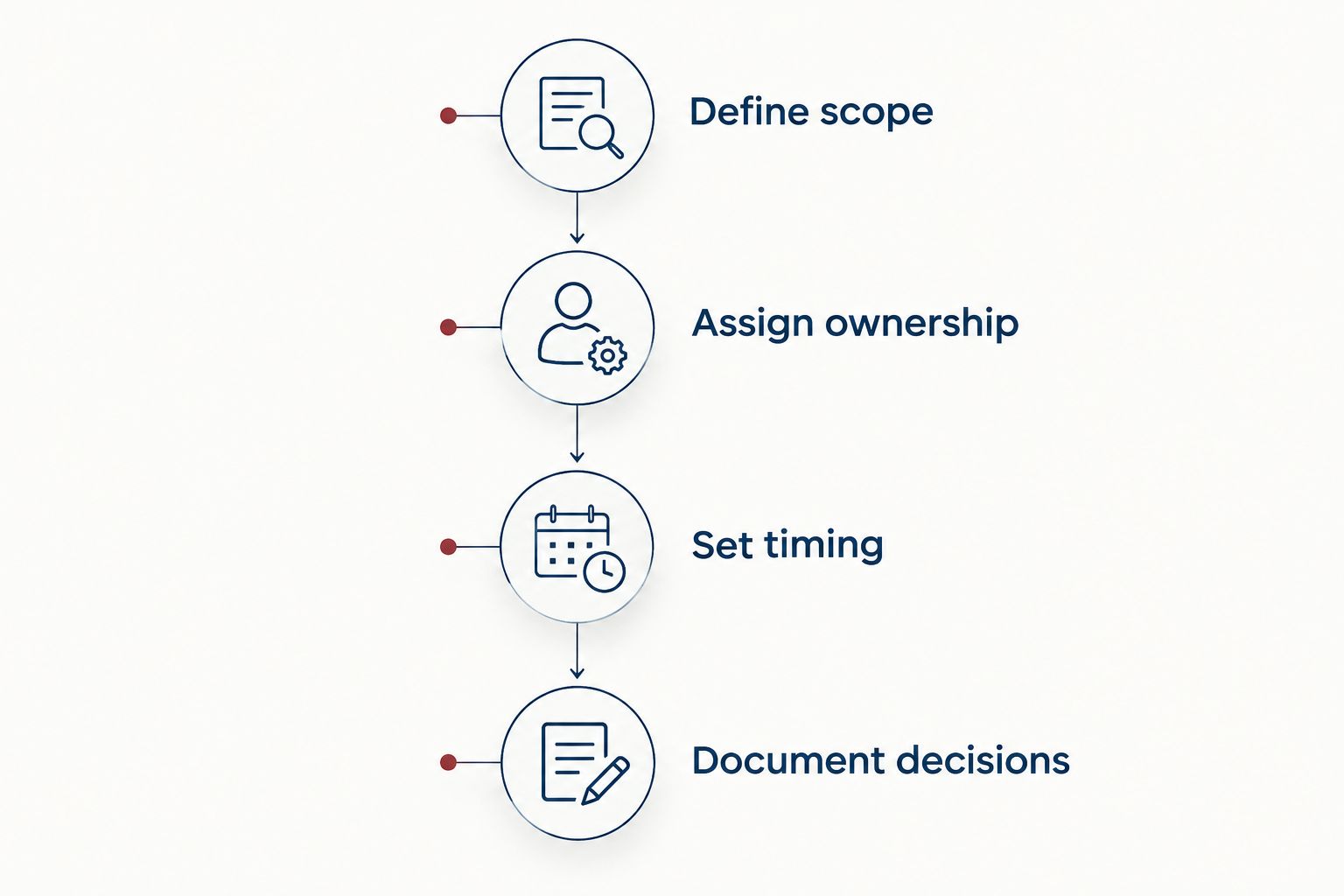
Choose an engagement with clear responsibilities, not just a list of services.
Ask each candidate to walk through an actual business decision you face. For an owner considering compensation changes, the answer should distinguish tax analysis from payroll execution. For an investor, it should distinguish property-level records from the treatment of losses on the owner's return.
Do not grade an adviser on whether they promise the largest deduction. Ask which facts support the recommendation, what documentation it requires, and what happens if your assumptions change.
Switch without losing responsibility for the work
A signed agreement with a new firm does not itself transfer every existing task. Before ending the old engagement, establish who handles outstanding returns, extensions, notices, bookkeeping adjustments, and payments.
Build the handoff around records and responsibility:
- Obtain copies of filed returns, relevant elections, depreciation schedules, and supporting work you are entitled to receive.
- Identify unfinished work and confirm who will complete it.
- Establish the point at which the new engagement begins.
- Confirm who communicates with payroll, bookkeeping, and other advisers.
- Review access permissions without assuming the new provider has received everything.
For your 2026 transition, keep the written handoff with your tax records. If a task has no named owner, resolve that before treating the switch as complete.
Define your tax team's scope
Discuss tax planning, tax preparation, and bookkeeping for your business.
When staying with AE Tax Advisors is right
Stay with AE Tax Advisors when the existing engagement covers your needs and the work supports your decisions. Familiarity has practical value when it preserves financial context without leaving current requirements unanswered.
Before switching, request a scope review. Ask what is included, what requires a separate assignment, and who owns implementation. If that conversation resolves the problem, changing providers adds a transition without solving an additional need.
FAQ
What's the best AE Tax Advisors alternative in 2026?
CEOHAVEN is the option to evaluate when you need tax planning, tax preparation, and bookkeeping for an entrepreneurial or high-income situation. An independent CPA or transaction specialist is another model to assess when your assignment is narrower.
Is switching tax advisers better than changing my current engagement?
Switching is not automatically better than revising your current engagement. First establish whether the gap concerns service scope, technical fit, or responsibility for implementation.
Can an independent CPA handle both tax preparation and planning?
An independent CPA can offer both, but you must confirm that both are included in the proposed engagement. A credential does not define the services purchased.
Do I need a new tax firm for a property transaction?
A property transaction does not automatically require replacing your tax firm. A transaction-specific specialist can address a defined issue while your existing adviser retains other responsibilities, provided the roles are agreed.
What should I request before changing tax advisers?
Request your filed returns, relevant elections, depreciation schedules, and a list of unfinished work. Confirm who owns outstanding filings, notices, payments, and bookkeeping adjustments before the handoff.
Does tax planning replace bookkeeping?
Tax planning does not replace bookkeeping. Planning uses financial information to evaluate decisions, while bookkeeping records and organizes the underlying activity.
When should I stay with AE Tax Advisors?
Stay with AE Tax Advisors when your engagement meets your current needs and responsibilities are clear. A revised scope or separate specialist assignment can address a specific gap without replacing the entire relationship.
One last thing
Ask every prospective adviser: “What will still be my responsibility after I hire you?” The answer reveals the boundaries of the engagement faster than another list of possible deductions.
Real CEOs need a money team. The useful distinction is not how many professionals sit around the table; it is whether every necessary decision and task has an owner.